
 GoBeauty Bay
  Shaista Rafi
Beauty & Lifestyle Content Writer
in
Shaista Rafi writes reader-focused beauty
and lifestyle content for GoBeautyBay,
covering skincare, hair care, makeup,
personal care and everyday beauty topics.
Shaista Rafi
Beauty & Lifestyle Content Writer
in
Shaista Rafi writes reader-focused beauty
and lifestyle content for GoBeautyBay,
covering skincare, hair care, makeup,
personal care and everyday beauty topics.
 Mirza Ibrahim Ali Khan
Editorial Reviewer
in
Mirza Ibrahim Ali Khan contributes to
GoBeautyBay's editorial review process,
focusing on clarity, content structure,
topical relevance and reader usefulness.
Mirza Ibrahim Ali Khan
Editorial Reviewer
in
Mirza Ibrahim Ali Khan contributes to
GoBeautyBay's editorial review process,
focusing on clarity, content structure,
topical relevance and reader usefulness.
Wellness is not one-meal focus, workout goal, and fancy morning ritual. Wellness is built from the simple conscious decision to make good food for your body, calm your mind, balance your energy, and improve the way you live.
Your life is working together with nutrition, lifestyle and natural wellness. Nutrition means giving your body the healthy foods it needs, lifestyle choices affect how you feel and how your body performs physically, and easy, natural activities to reduce stress are good habits to work into life.
No goal needs to be perfect; simply set a sensible goal you can maintain easily.
What Is Natural Wellness?
Natural wellness is a very gentle & Holistic way to approach your health-making better lifestyle choices including food, movement, rest, managing stress and connecting with your surroundings.This does not mean completely shunning medical treatments or only using “natural” products. Natural wellness can be complementary to medical practices by concentrating on habits that form the building blocks of health and wellbeing:
- Healthy, Balanced eating.
- Consistent movement and exercise.
- Sufficient rest and sleep.
- Plenty of hydration.
- Managing of stress levels.
- Fresh air, ideally spent outdoors.
- Healthy relationships and social connections.
- Self-care in all its many forms.
- A comfortable and safe home environment.
It’s quite often true that incremental steps taken over various fields, in small amounts but sustained, cause lasting change than rapid change in any given field.
Daily wellness is based on nutrition.
It’s vital to provide energy for your body and essential nutrients for your body functions. Nutrition usually means you need to take wide variation of foods, don’t make a lot emphasis on just one super food and stay away from cutting out entire food groups for reasons which you haven’t really thought through.
Centre most of your diet on whole and unrefined foods:
- Vegetables and greens
- Fruits
- Whole grains
- Beans and lentils
- Nuts and seeds
- Eggs
- Fish or a source of lean protein
- yogurt or other vitamin-rich dairy sources if appropriate
Different foods offer distinct nutrients so eating a variety of foods can optimize nutrient absorption and absorption within your body,
Consume adequate amounts of Protein
Protein aids muscles, tissues, enzymes, as well as many other elements throughout the entire body.
Try to eat protein evenly throughout the day and not have high amounts of it at dinner.
Some of the highest sources of protein: eggs, fish, chicken, Greek yogurt, cottage cheese, tofu, beans, other legumes
Try and distribute your protein over the entire day and do not eat huge meals of it during dinner.
Some sources that are extremely high in protein are-egg, fish, chicken, greek yogurt, cottage cheese, tofu, beans, other beans.
Also try to eat foods that are extremely high in Fiber. It helps a lot in our intestinal tracts to not feel so famished between and while we eat our meals.
Foods which are extremely high in Fiber are-vegetable, beans, fruit, and seeds, as well as seeds. Adding too much Fiber rapidly may cause issues to the digestive tract, however increasing it gradually may work with your body more efficiently.
Consider your fluid sources
You need water for basically every function your body performs. Severe dehydration may lead to thirst, physical weariness, headache and poor physical stamina.
Rather than just drink when you are incredibly parched, consider drinking water all through-out the day.
Have water in reach wherever you go whether it be at school or at work, while exercising, or travelling to various locations. The actual amount you need may shift depending on your diet, the weather/temperature, activity level, or other variables and no individual’s needs are the same.
Aside from being a necessary fluid, many different types of food, for example most fruit products, as well as various kinds of vegetables do contribute to the needs for water supply in the body.
Move Your Body Regularly
Exercise doesn’t have to be hours in the gym though.
We can increase activity by walking, cycling, swimming, dancing, weight training, stretching, playing a sport or by taking part in a wide range of recreational activities.
An ideal fitness plan could have:
- An aerobic section: This works on cardiorespiratory fitness and stamina.
- A strength training section: This helps us maintain our muscle strength and physical functionality.
- A mobility/flexibility section: This works on our ability to complete daily actions with comfortable movement.
- A recovery section: Recovery days/sleep are vital for body rest and repair.
- Pick activities that you enjoy – it makes them easy to stick with!
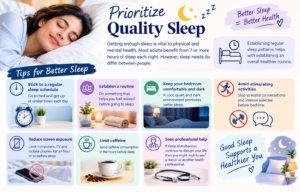
Prioritize Quality Sleep
Manage Everyday Stress
A moderate level of stress is to be expected, but excessive long-term stress can make a lot of your functioning and even feeling different to yourself. Some of the naturally beneficial ways to manage the stress can be breathing exercises, meditation and mindfulness, light exercise, getting into nature, journalling, listening to music, reading a book, getting creative, talking to other human beings who are encouraging. There is not one single way to deal with stress – in fact, what one thing will help you destress more than any other may only be apparent to you.
Spend Time in Nature
Get outside Spending time outdoors can be a great way to increase physical activity, boost your mood, and take a well-deserved break to calm your mind and switch up the environment. Any outdoor activity will do-such as a morning walk, relaxing outside, going to the park, or simply five minutes out-doors.
If possible, bring activity into your nature experience-walk through a park more vigorously instead of taking your exercise as a completely separate activity.
If you go out, take precautions against sun exposure.
Choose Natural Personal-Care Habits Wisely
Natural practices also span skin care. Regular use of mild skin, soap, hair treatments and sufficient consumption of water and staying out of the sun can lead to better skin as well as sense of wellbeing. Botanical and essential oils need careful use as they are not only not necessarily safe nor the right approach but can induce allergic reaction and skin irritation.
Read ingredients on a product for skin care and natural wellness, investigate formulation, see that there is science behind any stated benefits, and know how your skin will tolerate a given product before purchasing it solely because the label says it is “natural.”
Create a Healthier Home Environment
Your surroundings can influence your daily habits.
A supportive home environment might include:
- Keeping frequently used healthy foods accessible
- Maintaining a clean and organized space
- Creating a comfortable sleep environment
- Getting natural light during the day
- Reducing unnecessary clutter
- Making space for exercise or relaxation
- Keeping water easily available
The easier a healthy choice is to make, the more likely you may be to repeat it.
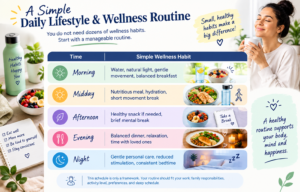
A Simple Daily Lifestyle & Wellness Routine
Avoid the “All or Nothing” Approach
The most common obstacle preventing the establishment of a sustainable wellness habit is the thinking that each health habit has to be followed perfectly. A single stumble with your fitness goals does not mean your plan to gain fitness is a failure, one day eating unhealthy does not erase the days or week beforehand of excellent choices that your food plan provided. One night sleeping until too late does not necessarily need to mark giving up your entire sleep schedule as being not possible, but the next opportunity you will resume taking good care of yourself. Over long periods of time consistently take the biggest gains.
Here’s a step-by-step for building habits with sustainable wellness:
First, start with only 1 or 2 changes each week as opposed to a large upheaval. E.g.
Week 1: Walking each day
Week 2: Adding more fruits and vegetables to meals.
Week 3: A regular sleep schedule.
Week 4: Incorporating some form of a quick de-stress exercise.
. When that habit feels do able, start adding more on top of it. You could even check in on your regular habits each couple of months and ask:
- What’s going well?
- What habits feels tough?
- What may be made much simpler?
- What behaviours are making me really feel good?
- What small habit adjustment can I try next?
- When Professional help is Appropriate
While Lifestyle improvements are beneficial, they aren’t A substitute for medical assistance and advice.
If symptoms are persistent, your weight has changes drastically, or you’re dealing with fatigue, digestive issues, sleeping issues, or you have specific nutrition and dietary-related symptoms. Getting recommendation from an experienced, registered medical professional, such as dietitian, and fitness instructor, your physician, will benefit you in your life changes. In
Conclusion
Lifestyle, nourishment, and natural wellness are often all linked.
Eating an array of plant foods, incorporating regular activities, drinking healthy protein-rich diet foods and beverages, fluids and staying sufficiently energized along with the best lifestyle modifications, will set the foundations for a healthier lifestyle.
You do not need to live a healthy perfect existence, rather concentrate on simple behaviours that can easily be duplicated within our own lives. So, as I suggest Start small, pay awareness to a what is happening within our bodies, and you will be able to develop healthier lifestyle habits over the life of time.