
 GoBeauty Bay
  Shaista Rafi
Beauty & Lifestyle Content Writer
in
Shaista Rafi writes reader-focused beauty
and lifestyle content for GoBeautyBay,
covering skincare, hair care, makeup,
personal care and everyday beauty topics.
Shaista Rafi
Beauty & Lifestyle Content Writer
in
Shaista Rafi writes reader-focused beauty
and lifestyle content for GoBeautyBay,
covering skincare, hair care, makeup,
personal care and everyday beauty topics.
 Mirza Ibrahim Ali Khan
Editorial Reviewer
in
Mirza Ibrahim Ali Khan contributes to
GoBeautyBay's editorial review process,
focusing on clarity, content structure,
topical relevance and reader usefulness.
Mirza Ibrahim Ali Khan
Editorial Reviewer
in
Mirza Ibrahim Ali Khan contributes to
GoBeautyBay's editorial review process,
focusing on clarity, content structure,
topical relevance and reader usefulness.
Buying products for curly hair can get confusing as “clean,” “natural,” “organic,” “plant-based,” or “free from” appear on almost every product packaging. However, you do not have all the answers when a product uses one of these descriptions.
The most valuable approach for Curly hair would be to learn about ingredients in curly hair products and understand how the formulas can influence your hair moisture levels, definition, frizz, build up or how your hair feels.
The curls on our hair will already make it more difficult for natural sebum (oils on your scalp) to be spread throughout the hair which means that selecting the right kind of product for Curly hair is critical no matter it’s the shampoo, conditioner, leave-in, styling creams, gels, and oils.
Why Ingredients Matter for Curly Hair
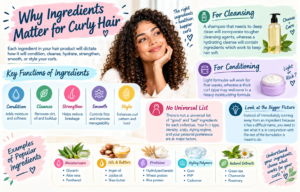
Moisturizing Ingredients for Curly Hair
Another one of the highest priorities for many with curly hair. Humectants, emollients, and conditioning agents will result in softer, easier to manage hair.
Typical moisturizing ingredients that we’ll see:
- Glycerin: a humectant that attracts and holds onto water
- Aloe Vera: often used for a lighter type of moisture
- Panthenol: a conditioning ingredient that conditions and enhances hair manageability and texture
- Honey: a humectant that adds moisture
- Amino Acids: adds hair conditioning for better feel
Note: Each ingredient’s individual effect is highly determined by its’ formulation and your unique hair.
Oils and Butters
To enhance shine, soften, reduce dryness and improve feel. Used by many curl product manufacturers, good examples of oils and plant butters to add to products include argan oil, jojoba oil, coconut oil, shea butter, avocado oil, and sweet almond oil. Many of these can be added to conditioners, mask products, creams and finishing products, although rich oils and butters may flatten or weigh fine and low-density hair down; avoid it if you often experience greasy or flat, residue-coated hair and use it in small quantities or lighter formulations if necessary
Proteins and Strengthening Ingredients
Chemical processes, heat styling (even heat-protected styling), bleaching and color processing may make protein or amino acid based conditioning treatments ideal for chemically altered curly hair. Examples may be hydrolysed proteins such as:
- Hydrolysed Keratin
- Hydrolysed Wheat Protein
- Hydrolysed Rice Protein
- Hydrolysed Silk Protein
Such items temporarily help damaged hair feel and be stronger by relating to the hair fiber’s composition. Yet not all curly girls need protein conditioning treatments regularly, as even over-proteinized hair will become overly stiff, wiry, and dry.
Ingredients for Curl Definition
Styling products make use of various ingredients to assist withCurl formation and to help hold them in place. Generally, conditioning agents, oils, butters and styling polymers combine to offer hold as well as definition and softness in the curl creams. Gels generally make use of styling ingredients which can film form and hold curls collectively to achieve longer hold, reduce frizz and offer more definition than other products.
Mousses and Foams are used for volume and light hold, particularly when heavy creams can be too overwhelming to use in the curls.
The “right” combination of styling product depends on whether more importance is given to softness, volume, hold, or definition and frizz protection of hair.
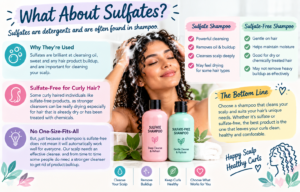
What About Sulfates?
What About Silicones?
One reason why many hair products contain silicones is the fact that they can coat the hair and make it appear smoother and more glossy as well as providing reduced friction for easy detangling.
In general, curly hair routines either omit or use certain silicones for frizzy or unmanageable hair conditions.
If you are using products with non-water-soluble silicones, then a suitable cleaning regimen can remove the silicone buildup effectively.
Rather than immediately labelling any silicone as bad, examine its effects upon your hair, coupled with your current regimen for any buildup.
Understanding “Clean Beauty”
Clean beauty has become the leading term in the beauty industry. However, there is no one set definition for what a “clean” product means. Different brands and retailer will adhere to a specific definition regarding ingredients.
Labels like ‘natural’, ‘organic’, ‘plant based’ don’t mean they will work better for curly hair as the name suggests. Some individuals will be sensitive and reactive to natural products and some synthetic products will be fine.
Therefore understanding the ingredient list and knowing your hair needs is actually of more use than reading front-of-pack claims.
Consider these Ingredients in Curly Hair:
The purpose of the product should also consider the specific needs of your curly hair.
- If your curls lack hydration: Use glycerine, aloe, plant oils, fatty alcohols, conditioners.
- If your curls lack smoothing: Use conditioning polymers, oils, silicones if appropriate for your hair, and styling agents that can form a film on the surface of the hair cuticle.
- If your curls lack volume: Use lighter conditions and stylers, lightweight humectants, light conditions, lightweight mousse, or light styling foams.
- If your curls lack strength: Use conditioners with proteins/amino acids, nourishing compounds to repair the hair and improve management.
- If your curls lack hydration (coily hair):Use heavily conditioning leave in, condition, cream or oil based products (how much will depend on how much volume your hair has).
How to Read curly Hair Products:
You really don’t need to have a degree to know how to analyze an ingredients list! Think of the reason the product was made in the first place. What is it trying to do for your hair?
First, you need to identify the function of the product, such as a cleanser, condition, leave in conditioner or styling product. Then you look to the ingredients list with your needs in mind. Did the product feel a bit too heavy after using it for a while? Too drying? Just the right amount of all things in a particular leave in conditioner? When looking to an ingredients list, ingredients appear in the order of percentage (however, in cosmetic applications sometimes a small amount of ingredients is listed in reverse at the end or appear randomly) from highest to lowest.
What is “Chemical Free”:
Unfortunately for some, there is not real such thing as chemical free products. Water itself is technically chemical, and ingredients found in products derived from plant or minerals or synthesized in the lab, all create chemical reactions within products and in relation to your hair and scalp. The thing we are working towards is not chemical free products, but rather products that contain ingredients suitable for your specific hair, scalp type and styling needs, at the correct percentages, and that are well formulated. Those with very sensitive scalp should read their ingredients meticulously and eliminate products if they feel an irritant response.
Construct a Clean curly Hair regimen:
It does not take multiple dozen hair products to find the right set up for curly hair. Consider this: A leave-in conditioner would be good if your hair seems a little dry, follow by a styler of your choice to define and shape your curls with either hold (gel/mousse/foam) or the combination of both definition and the hair moisturizing it with one (curl cream/defining balm). Also, do a deep conditioning session once a week (maybe more if hair is very dry or damaged). Oils can be added to provide further shine and smoothness when needed, such as finishing the styling routine with an oil/serum.
In general, you’ll want to incorporate new hair products one at a time when experimenting. This makes it easier for you to pinpoint any reaction to a specific product that cause your hair to misbehave.
Conlcusions:
The ingredients’ impact on our hair can be the difference in whether a styling product helps or not! Having a basic understanding of ingredients on your curly hair styling or hair care products can be essential to styling it right, so that you’re not choosing products for labels but for real performance. Choosing what to do for the hair is less about whether or not a product is “clean” or “natural” based, than it is about understanding individual ingredients and their function. Always choose an ingredients composition for your hair that will ensure you provide sufficient moisture, conditioning to reduce frizz and manageability for your specific curl type; all while protecting your hair’s structure as well as your scalp.