
 GoBeauty Bay
 Last Updated: September 23, 2026
Sensitive skin does not always behave the same way. Some people with sensitive skin experience dryness and tightness, while others have excess oil, acne, redness, or a combination of different concerns. Because of these differences, choosing a face wash should depend on both skin sensitivity and skin type.
A cleanser that works well for dry sensitive skin may feel too rich for oily sensitive skin. Similarly, an acne-focused cleanser may contain active ingredients that are useful for breakouts but too irritating when used too frequently on reactive skin.
The goal is to find a face wash that removes dirt, sweat, sunscreen, and excess oil without unnecessarily disrupting the skin barrier.
What Makes a Face Wash Suitable for Sensitive Skin?
A sensitive-skin cleanser should generally focus on gentle cleansing rather than aggressive treatment. Look for a formula that leaves the skin feeling clean but not tight, burning, or excessively dry.
Depending on your skin type, useful features may include:
- Gentle cleansing agents
- Fragrance-free formulas if fragrance causes reactions
- Hydrating ingredients such as glycerin
- Barrier-supporting ingredients
- A comfortable, non-stripping texture
- Ingredients appropriate for your specific skin concern
It is also important to remember that “natural,” “dermatologist tested,” or “for sensitive skin” does not guarantee that every person will tolerate a product. Individual sensitivity matters.
Face Wash for Dry Sensitive Skin
Dry sensitive skin often feels tight, rough, flaky, or uncomfortable after cleansing. Using a strong foaming cleanser can make this sensation worse.
What to Look For
A creamy, lotion-like, or gentle low-foam cleanser may be more comfortable than a strongly foaming face wash.
Look for ingredients such as:
- Glycerin
- Ceramides
- Panthenol
- Hyaluronic acid
- Squalane
- Other moisturizing or barrier-supporting ingredients
The cleanser should remove impurities without leaving the skin feeling stripped.
What to Avoid or Use Carefully
Be cautious with:
- Strongly fragranced cleansers
- Frequent exfoliating cleansers
- Very aggressive cleansing formulas
- Multiple active ingredients in the same cleanser
If your skin feels tight immediately after washing, that is a useful signal to reconsider the cleanser or cleansing frequency.
Face Wash for Oily Sensitive Skin
Oily sensitive skin can be challenging because you need to remove excess sebum without over-cleansing.
A cleanser that is too harsh may temporarily make the skin feel less oily but can leave it irritated or uncomfortable.
What to Look For
A gentle gel or lightweight foaming cleanser may work well for some people with oily sensitive skin.
Look for a formula that:
- Removes excess oil effectively
- Does not leave the skin tight
- Does not rely heavily on fragrance
- Can be rinsed away easily
- Fits into a simple skincare routine
If you have oily skin with sensitivity, avoid assuming that a cleanser needs to produce a lot of foam to be effective.
Salicylic Acid and Oily Sensitive Skin
Salicylic acid can be useful for oily or acne-prone skin, but sensitive skin may not tolerate frequent use.
If you choose a salicylic acid cleanser, introduce it gradually and monitor your skin. If burning, excessive dryness, or persistent irritation develops, reduce use or discontinue the product.
Face Wash for Combination Sensitive Skin
Combination sensitive skin can have an oily T-zone alongside normal, dry, or easily irritated cheeks.
The challenge is finding a cleanser that removes excess oil from the forehead and nose without making the cheeks uncomfortable.
What to Look For
A gentle gel or low-foam cleanser can be a practical option.
You may not need separate cleansers for different areas. Instead, adjust how much product you use and how long you cleanse.
For example, focus gentle cleansing on areas with more oil while avoiding unnecessary repeated cleansing of already-dry areas
Face Wash for Sensitive and Acne-Prone Skin
Acne-prone sensitive skin requires a balance between treating breakouts and protecting the skin barrier.
Some acne cleansers contain ingredients such as salicylic acid or benzoyl peroxide. These can be useful for acne but may cause dryness or irritation in some people.
A Better Approach
If your skin is both acne-prone and sensitive:
- Start with a gentle cleanser.
- Introduce an acne-focused cleanser gradually if needed.
- Avoid combining several strong acne treatments at once.
- Use a moisturizer after cleansing.
- Pay attention to persistent irritation.
A cleanser does not need to solve every acne concern. Sometimes keeping cleansing simple while using a separate targeted treatment is easier for sensitive skin to tolerate.
Face Wash for Sensitive and Redness-Prone Skin
People who experience frequent redness or stinging may want to keep their cleansing routine particularly simple.
Choose a cleanser that minimizes unnecessary potential irritants.
Helpful Features
Consider:
- Fragrance-free formulas
- Gentle cleansing agents
- Hydrating ingredients
- Minimal unnecessary actives
- A comfortable cream, lotion, or gentle gel texture
Avoid scrubbing the skin with brushes, rough cloths, or physical exfoliants.
If redness is persistent, painful, or associated with other symptoms, it is worth discussing it with a dermatologist because sensitivity can occur alongside conditions such as rosacea or eczema.
Face Wash for Sensitive and Dehydrated Skin
Dehydrated skin lacks water and can occur even when the skin produces plenty of oil.
You may notice:
- Tightness
- Dullness
- Fine dehydration lines
- Rough texture
- Increased sensitivity after cleansing
A gentle cleanser containing humectants such as glycerin may be helpful.
Avoid cleansing more frequently simply because the skin feels uncomfortable. Over-cleansing can make the problem more difficult to manage.
Face Wash for Sensitive Skin With Dry Patches
Some people have an oily forehead and nose but dry patches around the cheeks, mouth, or jaw.
In this situation, choosing the strongest cleanser based on the oily areas may leave the dry areas irritated.
A gentle cleanser can often be used across the face, followed by a moisturizer applied more generously to dry areas.
If dry patches repeatedly crack, itch, burn, or become inflamed, consider professional evaluation rather than repeatedly changing cleansers.
Face Wash for Mature Sensitive Skin
As skin changes with age, it may become drier or less tolerant of aggressive cleansing.
Mature sensitive skin may benefit from a cleanser that prioritizes:
- Gentle cleansing
- Hydration
- Barrier support
- Comfortable application
- Minimal irritation
A creamy or lotion-style cleanser may be preferable when the skin is particularly dry.
There is also no need for an anti-aging cleanser to contain numerous active ingredients. Cleansing is primarily about removing unwanted material from the skin rather than delivering a large number of treatment ingredients.
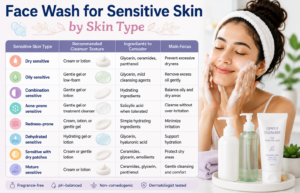
Face Wash for Sensitive Skin by Skin Type
How Often Should Sensitive Skin Be Cleansed?
The ideal cleansing frequency depends on your skin type, products used, activity level, and personal tolerance.
Many people cleanse their face in the evening to remove sunscreen, makeup, oil, sweat, and environmental debris. Morning cleansing can be adjusted according to skin needs.
For very dry or reactive skin, washing with cleanser too frequently may increase discomfort.
The important point is not simply how often you cleanse but how your skin responds afterward.
Common Face-Wash Mistakes for Sensitive Skin
Using Very Hot Water
Hot water can increase dryness and discomfort. Lukewarm water is generally a more comfortable choice.
Scrubbing Too Hard
Sensitive skin does not need aggressive physical scrubbing to become clean. Use your fingertips and gentle movements.
Choosing a Cleanser Only Because It Foams
Foam does not automatically indicate better cleansing. A gentle cleanser can be effective without producing a large amount of foam.
Using Too Many Active Ingredients
A cleanser containing several exfoliating or acne-focused ingredients may be unnecessary if your skin is already reactive.
Washing Until the Skin Feels “Squeaky Clean”
That tight, squeaky sensation is not a requirement for clean skin. If cleansing consistently leaves your face tight or uncomfortable, reconsider the formula or frequency.
How to Choose the Right Face Wash for Your Sensitive Skin
Start by identifying your main skin type: dry, oily, combination, acne-prone, or dehydrated.
Then consider your sensitivity pattern.
For example:
- Dry + sensitive: prioritize hydration and barrier support.
- Oily + sensitive: choose gentle oil removal without excessive stripping.
- Combination + sensitive: use a balanced cleanser rather than aggressively treating oily areas.
- Acne-prone + sensitive: introduce acne actives cautiously.
- Redness-prone + sensitive: keep the formula simple and avoid known triggers.
- Dehydrated + sensitive: prioritize gentle cleansing and hydration.
Introduce one new product at a time when possible. This makes it easier to identify what your skin tolerates and what may be causing a reaction.
Final Thoughts
The best face wash for different sensitive skin types depends on more than the word “sensitive.” Dry, oily, combination, acne-prone, redness-prone, and dehydrated sensitive skin can require different cleanser textures and ingredient choices.
For many people, the safest starting point is a gentle cleanser that removes impurities without leaving the skin tight, burning, or excessively dry. Ingredients such as glycerin, ceramides, and panthenol can complement a gentle cleansing formula, while exfoliating and acne-focused ingredients should be introduced according to individual tolerance.
If your skin regularly develops significant burning, swelling, itching, persistent redness, or other reactions, a dermatologist can help identify the underlying cause and recommend appropriate skincare.