
 GoBeauty Bay
  Shaista Rafi
Beauty & Lifestyle Content Writer
in
Shaista Rafi writes reader-focused beauty
and lifestyle content for GoBeautyBay,
covering skincare, hair care, makeup,
personal care and everyday beauty topics.
Shaista Rafi
Beauty & Lifestyle Content Writer
in
Shaista Rafi writes reader-focused beauty
and lifestyle content for GoBeautyBay,
covering skincare, hair care, makeup,
personal care and everyday beauty topics.
 Mirza Ibrahim Ali Khan
Editorial Reviewer
in
Mirza Ibrahim Ali Khan contributes to
GoBeautyBay's editorial review process,
focusing on clarity, content structure,
topical relevance and reader usefulness.
Mirza Ibrahim Ali Khan
Editorial Reviewer
in
Mirza Ibrahim Ali Khan contributes to
GoBeautyBay's editorial review process,
focusing on clarity, content structure,
topical relevance and reader usefulness.
An age defying skincare plan should actually involve the minimum possible product, and one well executed one focused on a few hard-working, tried-and-tested ingredients dealing with issues like lines, pigmentation, dryness, loss of firmness, and sun damage will be much more beneficial than covering all bases.
Certain ingredient forms protect the skin from harsh outer influences but some help maintain hydration while other ingredients can bolster the skins’ structure or the evenness of their appearance. Knowledge is needed for each of the ingredients and active skincare requires steady introduction.
Here are some beneficial age defying skincare ingredients and their role in a daily regime.
1. Retinoids
Retinoids are one of the older and most studied ingredients for anti-aging treatments. This ingredient group consists of retinol, retinal, and retinoids available by prescription.
Benefits of using a retinoid include improving signs of:
- Premature aging and wrinkles.
- Uneven skin tone or texture.
- Dark spots.
- Dull complexion.
These ingredients affect the skin’s cellular turnover and can encourage the mechanisms for skin collagen production. When introduced, retinoids can strip or burn the skin at a faster rate. If you are just beginning to use retinoids on your skin, always begin with a low strength application, with low or infrequent frequency. Application of an emollient can make your skin treatment more comfortable.
Best used in the evening.
Please note always follow direction of specific products; your tolerability dictates the speed at which it can be used.
2. Vitamin C
Vitamin C is especially favoured at morning routine due to its antioxidant power. Antioxidant fights against oxidative stress.
Vitamin C helps get rid of skin hyperpigmentation, while providing a clearer and evened out complexion.
Vitamin C often finds a home in the morning routine after cleanser, toner (if used), but before moisturizer and sun protection.When you purchase products, look for a stable form of vitamin C, formulated properly. Some well-researched vitamin Cs are known as l-ascorbic acids, but there are several forms out there today.
Best time of day: Morning, but not all vitamin Cs are only best when applied in the morning.
Vitamin C and Sunscreen:
Vitamin C should not be applied in lieu of sunscreen; rather, the two vitamins should be partners in your morning skincare. An example order for these would be as followed:
Cleanse – Vitamin C – Moisturizer – Sunscreen
3. Niacinamide
Niacinamide is another great anti-aging ingredient that can fit into many different skin care routines. While it has many benefits, it may help maintain the integrity of skin’s barrier, even out skin tone, and reduce the look of redness or large pores. People wanting an anti-aging ingredient that is not a highly potent treatment can benefit from niacinamide.
The ingredient can be utilized in all types of skin care products, ranging from serum, to lotion and toners.
It works best on: Many skin types including a range of sensitive-skin based routines.
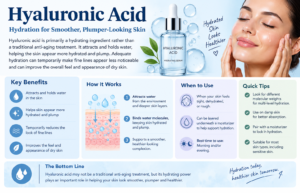
4. Hyaluronic acid
5. Peptides-
These are tiny chains of amino acids that are found in many up-and-coming skincare ingredients. It’s thought that different peptides perform slightly different roles, and in skincare, peptide products are often sold as improving overall firmness, smoothness and appearance of skin quality. Because peptides often occur naturally on the skin, they can be included into products more readily than the potent exfoliating or retinoid ingredients, making them useful to add to day creams and serums.
Peptides can support other ingredients in a full anti-aging regimen.
Best For: Adding to a daily routine for a mild supplement to the current regimen.
6. Ceramides
Ceramides are natural lipids of the skin barrier. Their purpose is to assist the skin in retaining moisture and protecting it.
Not a “direct” treatment on the wrinkles themselves but is very helpful for an anti-aging regimen to keep skin properly supported by the barrier.
Moisturizers containing Ceramides may benefit skin greatly during the use of potentially sensitizing actives, such as retinoids or alpha and beta hydroxy acids.
Best used: AM and PM
7. AHAs (Alpha Hydroxy Acids)
Also known as AHAs (e.g. Glycolic acid and lactic acid), these chemical exfoliators can break down and help shed the dead skin cells sitting on the skin’s surface. This may even help to reduce dullness, uneven texture, mild discoloration, rough skin and fine lines.
But more isn’t always better, too much acid can cause skin to become irritable and even thin your skin barrier.
Introducing an exfoliating acid and using a retinoid requires more careful management and most people find it easier to not use the two on nights that they already need to use a strong product but use alternate nights instead. The best way forward is to take things slow and don’t begin introducing several strong active ingredients while the skin gets adjusted to.
8. Sunscreen
If there is any one single product that must be in an anti-aging skincare routine it is sunscreen.
Excessive UV ray exposure each and every day leads to skin that prematurely looks older than its true age and can cause visible skin issues including, but not limited to; Wrinkles, uneven pigment, loss of elasticity etc.
Use a broad-spectrum to shield the skin from both UVA and UVB rays.
Use as the final part of your AM skin care routine and always use! Touch ups especially during long periods out in the elements are key, just as well for sweating and swimming.
It is not just an anti-aging product, but the cornerstone to an age preventing skin care regime.
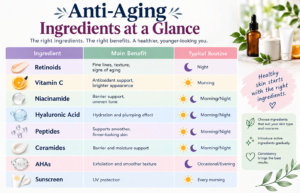
Anti-Aging Ingredients briefly
How to Combine Anti-Aging Ingredients
If you tried using all active ingredients together in a single regimen it could overly complicate your routine and potential for irritation could rise.
Try creating a more foundational routine first and build your actives in slowly
Morning Routine
- Gentle Cleanser
- Vitamin C OR Niacinamide serum
- Moisturizing serum
- Moisturizer
- Broad-Spectrum SPF
- Evening Routine
- Cleanser
- Treatment product like Retinoid etc.
- Hydration Product
- Moisturizer
On nights you are not using a Retinoid you may be able to concentrate on moisturizing and building your barrier. You may also be trying a AHA and could think about using an AHA separate from your other potentially irritating treatment products until you find how it affects you.
Select Your Actives based on Your Skin Concerns:
You might need to opt for different ingredients for each individual problem, such as:
- For Fine Lines and Wrinkles: Retinoids, Sunscreen, Peptides
- For uneven complexion: Vitamin C, Niacinamide, Retinoids, AHAs
- For Dry or dehydrated skin: Hyaluronic Acid, Ceramides, Moisturizer
- For rough texture: Retinoids, AHAs, Hydration
- For lack of firmness: Retinoids, Sunscreen, Peptides
- For sensitive or highly Reactive Skin: Ceramides, Niacinamide, Moisturizing and consistently using sunscreen might work much better in the long run than layering strong active ingredients on top of one another.
Common Mistakes with Anti-Aging Ingredients
A common error and perhaps the biggest one is adding multiple actives at one time-when irritation occurs you won’t know which product caused it. Some other common ones include:
- Overusing exfoliants
- Forgetting sunscreen
- Using intense actives too often
- Skipping moisturizer
- Expecting miracles overnight
- Changing products before trying them long enough
- Overdoing it based on your skin tolerance
- Often consistency is better than complexity.
How long are anti-aging ingredients before they kick in?
The benefit of Skincare products will not see an immediate result. While, hydrating ingredients could boost you with a smoother feeling on your skin instantly; to get a fairer pigmentation, firmer texture, or fine line reducing benefit, the usage needs to be continued, consistent and a longer period.
As far as retinoids or like kinds of active agents are concerned, it will require a few weeks or more to show you results.
Let it be a consistent and slow process to make an anti-aging breakthrough on your skin; immediate result may cause damages and are quite uncommon.
Conclusion
As an end product of anti-aging Skincare ingredient there cannot be the most recent product or luxurious brand; be it the most effective ingredient that there is, or maybe like vitamin C, niacinamide, hyaluronic acid, peptides or ceramides, exfoliating acids or a sunscreen each of them benefits skin in their own special ways.
A good routine will need to include protection, hydration, treatment, and barrier care. With starting active ingredients slowly, build up from there based on your skin’s reaction.
Feel free to look through the Morning & Night Anti-Aging Routines and Weekly Anti-Aging Routine posts to accompany the points on what to look for to put together a holistic anti-aging skincare regime.