
 GoBeauty Bay
 Shaista Rafi
Beauty & Lifestyle Content Writer
in
Shaista Rafi writes reader-focused beauty
and lifestyle content for GoBeautyBay,
covering skincare, hair care, makeup,
personal care and everyday beauty topics.
 Mirza Ibrahim Ali Khan
Editorial Reviewer
in
Mirza Ibrahim Ali Khan contributes to
GoBeautyBay's editorial review process,
focusing on clarity, content structure,
topical relevance and reader usefulness.
A step-by-step guide on how to cleanse dry skin
How you go about cleansing a product is just as vital. A product that “definitely fits” or “moisturizes” is unlikely to do anything for your skin if you use the most popular hot water, rubs it with a face scrub or scouring towel, cleans it for a very long period of time, or instantly uses a product that irritates the skin.Those things can aggravate dry, flaky, fragile, and tight skin. However, it won’t be as clean as you could be if it doesn’t effectively dissolve excess grime, sun protection products, make-up, perspiration, and the products that we apply throughout the day.
Step 1: Wash your hands first.
Your hands might be covered with dirt, oil, bacteria, makeup, lotions and whatever else. Minimize the transfer to your skin by washing your hands first.
Take this step especially if you are coming home from out of the house or touching on makeup, hairspray, and other products before you start cleansing.
Step 2: Use Lukewarm Water
Avoid very hot water on dry skin. We all love to have a really hot wash on a cold day but hot water will probably make your dry or sensitive skin itch or draw up tight. Use lukewarm water, it will still feel very comfy but not quite as hot as you want it for a lovely summer wash.
Step 3: Wet Your Face

Step 4: Use the Right Amount of Cleanser
You don’t have to use a large amount of cleanser to cleanse your face. Use your cleanser according to the directions and just use enough to easily work it over the areas that you want to cleanse. More cleansers is not always better and sometimes can just lead to more product wastage If you’re wearing lots of makeup and/or water-resistant sunscreen then it’s probably time to try a mild first cleanse (using an appropriate quantity of your standard facial cleanser).
Step 5: Gently Massage the Cleanser
Spread the facial cleanser onto the skin with your fingertips in a circular motion. Focus on the place where all the sunscreen, makeup, sweat, oil and dirt gather, such as around nose, hairline, chin and jaw. On drier parts of the face, such as the cheekbones, you can massage a little more lightly. Don’t scrub away with washcloths, cleansing brushes, scrubs or other mechanical tools unless you’re doing so for a specific reason and it works for your skin.
Just let the cleanser handle the majority of the work.
Step 6: Give the Cleanser Enough Time to Work
Extended cleansing may not actually be beneficial.
Unless there is a build-up of makeup, SPF, dirt, sweat and the like that needs to be broken down and physically lifted off the skin, continuing to massage the cleanser for a long time is unlikely to offer much more benefit. Cleansing is an important step. But. Less is better and less dragging and scrubbing is ideal. Rub in a first cleanser if you are attempting to remove makeup heavily layered with a lot of SPFS and don’t scrub!
Step 7: Rinse Thoroughly
Rinse off the cleanser with warm water. Eliminate visible cleanser residue from areas such as:
- Hairline
- Just above the sides of your nose
- Jaw line
- Chin
- Around the eyebrows
But don’t use the same area again to get the “squeaky clean” feeling. Squeaky is not always better. When you wash out dry skin, it may be too much!
Step 8: Pat Your Face Dry
Take a clean, soft towel and lightly press it onto your face. Don’t scrub the towel harshly on your nose, cheek, or any other dry part of the face. There’s no need to dry the skin thoroughly and remove all trace of moisture. Sometimes a slightly damp face is more comfortable to apply anything on to.
Step 9: Apply Moisturizer
After cleansing It’s not enough to just cleanse your skin to maintain comfort if you have very dry skin. A leave-on moisturizer that provides humectants, emollients and barrier-repair ingredients in a way a rinse-off cleanser cannot is beneficial. Your moisturizer may contain some or all the following:
- Glycerin
- Hyaluronic acid
- Ceramides
- Panthenol
- Squalane
Emollients and conditioning ingredients As your skin gets drier, don’t delay in moisturizing until it feels tight and uncomfortable.
How Often Should You Cleanse Dry Skin?
Cleansing – Is there a one size fits all cleansing plan? – If you have dry skin, many skin types go for a thorough but gentle cleansing at night and a lighter one in the AM. – During the day, if you’re able to use a mild cleanser or just rinse with lukewarm water, take your pick. You don’t need a full cleanser in the morning every day if the sensation is too tight or it causes irritation. – Of course, if you’re doing this every day, you do need to evaluate whether you need a cleansing at all in the morning. – What is great about a nightly cleanse is that it gets rid of the sunscreens, makeup, sweat, grime, pollution, excess oil, and skin care products used during the day. – If you wear waterproof or makeup, then you may need a separate first step in the cleansing.
Double Cleansing for Dry Skin
1st Cleanse: Cleansing Oil or Cleansing Balm
2nd Cleanse: Gentle Cream, Milk, Lotion, Hydrating Cleanser The 1st cleanse is to breakdown the make up, SPF and oil-based products. And the 2nd cleanse is to go in for the kill and breakdown what is remaining (e.g. The rest of the residue and water-soluble products).
When Double Cleansing May Be Useful
Double cleansing is likely to be beneficial if you wear: Heavy makeup Long-wearing foundation Water-proof makeup Water-resistant sun protection Multiple layers of cosmetics. When you might not need it Double cleansing isn’t always required. If you can find a mild cleansing product that gets rid of your sun protection and cosmetics without harming your skin, then another cleansing step might not be needed. For extremely dry skin, over-cleaning may actually be more difficult to get used to.
How to Remove Makeup for Dry Skin
Don’t Overdo
It if You’re Wearing Makeup If you wear makeup, don’t just scrub everything off until it falls off. Use a makeup-removing product (like a cleansing oil, balm or suitable micellar water) first and then, if you want, use an appropriate cleanser. Be especially gentle around the eyes — don’t scrub repeatedly at the makeup to get waterproof mascara or eyeliner off.
How to Cleanse Dry Skin When Wearing Sunscreen
If you’re applying a long-wearing or water-resistant sunscreen, then you’re also going to want to remove it at the end of the day and have some sort of cleansing product (like an oil-based or balm cleanser) as your first step. If you’re using a traditional, less long-lasting sunscreen, you may not need an oil or balm cleanse as your first step.
Common Cleansing Mistakes for Dry Skin
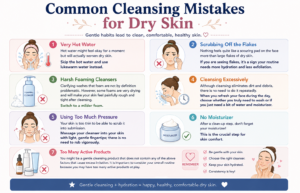
Adjust Your Cleansing Routine by Season
Sensitive Skin & Greasy Skin
Dry skin can feel very different in different environments: During Winter: You will notice your skin getting tighter and uncomfortable during Winter months, cold temperatures and arid winter air can dry out the skin even further. A light cleansing milk or cream form cleanser rather than one with a strong cleansing action will work better here.
Wet & Intense Skin
During summer months, sweat and sunscreen can increase the need for thorough cleansing but do not always have to assume stronger cleansing action is needed. A really gentle form of cleanser that can be used daily will lift away dirt and debris, whilst protecting the skin.
Signs Your Cleansing Routine Needs Adjustment
Note how your skin reacts right after cleansing and hours later. Signs that your routine might be harsher than necessary are: Tight feeling Burning Stinging More flakiness Roughness Redness Increased Sensitivity Persistent “squeaky” feeling uncomfortable and uncomfortable shortly after cleansing. These manifestations don’t necessarily point to a particular reason.
It can be your make-up remover, the frequency of the cleansing, the temperature of the water, other care products, a skin condition.
If the condition persists despite making your cleansing routine more simple, consider seeing a dermatologist. Keep it Simple Cleansing Routine for Dry Skin
Do you keep it simple? For all skin types
Morning
- Splash with lukewarm water or a simple rinse-off, no-rinse cleanser.
- Apply a moisturizer.
- Use a sunscreen.
Evening
- Remove makeup and/or sunscreen.
- Use a gentle cleanser.
- Pat dry with a soft towel.
- Use a moisturizer.
You can adapt it to your skin type, your products, the climate, and your skin’s specific needs.
Conclusion,
clean skin serves as the ideal foundation for the other skincare products to work, so there is always a sense in making sure that you wash out your face initially. No matter if the product is for example gel, cream or serum, it must have a clean fresh base on which it can perform it works.
If you wish to cleanse your dry skin, then you are supposed to follow some rules, which have to be adopted without ever getting lost the skin, without making any kind of pain. Use warm water – not hot, rinse away the amount of cleanser your skin needs, bohr your clean face lightly with tips of your fingertips, bear skin dry using a flannel, a deep clean face should not be scrubbing, do not use rough towels, does not start with hot water, does not give them a deep clean more often than once a week, do not over-cleans, etc! There are very many! Just keep in mind that when cleansing your whole skin routine, not every cleanser needs to create the largest impact, be safe, gentle and non-scaled. If your face feels on top of the other, jagged, tight or dry, then it is the wrong cleanser.