
 GoBeauty Bay
 Shaista Rafi
Beauty & Lifestyle Content Writer
in
Shaista Rafi writes reader-focused beauty
and lifestyle content for GoBeautyBay,
covering skincare, hair care, makeup,
personal care and everyday beauty topics.
Read full bio of Shaista Rafi →
 Mirza Ibrahim Ali Khan
Editorial Reviewer
in
Mirza Ibrahim Ali Khan contributes to
GoBeautyBay's editorial review process,
focusing on clarity, content structure,
topical relevance and reader usefulness.
Read full bio of Mirza Ibrahim Ali Khan →
There are loads of cleansers on the market, and choosing the right one can be tough when they all claim similar things. One promises to keep you hydrated, another is marketed as being suitable for sensitive skin, and yet another spends time telling you how brilliant it is for removing makeup and sunscreen. The trouble is, marketing claims don’t really explain how well the cleanser will work on dry skin.
It can be really helpful to read reviews and comparisons, but all of that information is much more useful if you understand what to look for, and how each thing matters to your dry skin.
A good cleanser comparison takes into account more than just which product is most popular or cheapest. Comparing cleansers is about looking at their cleansing power, full list of ingredients, how they feel on your skin, how they feel after cleansing, the makeup and sunscreen removal, sensitivity, cost, how often you use it, and your skin concerns.
1. Compare Cleansing Performance
The number one question to ask when comparing two or more cleansers is this: Does it clean your skin? An effective cleanser should assist in removing those things that tend to accumulate on the skin during the day, which can include: Dirt and pollutants; Sweat; Excess oil; Sunscreen; Makeup; Pollutants and daily residue If a cleansing product is more intense, that doesn’t necessarily mean it is better cleansing. For those with dry skin this can be particularly important.
If one product that is great at stripping out every last bit of oil from your skin and your face feels tight and dry afterwards, that’s probably a cleanser that is too strong.
If another product that seems to be really gentle on your face can’t quite remove sunscreen or makeup effectively, that’s also not a good option.
How to Compare Cleansing Performance
Consider what you normally have on your face when you consider a cleanser. If you wear less than a little makeup and the odd application of SPF then perhaps a simple milk, cream or hydrating cleanser is suitable for you. If you’re wearing foundation, waterproof makeup or waterproof SPF then most likely you will need to cleanse away that makeup and SPF first, before the second step of your cleansing process.
2. Evaluate the After-Cleansing Feel
Your skin’s post-wash sensation is one of the best clues you’ll find when trying to determine if a particular cleanser is right for your skin. How does your skin feel immediately after rinsing? Ideally, a good cleanser should leave your skin feeling clean and comfortable -never feeling like it’s always: Too tight Squeaky Burning and stinging Bumpy/rough Uncomfortable and dry Too tight skin is common in the winter and in dry environments, but if your skin feels much tighter or uncomfortable after every single wash, that cleanser may not be right for you.
Why “Squeaky Clean” Is Not Always Good Thing
Some people think if their skin feels rough, squeaky clean, then the cleanser must be very effective. But for dry skin, that isn’t necessarily good news. Cleansing is meant to get rid of excess debris-and, of course, that it doesn’t dry out your skin’s natural comfort zone.
When you compare products, a cleaner that feels comfortable may be more important than one that’s “Oh so fresh.
” 3. Compare the Complete Ingredient List
Another important consideration in judging cleansers. Don’t pick it because it contains an ingredient you think is important or on trend. Read the whole formula.
Some ingredients that are found in moisturizers for dry skin and sensitive skin include:
- Glycerin – a humectant often found in many formulas to help attract water.
- Ceramides – skin barrier associated lipids.
- Panthenol – a moisturizer and conditioner.
- Squalane – emollients that may help deliver a softer feel to skin.
- Hyaluronic acid – humectants often present in formulas that are hydrating.
- Colloidal oatmeal – typically found in formulas for dry and sensitive skin.
- Plant oils – can sometimes be used as an emollient, but this depends on the oil and the formulation.
Keep in mind that cleansers rinse off and so may not be able to deliver the same kind of benefit as in a leave on serum or moisturizer.
Look at Cleansing Agents Too
Don’t only look at moisturizing ingredients…
Cleansers are about the performance of the cleansing agents. It’s possible to have a formula that has glycerine or other moisturizing elements in it and still leaves your skin feeling dry and tight. A particular surfactant mix can result in different foaming, cleansing performance and after-feel.
So, it’s worth looking at the whole formula – not only the highlighting ingredients printed on the front.
Fragrance and Sensitive Dry Skin
Scent and Sensitive, Dry Skin You may want to opt for a fragrance-free version if you have sensitive, dry skin. While fragrance can be a good thing, if you have sensitive skin, you may have a more difficult time with a more complex formula.This applies equally to Essential Oils and any other ingredients which might not be tolerated by you.
4.Compare Cleanser Texture
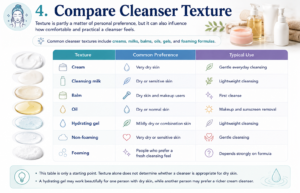
5.Compare Makeup and Sunscreen Removal
If you wear makeup or sunscreen every day, then cleansing ability will be based on what you need to remove. Perhaps, a simple light makeup and non-water resistant sunscreen can be handled with the right gentle cleanser. However, wear time and water resistance may make a first cleansing step necessary.
Cleansing oils and balms are often used as a first cleansing step, as their formulations are helpful in dissolving make-up, sunscreens, and other products from the skin.
As these can generally be massaged into the skin and rinsed away with water using an emulsifying formula, many people will then do a simple, gentle second cleanse.
Should you double cleanse for dry skin?
Not always. Double cleansing is helpful to extra remove make-up or sunscreen if wanted, however not each dry-skin routine must double cleanse.
If a delicate cleanser does the job and your pores and skin feels nice afterwards, there’s no want to clean twice.
It really is determined by what you employ, what your cleansing wants are, and the way your pores and skin tolerates it.
6. Consider Skin Sensitivity
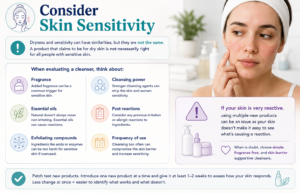
7. Cream Cleanser and Hydrating Gel Cleanser
Both gentle cleansers and hydrating gel cleansers may work fine if your skin is dry, but there are differences. Cream Cleanser If you prefer the feel of a soft and lotion-like product you might prefer a cream cleanser if you have: Very dry skin Flaking skin Dry, older-feeling skin Dry skin in dry and cold weather Sensitive skin if you dislike foaming cleansers Creams have the potential to be softer feeling on the skin, but the whole formula is more important than the label “Cream” Hydrating Gel Cleanser If you like a lighter feel you might like a hydrating gel if you have: Slightly dry skin Combination skin Don’t enjoy anything heavy on the skin Nice warm weather “Gel” doesn’t necessarily mean dry. The cleansing system and formulation are both important.
Which is better?
Neither are always better. Choose based on your level of dryness, texture preference, skin needs and the way your skin feels after cleansing.
8. Cleansing Balm and Cleansing Oil
These are both common first cleansing options and both are widely popular. Cleansing Balm Depending on the jar, a balm may initially feel thicker or more dense in the jar.
When you massage it onto your face it warms up and melts, offering a rich and luxurious cleanse.
It is suitable for someone who: Wears makeup Uses a water-proof sunscreen Likes the richness of texture Massage cleanses prefer an oil-based cleansing product An oil-based cleanser is more fluid and tends to be thinner in texture when spread onto the face. It’s suitable for someone who: Removes makeup Removes water-proof sunscreen Tends to dislike anything heavy on the skin
9. Budget and High-End Cleansers
Budget and expensive cleansers Depending on your budget, you may opt for a certain cleanser but it shouldn’t be your most important factor to consider. An expensive cleanser doesn’t always mean it will be more hydrating than a budget product if your skin is dry. When considering price:.
- Formula
- Ingredients
- Cleaning power
- Texture
- Size of bottle
- How much you need to use each time
- How often you use it
- Suitability for your skin
Cost per wash/cleanse
An Economical Wash You may consider purchasing a budget-friendly cleanser which is not overly tight or stripping on your face, but consider whether or not it is still a good bargain than the costlier equivalent which may not necessarily works well with your skin. On the other hand, if you love the texture, formula or the experience of the more expensive or high-end product, splurge.
10. Read Cleanser Reviews Carefully
Customer reviews have their place but need to be put into perspective A cleanser may have ten thousand positive reviews, but that doesn’t mean it is suitable for your skin.
Find reviews by:
- People with the same skin type
- Experienced the same level of dryness
- Was sensitive to the formula
- Used the product with makeup on
- Used the product with sunscreen on
In the same climate Same cleansing routine There is very little information in this five-star review from someone who has very oily skin about how a cleanser will be for those with very dry, sensitive skin.
What to look for in reviews
Check reviews for mentions of:
- Dryness
- Tightness
- Flaking
- Irritation
- Burning or stinging
- Make-up removal
- Sunscreen removal
- Texture
- Foaming
- Rinsing
- Residue left on the skin
- Skin softness after cleansing
- Long term use
Look for any common problems, but don’t make hasty judgments based on one extreme or the other. When one person experiences irritation, it may be due to their unique sensitivity, where someone else might have no issues at all.
11. Short-Term vs. Long-Term Reviews
A cleanser might be wonderful for the first few times but could not stay so with repeated use. So, long-term reviews might give some perspective. Search for reviews that mention how the product did after many weeks, not just a few days of application. Keep in mind, though, that your personal long-term experiences shouldn’t necessarily be taken as evidence for everyone.
12. Compare Cleansers According to Specific Dry-Skin Concerns
Match Cleansers based on your skin concern Dry and sensitive skin You’re looking for: Gentle cleansing Gentle formulas Fragrance-free products Comfortable feeling Non-irritating risk Very dry or flaky skin You’re looking for: Cream cleansers milky cleansers Non-foaming cleansers Thicker cleansers Avoid the assumption that flaky skin means you need to more dry exfoliation! More exfoliation on damaged and uncomfortable skin feels miserable on your barrier. Dry and acne-prone skin You need a balance of gentle cleansing with an effective treatment for acne.
An acne treatment might be perfect for some, but too dry of a product to use every day.
Dry and aging skin You want a gentle non-drying cleanser as a base for your daytime routine that will contain various ingredients.The cleanser doesn’t need to provide all the anti-aging benefits; it just needs to cleanse effectively and fit in without bothering the other products. Dry skin with heavy makeup Try to find a cleanser that will remove the makeup.
You may find that a cleansing oil or balm first does the trick, then follow with a gentle cleanser if needed.
13. How Well does the Cleanser Compare with your Routine
Consider your current routine Don’t use a cleanser on its own. Think about your existing routine: Retinoids Exfoliating acids Acne treatments Vitamin C Other actives your other routine treatments What cleansing ingredients are in other elements of your routine (do you want a rather simple cleanser) Sunscreen (do you want a deep-cleaner product that takes away makeup and sunscreen) You probably won’t need an additional cleanser with cleansing actives. Or you want a very thick moisturizer and a difficult-to-remove SPF, in which case you probably want a product that is better at removing makeup and SPF.
The best cleanser should be an aid to the rest of your routine rather than a struggle against it.
Dry Skin Cleanser: The 7-Q’s You Should Ask Yourself Before Choosing
- Skin compatibility Does it work for my level of dryness?
- Do I have sensitive skin that reacts to similar ingredients?
- Will it remove my current routine products?
- Will it require a separate makeup remover?
- Will I need to double cleanse?
- Formula Does the cleansing system look appropriate?
- Does it contain ingredients that would be suitable?
- Would I prefer fragrance-free?
- Texture Do I prefer a cream, milk, gel, balm, or oil?
- Would I even enjoy using the product?
- After-feel Does it leave my skin comfortable?
- Or does it cause tightness?
- Is it worsening my flaking?
- Is it causing a stinging sensation?
- Cost Is the product worth its price?
- How much will I need to use each time?
- How long does one bottle last?
- What is the value for the money?
- Routine integration Does it work with my moisturizer?
- Does it work with my active treatments?
- Does it cleanse enough without irritating the other products in my routine?
Don’t Use Popularity alone
Popularity can be helpful, but the best cleansers for dry skin should not be chosen by popularity alone. A cleanser may be popular for any or all of these reasons:
Your favourite brand makes it.
It has attractive packaging.
It is easy to find.
It feels nice.
It is marketed a lot.
It has lots of reviews.
And none of those things indicate that it will be suitable for your dry skin! Or, rather than exhaust yourself trying new things, use reviews and popularity to help decide what to try and then decide if you think that it will work for you. Wrapping up. The best cleanser for dry skin will not necessarily be the most popular, costly or marketed product.
A good cleanser will leave you feeling comfortable in your skin while cleansing thoroughly.
When you focus on the factors that affect your experience directly:
- How well it cleanses.
- How it performs as a full formulation.
- The texture
- The sensation after cleansing
- Its ability to remove sunscreen and makeup
- Your sensitivity
- Its price.
- Your specific skin concerns.
Cream cleansers may appeal to dry people who want rich textures, while the refreshing feel of a hydrating gel may be more desirable for oily types. Cleansing oils and balms are useful for removal of sunscreen and makeup. Non-foaming milk cleansers may be the best choice for very dry, sensitive skin. Customer reviews will be helpful, but you should read mostly from people with skin and routines like your own.
The most helpful comparison for the best cleansers for dry skin is not about deciding which product is ‘better.’ It should be about finding a formula that works for your skin and keeping you comfortable.