
 GoBeauty Bay
  Shaista Rafi
Beauty & Lifestyle Content Writer
in
Shaista Rafi writes reader-focused beauty
and lifestyle content for GoBeautyBay,
covering skincare, hair care, makeup,
personal care and everyday beauty topics.
Shaista Rafi
Beauty & Lifestyle Content Writer
in
Shaista Rafi writes reader-focused beauty
and lifestyle content for GoBeautyBay,
covering skincare, hair care, makeup,
personal care and everyday beauty topics.
 Mirza Ibrahim Ali Khan
Editorial Reviewer
in
Mirza Ibrahim Ali Khan contributes to
GoBeautyBay's editorial review process,
focusing on clarity, content structure,
topical relevance and reader usefulness.
Mirza Ibrahim Ali Khan
Editorial Reviewer
in
Mirza Ibrahim Ali Khan contributes to
GoBeautyBay's editorial review process,
focusing on clarity, content structure,
topical relevance and reader usefulness.
It can be tricky searching for the “best” products for curly hair since no two curls require quite the same care. As wavy, curly and coily textures can be more prone to dryness, tangles, frizz, breakage and a lack of moisture, some of the time choosing a product for your individual concern can do so much more than simply checking out a department store “for curly hair” section. In fact, according to the American Academy of Dermatology, both naturally curly wavy and coil hair textures can be very dry and prone to breakage tips-whether your trying to combat dry curls or the over- dryness, fizziness and brittleness or damage of your own, OR just figuring out how to define your curls or avoid products that may make your hair fall flat.
Here, learn exactly what kinds of curly hair products you should be considering for various curl types and how to layer them in to work for the specific needs of your hair:
How to Choose Curly Hair Products for Your Hair Concern
Before selecting, understand the conditions of your curl pattern, thickness, hair porosity, and scalp and the problem you are aiming to fix. For example, fine curls might require light moisture while coarse or thicker curls may require heavy conditioners and hydrating products for Dry hair and products with breakage-repairing and strengthening properties if concerned about damage from Styling. Think streamlined routine; you should take with you 2 or 3 staple items: Gentle or moisturizing shampoo; rinse out conditioner; Leave in or detangler; Curl cream, mousse or gel; Once in a while it is a good idea to clarify to remove buildup; When using tools consider a protectant spray; Dermatologist’s note: take care to always match products with your hair type and condition your curls totally, the whole point of a conditioner is to moisten the hair and to provide ease of manipulation.
Best Curly Hair Products for Dry Hair
Dryness is the most common concern for curly hair types. Curly hair strands make it harder for the natural oils produced by the scalp to travel down the length of the hair strand so dry curly hair is common.
You should look to use a:
- Moisturising shampoo
- A rich rinse out conditioner
- A leave-in conditioner
- A curl cream
- A light hair oil or serum
Moisturising agents like glycerine, argan oil, and conditioning fatty alcohols like cetyl and stearyl alcohol should be used in curly hair conditioning products. When moisturizing curly hair, the AAD recommends that you should look to for conditioning ingredients like argan oil, glycerine and fatty alcohols when you are moisturising curly hair types.
Don’t wash your curls overly rigorously as they may feel stripped after doing so. When you should wash your curls depend on the needs of both your hair and scalp rather than a fixed schedule.
Best Products for Frizzy Curly Hair
Dry, brittle, tangly hair can be prone to frizz. Humidity and friction are two things that can make frizz worse, too. Some anti-frizz steps can incorporate:
- A moisturizing shampoo
- A smoothing conditioner
- Leave-in conditioner
- Curl cream
- Styling gel or mousse for hold
- A lightweight serum or oil if needed.
Leave-in conditioners will help in reducing frizz, as well as improvemanageabilityand detangle the hair. Many dermatologists indicate this step could be ideal for curly, dry, brittle, tangled, and frizzy hair.
It’s best not to brush a dry curly style multiple times, since it can alter your curl pattern and create frizz and break up hair to create breakage. Curly styles are best combed through while they are wet and coated with conditioner.
Best Curly Hair Products for Hair Breakage
If your curls are constantly breaking, pay more attention to decreasing mechanical manipulation and increasing conditioning instead of simply coating your hair with more styling product. Try: Mild shampoo good conditioner Leave-in conditioner Detangling spray Hair protectant. Deep condition occasionally, as recommended for your hair type. It’s also great to ease hair, decrease breakage by detangling it. When detangling, use a wide-tooth comb or a specialized detangling brush in wet hair.
No brushing, no manipulation!
A heat styling tool can also cause breakage. Apply the appropriate heat protectant spray to your hair when using a diffuser or another heated styling implement and avoid extremely high heat.
Best Products for Curl Definition
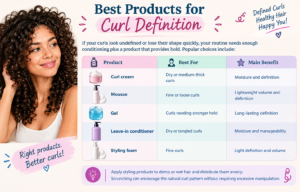
Best Curly Hair Products for Fine Curls
Fine, curly hair types might find that creams, butters, and oils with rich emollients cause their curls to loosen or get greasier; use light emollients instead, such as; Lightweight leave-in conditioner Curl mousse Styling foam light gel Lightweight serum Begin with a little product and build up as necessary. Similarly, the AAD recommends using only as much leave-in conditioner as you require, as the fine hair-types don’t need it and thick hair types do, as much product.
Best Products for Thick or Coarse Curly Hair
Dry or coarse curls might require more conditioning for easier softness, definition, and manageable hair. I would also include these types of hair and their styling products into the list:
- Creamy moisturizing shampoo
- Rich conditioner
- Leave-in conditioner
- Curl cream
- Styling gel
- Occasional hair oil or serum
Condition the full length of hair instead of just the ends, dermotologists suggested that the whole length of dry or curly hair requires conditioning. For thick hair this method will simplify product application and minimize manipulation
Best Products for Tangled Curly Hair
Curly hair tangles easily, especially while dry.
Products that will likely be most beneficial are:
Detangling conditioner
Leave-in conditioner
Slip-enhancing curl conditioner
Wide-tooth comb
Use a lot of enough conditioner to get slip and then carefully detangle while sectioning hair. It may be easier to start detangling at the ends and then pull towards the roots.
Do not pull a comb forcefully through severe knots because this will increase breakage.
Best Products for Curly Hair with Product Buildup
Over time, styling creams, gels, oils, and other styling products can begin to weigh down on your hair. If your curls have all of a sudden become heavy, dull, stick, or you’re struggling to revive your hair with the refresh sprays and other styling products, then the product buildup may have an issue.
You can use a clarifying shampoo to get rid of any leftover product buildup sometimes.
When this happens, a clarifying shampoo should not replace the regular moisture shampoo. AAD recommends taking the approach that clarifying happens prior to a moisturizing shampoo when styling curly hair on a daily use that involves gels, oils, creams, or pomade.
Use based on your products, scalp, how often you wash your hair, and how the hair is receiving the wash/stylers.
Best Products for Curly Hair with an Oily Scalp
Just because you have curly hair it doesn’t mean your scalp is dry. Some people experience oily roots AND dry curls! In that scenario, focus cleansing on your scalp while keeping your lengths conditioned.
A realistic routine might look something like: Mild shampoo as you wash regularly Conditioner as you condition your lengths Light leave in conditioner Stylers through the middle and ends This kind of routine involves avoiding heavy oils, creams, or leave ins over the scalp, unless specifically targeted for your scalp.
Hair Products can also cause bumps around your hairline-The AAD notes that the oils used in many shampoos, conditions and hair care products could trigger product associated breakouts.
Best Products for Curly Hair with a Dry or Flaky Scalp
Itchy, flaky scalps can sometimes cause us to think that we simply need to re-moisturize it with oils! In reality, dandruff and a host of other disorders can contribute to an itchy, flaky scalp. Therefore, instead of slathering on even more oils on your hair and scalp if you have recurring scratching, itching, or redness on the scalp, select hair-care products and remedies that are designated to treat the problem.
The AAD states that despite the way dry scalps and dandruff both look-the two conditions may need completely different remedies.
If after trying an OTC product the issues continue; make an appointment with your dermatologist.
Best Curly Hair Products for Heat-Damaged Hair
The more frequently you blow-dry, curling or flat iron your curls, and high heat is impacting your curls, the more you need to prioritize products and processes that can help prevent continued damage.
Look for:
Moisturizing conditioner
Leave-in conditioner
Heat protector
Lightweight styling cream
Gentle cleansers
Reduce heat styling impact/use as much as possible. Experts recommend limiting the exposure to excessive heat and setting heat tools on a medium or low temperature for styling.
Best Products for Refreshing Curly Hair Between Washes
It is not necessary to wash your curls every time it starts looking undefined.
Just spray your curls lightly with water and apply very small portion of leave in conditioner (if required), and small amount of curl cream or gel to areas that looks undefined.
Scrunch them nicely and either air-dry or diffuse with on mild condition.
Do not apply quite so much product on your hair during a refresh, it can cause build-up.
How to Build a Curly Hair Product Routine
A quick regime is usually much easier to maintain than a variety of products and applications! Washing Day- 1. Cleanses apply the shampoo and focus on the scalp wash it out.
- Condition work it through the lengths and detangle lightly with your finger.
- Leave in conditioner- apply to damp curly lengths if they need a bit of extra moisture or a helping hand with detangling. 4. Define apply your method of curl cream/ mousse/ foam/ gel suitable for your hair.
- Air dry/ Diffuse- with a suitable heat level.
Between washes Refresh on days when you can’t wash with a little bit of water and applied styling product instead of a plethora of product!
Reducing frizz on nights with a satin or silk scarf/bonnet is a must as this greatly reduces friction.
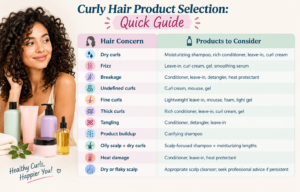
Curly Hair Product Selection: Quick Guide
 Final Thoughts
 Final Thoughts
Curly hair doesn’t require a costly range with a massive ingredient list-instead find products that specifically address your curls. Heavy conditioning to a dry curl, lightweight styling for a fine curl, leave-in and stronghold for a frizzy curl or heat damage protection will require sensitive treatment. Begin a simple routine, adding products in slowly and determining which ones leave you heavy, with buildup, irritation or dryness.
Curly hair is a ‘case of trial and error’, and depends entirely on season, how you style it, how long it is and its condition.
However, if a tight/irritated scalp continues, you have abnormal amounts of breakage or unusual hair loss even when perfecting your routine, your best bet is to see a board certified dermatologist for help with any scalp condition or skin problems that may need treating.