
 GoBeauty Bay
 Shaista Rafi
Beauty & Lifestyle Content Writer
in
Shaista Rafi writes reader-focused beauty
and lifestyle content for GoBeautyBay,
covering skincare, hair care, makeup,
personal care and everyday beauty topics.
 Mirza Ibrahim Ali Khan
Editorial Reviewer
in
Mirza Ibrahim Ali Khan contributes to
GoBeautyBay's editorial review process,
focusing on clarity, content structure,
topical relevance and reader usefulness.
Gels vary in quality When you choose a product, it can be the ingredients and formula as much as the name of the product – whether it’s a gel, mousse, serum, wax or cream. In fact, two gels might have similar textures, but one will give you stronger hold, more moisture, shine, texture or volume than the other. Getting familiar with the main styling ingredients can help you pick the products that will complement your hair and steer clear of ones your hair or scalp don’t get along with.
Common Ingredients in Hair Styling Products
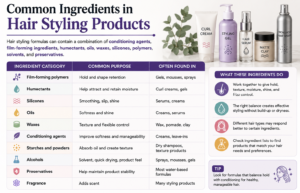
Film-Forming Ingredients for Hold
Film-forming polymers are important in styling products because they help create a thin film around the hair as the product dries. This can provide hold, curl definition, volume and resistance to humidity or movement depending on the formula.
They are particularly common in:
- Hair gels
- Mousses
- Styling foams
- Hairsprays
Curl defining products
A product with good film forming properties may be preferable to a purely conditioning cream if a person is looking for curl definition or longer lasting styles.
Humectants
Humectants are ingredients which bind water to them. They are used in products which aim to provide moisture and improve the tactile quality of the hair.
Examples include and some types of panthenol.
Humectants can have variable effectiveness in moisture treatments and people with prone hair may prefer to assess for themselves how a product performs in different climates instead of judging a product on just one ingredient.
Silicones
Silicones give a slippery feel, shine and softness and help products to comb through hair easily. They also make hair easier to style when using a hairdryer.
- Dimethicone
- Amodimethicone
- Dimethiconol
Silicones are not inherently bad for hair. Their usefulness depends on the formula how frequently the product is used and how the individuals hair responds.
If repeated use leaves your hair feeling coated or difficult to cleanse you may prefer a formula or adjust your cleansing routine.
Oils and Emollients
Oils and other emollient ingredients can help make hair feel softer, smoother and more conditioned.
Styling products may contain ingredients such as:
- Coconut oil
- Argan oil
- Jojoba oil
- Sunflower seed oil
- Plant-derived esters
These ingredients can be particularly appealing in styling creams and serums for coarse hair.
However an oil-rich product may feel too heavy on hair. More oil does not automatically mean hydration or better styling performance.
Waxes
Waxes are commonly used in products designed to provide texture, separation, definition and flexible control.
They are particularly common in:
- Hair wax
- Pomades
- Styling pastes
- Some clay products
Waxes can work well for short and medium-length hairstyles where you want individual sections of hair to remain defined.
Because they can be relatively rich using much may make hair feel heavy or greasy.
Conditioning Components
Conditioning agents can add slip, softness, manageability and a nice touch to the hair. These qualities may assist you in styling your hair if it’s dry, curly, coarse, or unmanageable. Use conditioning agents in: Curl creams Styling creams Leave-in conditioners Detangling products that offer some control for those trouble spots associated with your styling may be more advantageous for you if dryness and/ or tangling is a primary problem.
Choosing Ingredients Based on Your Hair Type
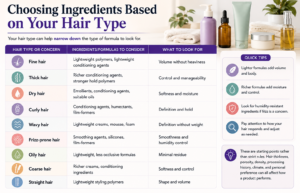
Product Selection: What Should You Check?
Before purchasing a styling product, consider more than its marketing claims.
-
Identify Your Styling Goal
I first ask myself what I want the product to do.
Do I need volume?
Do I need hold?
Do I need curl definition?
Do I need frizz control?
Do I need texture?
Do I need shine?
Do I need a finish?
Do I need heat protection?
Do I need softness and manageability?
Choosing the goal that matches my result makes picking a product easier.
-
Consider Your Hair Thickness
Fine hair can become weighed down by rich creams, oils, waxes or heavy conditioners.
Lightweight mousse, foam, spray or gel may be more appropriate.
Thicker hair may tolerate creams and stronger styling products especially when extra control is needed.
-
Consider Your Desired Hold
Styling products can give levels of control.
Light hold is best for movement and subtle styling.
Medium hold is useful for definition and moderate control.
Strong hold is better for long‑lasting styles, defined curls, sleek hairstyles or structured looks.
A strong‑hold product is not always the choice.
I choose the level of hold that matches the hairstyle that I want to create.
-
Think About the Finish
The same hairstyle can look very different depending on the finish.
Matte finish is usually linked with clays, pastes and some waxes.
Natural finish is common with creams, foams and flexible products.
Shiny finish is often linked with serums, pomades and glossing products.
I choose the finish that matches the look that I want than just picking the strongest hold.
-
Check for Fragrance
If I am sensitive to fragrance I check the ingredient list of just looking at the front label.
Fragrance does not decide whether a styling product works. People who are sensitive, to scented products often prefer fragrance‑free or minimally fragranced options.
-
Think About Buildup
Buildup of gel, wax, pomade, cream, serum or spray can create a fuss. When my hair feels weighed down or greasy, limp, dull and I can’t have a good time playing with it, I’m in need of to depart utilizing so a lot of the product, get rid of a method and locate a cleaning method that’s correct for my hair and scalp.
Natural vs. Synthetic Styling Ingredients
Make sure to not use the phrases natural and synthetic when selecting a hair styling product.
Ingredients derived from plants are best. Natural elements can trigger complications or cause some individuals to be sensitive. Manmade elements could cause functions which include stable hold, stability, conditioning or texture.
Of choosing solely based on the word “natural ” consider:
- Ingredient function
- Overall formulation
- Hair compatibility
- Scalp tolerance
- Fragrance preferences
- Desired styling performance
- Frequency of us
The goal is a product that works well for your hair and feels comfortable to use.
How to Read a Hair Styling Product Labe
The ingredient list can look complicated. You do not need to know every ingredient before deciding.
Start by identifying the products purpose and formula characteristics. Then look for ingredients that support the styling goal
For example:
Want curl definition
Look for a combination of conditioning ingredients and film‑forming agents.
Want volume
Look for formulas designed to add body without excessive oils or heavy conditioning ingredients.
Want smoothness?
Look for conditioning and smoothing ingredients such as silicones or suitable emollients.
Want texture
Look for waxes, clays, starches or other texturizing ingredients.
Want hold?
Look for a formula built around styling polymers or other hold‑producing ingredients.
How Styling Product Should You Use?
More product does not necessarily produce a hairstyle.
Start with an amount distribute product evenly and add more only if necessary. This is particularly important for hair and products containing concentrated waxes, pomades, oils or silicones.
For hair applying product evenly to damp hair can help distribute product through the curl pattern.
For hair emulsifying a small amount between your hands before application can make distribution easier
Always follow the products directions when the directions specify an application method
Final Thoughts
Selecting a hair styling product should be based on a combination of ingredients, formulation, hair characteristics, styling goals and personal preferences
Look beyond labels such as “natural,” “professional,” “clean,” or “strong.” A well‑formulated product that suits your hair can be more useful than one chosen because of its marketing claims.
The best approach is to identify your styling goal choose an appropriate product category check the formula, for characteristics that support that goal and start with a small amount. Over time you can adjust the product type, amount and styling routine based on how your hair responds.