
 GoBeauty Bay
 Last Updated: September 23, 2026
Sensitive skin can react to products that seem perfectly suitable for other skin types. Redness, burning, stinging, dryness, itching, or discomfort may occur when the skin barrier is irritated or when a product contains an ingredient the skin does not tolerate well.
Choosing skincare based on ingredients rather than marketing claims can make a routine simpler and more predictable. However, there is no universal list of ingredients that every person with sensitive skin will tolerate. Skin sensitivity varies, and even commonly recommended ingredients can cause irritation in some people.
This guide explains ingredients for sensitive skin, what they do, which ingredients are commonly used to support the skin barrier, and what to consider when selecting cleansers, moisturizers, and other skincare products.
What Is Sensitive Skin?
Sensitive skin is generally used to describe skin that reacts easily to environmental factors or skincare products. Common symptoms include:
- Redness
- Burning or stinging
- Tightness
- Dryness or flaking
- Itching
- Increased discomfort after cleansing
- Reactions to fragrances or active ingredients
Sensitive skin can also occur alongside dryness, acne, rosacea-prone skin, or a weakened skin barrier.
Because sensitivity has different causes, the goal should not simply be to choose products labeled “for sensitive skin.” Instead, look at the complete formula, the concentration of active ingredients, how frequently you use the product, and how your skin responds.
Best Ingredients for Sensitive Skin
Some ingredients are commonly used in gentle skincare because they help hydrate, soften, or support the skin barrier.
1.Ceramides
Ceramides are lipids naturally found in the skin barrier. They help reduce moisture loss and support the structure of the outer skin layer.
Ceramides can be particularly useful in moisturizers designed for:
- Dry sensitive skin
- Tight or uncomfortable skin
- Compromised skin barriers
- Skin exposed to drying conditions
A moisturizer containing ceramides may be more useful than simply choosing the lightest possible moisturizer.
2. Glycerin
Glycerin is a humectant that attracts water to the outer layers of the skin.
It is widely used in cleansers, serums, moisturizers, and lotions because it can provide hydration without relying on strong exfoliating or active ingredients.
For sensitive skin, glycerin can be a practical ingredient to look for when the main goal is basic hydration.
3. Hyaluronic Acid
Hyaluronic acid is another humectant commonly included in hydrating skincare.
It can help the skin retain water and is available in different molecular weights and formulations. However, the overall formula matters more than the presence of hyaluronic acid alone.
If a hyaluronic acid serum contains several potentially irritating ingredients, the product may not necessarily be suitable simply because it is marketed as hydrating.
4. Squalane
Squalane is an emollient that helps soften the skin and improve its smoothness.
It is commonly found in moisturizers and facial oils and can be useful for sensitive skin that also experiences dryness.
A lightweight squalane-containing moisturizer may provide softness without requiring a complicated routine.
5. Petrolatum
Petrolatum is an occlusive ingredient that helps reduce water loss from the skin.
It can be particularly useful when the skin barrier feels dry or compromised. Petrolatum is commonly found in ointments and barrier-protective products.
For very dry sensitive areas, an occlusive product may be more helpful than repeatedly adding multiple hydrating serums.
6. Panthenol
Panthenol, also known as provitamin B5, is commonly used in moisturizing and soothing skincare formulas.
It can help support hydration and is often included in products designed for dry or irritated-feeling skin.
It is a useful ingredient to consider when building a simple sensitive-skin routine.
7. Colloidal Oatmeal
Colloidal oatmeal is used in skincare products intended to soothe and moisturize dry, uncomfortable skin.
It can be found in creams, lotions, and body-care products and may be especially useful for people whose sensitive skin is also very dry.
However, people with an individual sensitivity or allergy to oats should avoid products containing the ingredient.
8. Niacinamide
Niacinamide is a form of vitamin B3 used in many skincare products. It can support the skin barrier and help with several skin concerns.
For sensitive skin, lower concentrations may be easier to tolerate than highly concentrated formulas.
If a product containing niacinamide causes burning or redness, stop using it rather than assuming that the ingredient must eventually be tolerated.
Ingredients to Approach Carefully
Sensitive skin does not automatically mean that every active ingredient must be avoided. However, some ingredients and formulations are more likely to cause irritation, particularly when used frequently or at high concentrations.
Fragrance
Fragrance can be a concern for people with easily irritated skin.
Look for fragrance-free products when your skin tends to react to scented skincare. Remember that “unscented” does not necessarily mean the same thing as fragrance-free.
Essential Oils
Essential oils such as citrus, peppermint, eucalyptus, or tea tree may cause irritation or sensitization in some people.
Natural origin does not automatically make an ingredient suitable for sensitive skin.
Alcohol
Some forms of alcohol can contribute to dryness or irritation, depending on the formula and concentration.
However, not every ingredient with “alcohol” in its name has the same function or effect. Fatty alcohols such as cetyl alcohol and stearyl alcohol are commonly used as emollients and texture ingredients and are different from drying alcohols.
Exfoliating Acids
AHAs, BHAs, and other exfoliating acids can be useful for particular skin concerns, but they may cause irritation when overused.
If your skin is sensitive, consider:
- Lower concentrations
- Less frequent use
- One active ingredient at a time
- A gentle moisturizer alongside the active
- Avoiding exfoliation when the skin is already irritated
Retinoids
Retinoids can provide significant skincare benefits, but irritation is common when beginning treatment.
If you have sensitive skin, introduce retinoids gradually and avoid combining several potentially irritating actives at the same time.
For prescription retinoids or persistent skin reactions, professional guidance can help determine an appropriate approach.
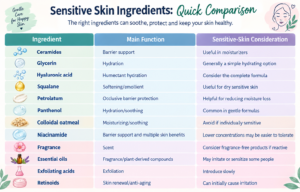
Sensitive Skin Ingredients: Quick Comparison
How to Choose Ingredients for Sensitive Skin
Instead of searching for a single “best” ingredient, build your routine around simplicity and tolerance.
Step 1: Start With a Gentle Cleanser
Choose a cleanser that removes dirt, sunscreen, and makeup without leaving the skin feeling excessively tight or uncomfortable.
A gentle cleanser with moisturizing ingredients such as glycerin can be a useful starting point.
Step 2: Use a Barrier-Supporting Moisturizer
Look for combinations such as:
- Ceramides + humectants
- Glycerin + emollients
- Ceramides + cholesterol + fatty acids
- Panthenol + moisturizing ingredients
- Squalane + barrier-supporting ingredients
The exact combination is less important than how well the finished product works for your skin.
Step 3: Keep Actives Limited
Sensitive skin generally benefits from avoiding unnecessary complexity.
Rather than using several exfoliating acids, retinoids, vitamin C products, and treatment serums simultaneously, introduce products individually.
This also makes it easier to identify the product responsible if irritation develops.
Step 4: Consider Fragrance-Free Formulas
If your skin frequently becomes red, itchy, or irritated after skincare application, fragrance-free products may be worth considering.
Check the complete ingredient list instead of relying only on the front label.
Step 5: Patch Test New Products
Patch testing can help identify potential reactions before applying a new product broadly.
Apply a small amount to a limited area according to the product’s directions and observe your skin before introducing it into your full routine.
A patch test cannot guarantee that a product will never cause a reaction, but it can be a useful precaution.
Ingredients for Sensitive Skin by Product Type
Sensitive Skin Cleanser
Look for a cleanser that is:
- Gentle
- Non-stripping
- Fragrance-free if fragrance causes reactions
- Hydrating or barrier-supportive
- Appropriate for your skin type
Glycerin and gentle cleansing agents are commonly found in these formulas.
Sensitive Skin Moisturizer
Moisturizers can contain:
- Ceramides
- Glycerin
- Squalane
- Petrolatum
- Panthenol
- Colloidal oatmeal
- Hyaluronic acid
If your skin is extremely dry, a cream or ointment may provide more protection than a lightweight gel.
Sensitive Skin Serum
A serum is not essential for everyone with sensitive skin. If you use one, prioritize a simple formula with a specific purpose.
A hydrating serum containing glycerin or hyaluronic acid may be more appropriate than layering several strong actives.
Sensitive Skin Sunscreen
Daily sun protection is important for maintaining skin health. If sunscreen causes stinging, consider trying a different formulation or discussing suitable options with a dermatologist.
The most appropriate sunscreen is one that provides adequate protection and that you can comfortably use as directed.
Ingredients Are Only One Part of the Formula
A common skincare mistake is evaluating a product based on one ingredient.
For example, a moisturizer may contain ceramides but also contain fragrance or several active ingredients that a particular person does not tolerate.
Similarly, a product without fragrance may still contain an ingredient that causes an individual reaction.
When evaluating skincare for sensitive skin, consider:
- The complete ingredient list
- Ingredient concentration where known
- Product texture
- Your existing routine
- How often you use it
- Your individual sensitivities
- Whether your skin barrier is currently irritated
This approach is more useful than automatically labeling one ingredient as “good” or “bad.”
A Simple Sensitive-Skin Routine
A basic routine can help reduce unnecessary exposure to potentially irritating products.
Morning
- Gentle cleanse or rinse, depending on your skin needs
- Moisturizer
- Broad-spectrum sunscreen
Evening
- Gentle cleanser
- Hydrating or treatment product, if needed
- Barrier-supporting moisturizer
When your skin is irritated, simplifying the routine may be more appropriate than adding additional treatment products.
When to Stop Using a Product
Stop using a new product if you experience significant burning, swelling, persistent itching, or worsening irritation.
If a reaction is severe, spreads, or does not improve after stopping the suspected product, seek medical advice. A dermatologist can help determine whether the problem is irritation, allergic contact dermatitis, rosacea, eczema, or another skin condition.
Final Thoughts
The best ingredients for sensitive skin are not necessarily the newest or most active ingredients. A simple combination of ceramides, glycerin, squalane, panthenol, petrolatum, and other moisturizing or barrier-supporting ingredients can provide a useful foundation for many sensitive-skin routines.
At the same time, sensitive skin varies considerably. Fragrance, essential oils, strong exfoliants, and highly concentrated actives may be difficult for some people to tolerate, but individual responses matter more than a universal ingredient blacklist.
Focus on a simple formula, gradual product introduction, adequate moisturization, and consistent sun protection. When persistent or significant reactions occur, professional evaluation is more appropriate than repeatedly changing skincare products.