
 GoBeauty Bay
  Shaista Rafi
Beauty & Lifestyle Content Writer
in
Shaista Rafi writes reader-focused beauty
and lifestyle content for GoBeautyBay,
covering skincare, hair care, makeup,
personal care and everyday beauty topics.
Shaista Rafi
Beauty & Lifestyle Content Writer
in
Shaista Rafi writes reader-focused beauty
and lifestyle content for GoBeautyBay,
covering skincare, hair care, makeup,
personal care and everyday beauty topics.
 Mirza Ibrahim Ali Khan
Editorial Reviewer
in
Mirza Ibrahim Ali Khan contributes to
GoBeautyBay's editorial review process,
focusing on clarity, content structure,
topical relevance and reader usefulness.
Mirza Ibrahim Ali Khan
Editorial Reviewer
in
Mirza Ibrahim Ali Khan contributes to
GoBeautyBay's editorial review process,
focusing on clarity, content structure,
topical relevance and reader usefulness.
Healthy, shiny and strong hair begins with hair care. If you are having problems with hair falling out dryness, dandruff, frizz or hair not growing enough using a natural method can help make your hair healthier without depending a lot on strong chemicals. As more people learn about what’s safe to put on their skin and how to keep their hair healthy in the long run natural hair care has become one of the fastest growing beauty trends in 2026.
Natural hair care is different from solutions that only make hair look better for a short time. It works by giving the scalp care making the hair strong from the roots and keeping the natural oils and moisture in balance. A regular routine that uses cleaning, good food care for the scalp and plants can really help over time.
If you’re looking to encourage thicker, healthier strands, explore our guide to natural hair care for hair growth, featuring proven tips and nourishing ingredients.
What Is Natural Hair Care?
Natural hair care is maintaining healthy hair using beneficial ingredients as well as healthy habits rather than relying primarily on products that contain harsh chemicals or unnecessary ingredients.
It does not promise to change your hair. It wants to make your hair and scalp better in the term.
A natural routine usually has:
- Soft cleaning
- Massaging the scalp
- Plant oils
- Plants that are good for the hair
- Good water balance
- Eating healthy
- Using less heat to style
- Keeping hair safe from bad weather
Natural hair care does not require you to eliminate all synthetic ingredients in your hair care routine. Instead, it requires that you use products which are beneficial to your hair in addition to those that are harmful to your hair in the long run.
Reasons Why Many People are Turning to Natural Hair Care in 2026
People now know a lot more, than before. They do not just buy products because the ads say so. Many people check the list of ingredients compare products and look for ways that help their scalp stay healthy.
Some of the biggest reasons behind this shift include:
| Traditional Approach | Natural Hair Care Approach |
| Focuses mainly on appearance | Focuses on long-term hair health |
| Heavy product layering | Minimal, targeted routine |
| Frequent heat styling | Heat protection and moderation |
| Strong cleansers | Gentle cleansing |
| Temporary shine | Healthier hair over time |
| Quick fixes | Consistent maintenance |
Caring for your natural hair is a process that requires developing healthy habits, as opposed to finding a quick fix.
Hair properties: the basis of hair care
Before you guys go and get that fancy smoothing oil or that special shampoo I saw on my vloggers channel here are some things about your hair.
Hair strands consist of 3 layers: cuticle, corlex and medulla.
Cuticle is the outer layer of hair and it keeps all the other layers safe.
When your cuticles are healthy they lie flat. Your hair looks smooth and shiny
When your cuticles are damaged you can get frizz split ends, rough texture and tangling.
Cortex: this is the layer of your hair.
It has protein, which is also called keratin. It gives your hair strength and elasticity.
Your hair color is also in the cortex.
If your cortex is damaged your hair can break easily. Become weak
Medulla: this is the layer of your hair.
It does not play a role in keeping your hair healthy and some people with fine hair do not even have a medulla.
Why Your Scalp Matters More than Your Hair
Many people only worry about fixing their damaged hair.
But they rarely think about caring for their scalp.
The scalp is essential because it allows hair follicles to grow hair.
A healthy scalp allows you to enjoy healthy hair with fewer flakes, irritations, oily secretions, normal hydration and regularity of the skin.
An unhealthy scalp often causes dandruff, oily secretion of sebaceous glands, dryness, irritation, roughness, and soreness
Therefore, it is necessary to take care of the scalp, and then of the hair.
Overview of the Benefits of a Natural Hair Care Routine
A consistent natural hair care routine is the foundation of healthier, stronger hair and helps reduce dryness, frizz, and breakage.
A natural hair care routine is an amazing opportunity to care for the hair properly. To keep your mane healthy, it is essential to treat it with natural remedies and exclude chemical ones as much as possible
Therefore, a natural hair care routine is undoubtedly a necessary procedure for the health and long life of your hair.
First natural routines help your scalp be healthy by using cleansers massaging your scalp and keeping it moist.
This helps your hair grow normally.
Second natural routines can help reduce breakage.
When your hair is moist and protected it is less likely to break when you brush or style it.
Third natural routines can help keep your hair moist.
Natural oils and conditioners can help reduce dryness and make your hair softer and smoother.
Fourth natural routines can help reduce frizz.
When your hair is moist and your cuticles are smooth your hair will reflect light better. Be easier to manage.
Fifth natural routines can help your scalp feel better.
Gentle cleansers and avoiding irritating products can help reduce dryness, itching and product buildup.
Sixth natural routines can help your hair be strong in the run.
Healthy routines focus on protecting your hair from damage caused by heat, rough handling and stress.
Lastly natural routines can make your hair more manageable.
When you take care of your hair you might notice that it is easier to detangle, softer, shinier, less frizzy and more elastic.
You will have hair growth environment, less breakage, improved moisture balance, reduced frizz better scalp comfort, long-term hair strength and more manageable hair, which is what natural hair care routine is all, about and that is natural hair care.
Natural Hair Care vs Chemical Hair Care
| Feature | Natural Hair Care | Chemical-Focused Routine |
| Daily Maintenance | Gentle | Often intensive |
| Long-Term Health | High priority | May vary by product and use |
| Heat Styling | Minimized | Often frequent |
| Scalp Health | Core focus | Sometimes overlooked |
| Hair Damage Risk | Lower with proper routine | Can increase with repeated harsh treatments |
| Sustainability | Often emphasizes simpler routines | May involve multiple specialized products |
When it comes to taking proper care of your hair, there is no universal approach that would suit all hair types. A proper hair care routine should be determined depending on your hair characteristics, the state of your scalp, lifestyle, and desired goals. It is not a secret that the combination of using specific ingredients with modern cosmetics may yield the best result.
So how does hair get damaged in the place?
It is not usually because of one thing. Instead, it is often the result of a number of factors building up over time.
Here are some things that can cause hair damage:
Heat from hair dryers,
Curling irons and straighteners can damage your hair over time.
Being exposed to the sun can dehydrate your hair, bleach your hair, and damage your hair, and pollution in the environment can stick to your hair which is why you should wash your hair often.
Hard water can make your hair feel frizzy,
while wearing the hair in certain styles can cause breakage and hair loss.
Furthermore, a lack of nutrients can have a negative effect on the hair and washing the hair too frequently or not frequently enough can also have adverse effects.
It is important to pay attention to these warning signs in order to make necessary changes to your hair care routine.
Warning signs can include:
- The hair feeling dry and frizzy after washing, having split ends or tangles,
- Hair that breaks easily
- Having an irritated scalp and having hair that feels heavy and greasy.
Learning How to Choose the Best Natural Ingredients
Not all of them are right for all hair types. You should consider what your hair needs, instead of what’s trendy.
The right ingredients make all the difference. Explore our guide to the best natural hair care ingredients, including aloe vera, shea butter, coconut oil, and argan oil.
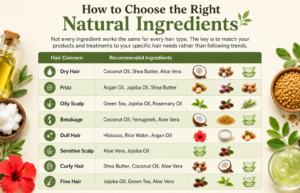
Most Natural Ingredients for Hair Care
When it comes to changing your routine, it is essential to be familiar with the benefits of different ingredients that can aid in enhancing your hair’s condition.
As you may know, various ingredients serve different functions; therefore, it is critical to become well-versed in which ingredients fulfill which purpose.
For instance, there are certain components beneficial for the hair while others are meant to soothe the scalp and protect the strands.
- One of the most demanded substances in this list is coconut oil. There is coconut oil is beneficial for hair because it gets inside the hair strand and nourishes it from within;
This ingredient contains healthy fatty acids that ultimately lower protein loss and leave the hair smooth.
Coconut oil is highly recommended for all hair types including hair, thick hair, curly hair and damaged hair. This ingredient can be used as a -shampoo treatment or as an overnight hair mask.
- Argan oil, also known as “Moroccan gold”, is another fantastic ingredient because it is abundant in antioxidants and vitamin E, which smoothens the hair and improves manageability.
Argan oil is ideal for color-treated hair, heat-damaged hair and dry hair.The product can be used on hair.
However, it is suggested to stay from using it on the scalp if the hair is oily.
- Aloe vera is suitable for the hair because it will hydrate the scalp as well as the hair, leaving it soft and shiny
Aloe vera is used for the scalp for scalp care for curly hair and for dry hair.
The juice of Aloe Vera can be applied directly to the roots and hair strands. It can also be used as a hair mask by mixing other ingredients.
- Rosemary oil is needed to stimulate blood circulation on the scalp, thus strengthening the hair follicles.
This product is good for reducing the damage to thin hair for scalp and hair loss, but not suitable for direct absorption on the scalp.
- Castor oil can be safely used, mixed with jojoba oil or coconut oil.
This oil is great to intensively hydrate the hair and prevent it from becoming dry and brittle.
This ingredient is good for the ends for hair and for protective styles. The texture of castor oil is very thick. It is best to mix it with other oils before using it.
- Jojoba oil is an ingredient for adding moisture to the hair without making it heavy.
Jojoba oil works for hair for oily scalp for normal hair type and for wavy hair.
- It can be used as a leave-in conditioner by rubbing it into the roots and strands. It is also advised to use it on the scalp before washing the hair.
- Shea Butter is an ingredient for making the hair soft and for protecting it.
Shea Butter contains essential fatty acids and vitamins that penetrate the hair shaft to moisturize and nourish the hair, eliminating frizz.
- Hibiscus flowers are used in products for their antioxidant and phytochemical properties that stimulate hair growth and add volume to limp hair.
It is a beneficial ingredient for improving the appearance of the hair and for making it more manageable. Hibiscus is great for hair, for dry hair and for normal hair.
Hibiscus is great for hair, dry hair and normal hair. Hibiscus can be crushed into a paste or used in a hair mask that contains hibiscus extract.
- Fenugreek seeds are high in proteins and mucilage that help to hydrate and improve the overall look of the hair.
This is ideal for hair, dry hair and curly hair.
Curly and coily textures require specialized care. Learn more about natural hair care for curly hair to enhance curl definition while minimizing frizz.
- Hibiscus flowers are used in products for their antioxidant and phytochemical properties that stimulate hair growth and add volume to limp hair.
It is a beneficial ingredient for improving the appearance of the hair and for making it more manageable. Hibiscus is great for hair, for dry hair and for normal hair.
- Rice water is also helpful for dull hair.
If you use it as a rinse after you wash your hair it will make your hair smooth and shiny and easy to manage. The best way to use rice water is to use it as a rinse after you wash your hair or use it after you condition your hair and let it sit for a while.
- Green tea is also very good for your hair. It has a lot of antioxidants that help keep your scalp healthy and protected from the things in the air.
You can use tea on your scalp and on all types of hair. You can use a cup of tea as a rinse after you wash your hair just make sure it is not too hot.
Tips for Using Natural Hair Care Products
Choosing high-quality natural hair care products can help improve moisture retention, strengthen hair, and support long-term hair health.
Using natural things on your hair can be very good but you have to be careful. Here are some things to remember:
- You should add things to your hair slowly and see how they work;
- You should only use essential oils when you mix them with another oil;
- You should not leave heavy oils on your hair and scalp, for too long if you get build-up easily;
- You should wash your hair a lot to get rid of extra oil and dirt and things you use to style your hair;
- You should only use good ingredients and products from companies you trust;
- You should eat well drink a lot of water and protect your hair from the sun and wind.
The best way to treat your hair with products is to use the right products apply them on a regular basis and to have patience with the process. Beautiful healthy hair doesn’t come overnight it takes years to properly care for your hair.
Natural Ingredients Comparison Table
| Ingredient | Primary Benefit | Best For | Frequency |
| Coconut Oil | Reduces protein loss, moisturizes | Dry, damaged, curly hair | 1–2 times/week |
| Argan Oil | Smooths frizz and adds shine | Dry, color-treated hair | Daily or as needed |
| Aloe Vera | Hydrates and soothes the scalp | Dry or sensitive scalp | 2–3 times/week |
| Rosemary Oil* | Supports scalp health | Thinning or oily hair | 2–3 times/week |
| Castor Oil | Seals in moisture | Coarse, dry hair | Weekly |
| Jojoba Oil | Lightweight conditioning | Fine or oily hair | 2–3 times/week |
| Shea Butter | Deep nourishment | Curly, coily hair | Weekly |
| Hibiscus | Softens and conditions | Dull or dry hair | Weekly |
| Fenugreek | Improves manageability | Brittle hair | Weekly |
| Rice Water | Enhances smoothness | Long, dull hair | Every 1–2 weeks |
| Green Tea | Refreshes the scalp | Oily scalp | Weekly |
*Always dilute essential oils such as rosemary oil with a suitable carrier oil before applying them to the scalp.
How to Build a Natural Hair Care Routine
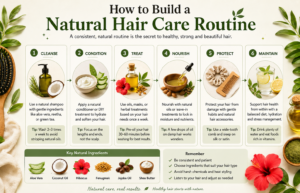
Mistakes to Avoid
- Avoid Washing with very hot water
- Using too many styling products
- Brushing wet hair aggressively
- Applying heavy oils to the scalp every day
- Expecting overnight results
- Frequently changing products before giving them time to work
Building a Natural Hair Care Routine
Creating a natural hair care routine is actually pretty simple. The best natural hair care routines are the ones that’re easy to follow and work well for your Natural Hair Care Routine. They help keep your scalp healthy and your Natural Hair Care Routine safe from damage. Of using a lot of products start with a few basic ones and adjust your Natural Hair Care Routine based on how your Natural Hair Care Routine responds.
Step 1: Figure Out Your Natural Hair Care Routine Type
Before you choose products or try DIY treatments you need to know your Natural Hair Care Routine.
Many people also benefit from simple DIY treatments. Discover effective natural hair care remedies made with everyday ingredients to nourish your hair naturally.
What is your Natural Hair Care Routine texture like. Is it wavy, curly, straight or coily?
How thick is your Natural Hair Care Routine. Is it fine, medium or thick?
What is your scalp like. Is it dry, normal, oily or sensitive?
What problems do you have with your Natural Hair Care Routine.
Do you have frizzy natural hair? Is your natural hair dry? Do you have dandruff? Breakage? Thinning?
Knowing these things help you find products that work well with your Natural Hair Care Routine.
Now step 2, Washing your Natural Hair Care Routine.
Clean Natural Hair Care Routine starts with a scalp. You should wash your Natural Hair Care Routine enough to get rid of oil, sweat and product buildup. Not so much that you strip away the natural moisture.
Here are some general rules:
If you have a scalp you should wash your Natural Hair Care Routine every 2-3 days.
If you have a scalp you should wash your Natural Hair Care Routine 2-3 times a week.
If you have a scalp you should wash your Natural Hair Care Routine 1-2 times a week.
Choose a shampoo that cleans your Natural Hair Care Routine well. Is still gentle on your scalp.
Healthy hair begins with a healthy scalp. Read our expert guide to natural scalp care to reduce buildup, soothe irritation, and promote optimal hair growth.
Step 3: Condition Your Natural Hair Care Routine Every Time You Wash It
Conditioner adds moisture to your Natural Hair Care Routine which makes it more manageable and decreases frictions between Natural Hair Care Routine strands
You should put conditioner on the middle. Ends of your Natural Hair Care Routine leave it on for a few minutes and then rinse it out thoroughly.
Step 4: Moisturize and Seal your Natural Hair Care Routine
If your Natural Hair Care Routine is getting dry or frizzy you can put a conditioner or some drops of oil on it while it is damp, this will help seal your Natural Hair Care Routine and make it not as frizzy or dry.
Be careful not to use much especially if you have fine Natural Hair Care Routine.
Step 5: Take Care of Your Scalp
A scalp is an essential part of healthy-looking Natural Hair Care Routine.
Let’s consider some helpful tips for Natural Hair Care Routine scalp care:
Massage while cleaning
Make sure to clean the scalp.
Do not scratch the scalp.
Use a soothing cream if the scalp becomes dry.
Step 6: Reduce Heat Styling
Using heat styling tools much can damage your Natural Hair Care Routine and make it dry and break.
If you do use heat styling tools:
- Use a heat protectant.
- Use the temperature that works.
- Let your Natural Hair Care Routine air-dry when you can.
-
How to Keep Your Natural Hair Care Routine Looking Great While You Sleep
What you do while you sleep can have an effect on how your Natural Hair Care Routine looks.
Here are a few things you may want to try:
Sleeping on silk/satin pillowcase
Putting your Natural Hair Care Routine in a protective style And
Avoiding tight elastics.
-
Deep Conditioning Your Natural Hair Weekly
Natural Hair gets moisture with Deep conditioning can help restore your Natural Hair if it is dry, curly, or damaged.
Suggestion – use aloe vera, shea butter, coconut oil, and/or argan oil mask.
9.Getting Your Natural Hair Care Routine Trimmed On A Regular Basis
Split ends do not fix themselves. Getting trims can help keep your Natural Hair Care Routine looking healthy and prevent more split ends.
Step 10: Take Care of Your Natural Hair Care Routine from the Inside Out
Your Natural Hair Care Routine is not about what you put on it it is also about what you eat and how you take care of your body.
Make sure to:
- Eat protein.
- Eat foods that have iron in them
- Drink lot of water.
- Get sleep.
- Do not stress much.
Here is an example of what your weekly Natural Hair Care Routine might look like:
- On Monday wash your Natural Hair Care Routine condition it and put a leave-in conditioner on it.
- On Wednesday massage your scalp gently. Refresh your Natural Hair Care Routine if you need to.
- On Friday wash your Natural Hair Care Routine deep condition it. Put a lightweight oil on the ends.
- On Sunday detangle your Hair gently wear a good hairstyle and get ready for the week.
Common Mistakes to Avoid
Using styling products.
Brushing your Natural Hair Care Routine hard when it is wet.
Putting oils on your scalp every day.
Expecting your Natural Hair Care Routine to look great overnight.
Changing products often.
If you have problems with your Natural Hair Care Routine do not worry.
Most Natural Hair Care Routine troubles can be solved by identifying their triggers and changing your Natural Hair Care Routine habits accordingly.
Problems: Dry Natural Hair Care Routine
If your strands are brittle or dehydrated, our guide to natural hair care for dry hair offers practical solutions to restore moisture and softness.
Solution: Use conditioning mask made with nourishing ingredients and no-heat styling
Oily scalp: wash your Natural Hair Care Routine as needed use a conditioner and do not put oils on your scalp.
Frizzy Natural Hair Care Routine: use a moisturizing conditioner put a leave-in conditioner on your Natural Hair Care Routine and use an oil on the ends.
Natural Hair Care Routine breakage: detangle your Natural Hair Care Routine gently do not use heat styling and wear protective hairstyles.
Natural Hair Care Routine fall: eat a diet manage stress and massage your scalp gently.
Remember, taking care of your Natural Hair Care Routine is not just about what you do to it it is also about how you take care of your body. Eat well drink plenty of water and get sleep to help your Natural Hair Care Routine look its best.
This is really important for your Natural Hair Care Routine is
- Detangle your Natural Hair gently.
- Eat a goof diet food.
- Have more water ,Stay hydrated.
- Clean your hair brushes and combs regularly.
Common Natural Hair Care Routine Care Mistakes
We all make mistakes when it comes to our Natural Hair Care Routine.
Avoid these habits that may contribute to Natural Hair Care Routine damage:
Washing with water
Overusing heat tools
Applying oils daily without cleansing
Brushing aggressively especially when Natural Hair Care Routine is wet
Using hairstyles
Frequently switching products before giving them time to work
Ignoring scalp symptoms
Natural hair care can improve many everyday concerns but some issues require professional evaluation.
Consider seeing a dermatologist if you experience:
Natural Hair Care Routine loss
Bald patches
Persistent dandruff despite treatment
Scalp pain, swelling or sores
Signs of infection
Natural Hair Care Routine loss associated with weight changes, fatigue or other health concerns
Early diagnosis can helps in identifying conditions and treatments leads to improve outcomes.
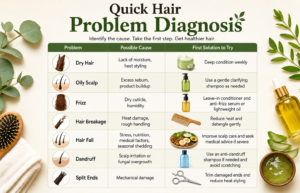
Problems and Solutions
Even if you do everything you know to help your hair, the issue may arise anyway, but in most cases, the damage is not permanent and can be fixed by finding out why exactly your hair is losing its condition and making some changes to your daily routine or diet. After all, your genes, hormones, ecology, cosmetics, styling tools, and even your breakfast can affect the state of your Natural Hair Care Routine, leading to dryness, oiliness, flakiness, damage, split ends or other issues.
Still, most often problems can be solved or significantly improved if you understand what the reason for it is and make some adjustments to your routine. The following natural hair care routine troubleshooting guide discusses the most frequent problems and how to solve them.
Experts’ Tip: Remember that results take time, so give new treatments and adjustments a good six months to really take effect.
Quick Hair Problem Diagnosis
 FAQs Answered by Experts
 FAQs Answered by Experts
Hair Care Solution What is Natural Hair Care Routine ?
Natural Natural Hair Care Routine care is the maintenance of Natural Hair Care Routine and scalp health through cleansing, nourishing, protecting, and styling regimens and promoting general wellbeing. It is a long-term commitment to Natural Hair Care Routine health rather than a short-term solution to hair issues. Natural Natural Hair Care Routine care is about caring for your hair.
Does natural Natural Hair Care Routine care really work?
Yes, it does. Because, after taking good hair care such as cleansing, conditioning, reducing damage by using heat and other hair treatments, it can improve the beauty of your Natural Hair Care Routine, lessen hair breakage and split ends, and improve the health of your scalp. The way Natural Hair Care Routine works is it depends on the person, their genes, and the person’s overall health. And also, their hair type.
How long will the results take?
Most people see results in about a week, of softer hair that is easier to manage. Improvements in breakage scalp condition or Natural Hair Care Routine density typically require weeks to months of natural Natural Hair Care Routine care. You will see results from Natural Hair Care Routine care.
Which natural oil is best for Natural Hair Care Routine?
There is not one “oil for everyone.
Coconut oil: Dry and damaged Natural Hair Care Routine
Argan oil: Frizz and shin
Jojoba oil: scalp and fine Natural Hair Care Routine
Rosemary oil (diluted properly): Scalp care
Castor oil: Moisture retention
It is important to choose the oils according to the type of your Natural Hair Care Routine and not based on popularity. Natural oils are good for your Natural Hair Care Routine
Can the coconut oil accelerate Natural Hair Care Routine growth?
The available research does not support the claim that coconut oil promotes Natural Hair Care Routine growth. It can prevent hair from becoming brittle and reduce protein loss from hair, therefore, contributing to its overall length. Coconut oil is good for your Natural Hair Care Routine.
Is rosemary oil good for Natural Hair Care Routine growth
Some studies suggest diluted rosemary oil may support Natural Hair Care Routine growth in individuals when used consistently. It should always be diluted with a carrier oil before application. Rosemary oil can be good for your Natural Hair Care Routine growth.
How often should I wash my Natural Hair Care Routine?
It depends on your scalp type.
Oily scalp: Every 2–3 days
scalp: Two to three times per week
Washing One to two times per week cause Dry or curly Hair
Washing hair often enough to avoid buildup but not frequently enough to cause dryness.
Can I wash my Natural Hair Care Routine every day?
It is not necessary for the majority of people to wash their Natural Hair Care Routine on a daily basis, unless one has an oily scalp, works out frequently, or has some other particular requirements. One is to use a special shampoo designed for frequent washing if one needs to wash their Natural Hair Care Routine more often than others. Daily washing is not mandatory for most individuals. Therefore, it is not mandatory to wash Natural Hair every day.
Sulfate-free shampoos Are better?
The usage of a Sulfate-free shampoo is a good investment for those with dyed hair or a sensitive Natural Hair Care Routine, however, otherwise, there is no harm in using traditional shampoos for daily use. Sulfate free shampoos allow one to keep their colored hair vivid for much longer, as sulfates remove the natural oils from the hair, damaging the cuticle. Therefore, those with sensitive scalps should invest in the sulfate free shampoos.
No. Natural Hair Care Routine grows from the follicles beneath the scalp not from the ends. Regular trims remove split ends helping Natural Hair Care Routine appear healthier and reducing breakage. Trimming your Natural Hair Care Routine is good, for your Natural Hair Care Routine.