
 GoBeauty Bay
  Shaista Rafi
Beauty & Lifestyle Content Writer
in
Shaista Rafi writes reader-focused beauty
and lifestyle content for GoBeautyBay,
covering skincare, hair care, makeup,
personal care and everyday beauty topics.
Shaista Rafi
Beauty & Lifestyle Content Writer
in
Shaista Rafi writes reader-focused beauty
and lifestyle content for GoBeautyBay,
covering skincare, hair care, makeup,
personal care and everyday beauty topics.
 Mirza Ibrahim Ali Khan
Editorial Reviewer
in
Mirza Ibrahim Ali Khan contributes to
GoBeautyBay's editorial review process,
focusing on clarity, content structure,
topical relevance and reader usefulness.
Mirza Ibrahim Ali Khan
Editorial Reviewer
in
Mirza Ibrahim Ali Khan contributes to
GoBeautyBay's editorial review process,
focusing on clarity, content structure,
topical relevance and reader usefulness.
In most minds, self-care is equated with lavish spa days, expensive beauty products, an extravagant weekend break or a quiet morning over a coffee cup. Though such an idea might certainly be nice to experience occasionally, real self-care is a way of life which extends far beyond what most think.
It’s a collection of daily practices for keeping yourself healthy, replenished, calm and less- stressed-out, for keeping your connections solid and valuable, and for making your life worth more to you. They could involve: a simple glass of water, a little jogging of the path in morning, a hot, wholesome meal, adequate sleep, the ability to say no to the tenth, phone away for the social media and endless online content stream, or five peaceful minutes to yourself while engaged in a pleasurable activity.
The best ideas for self-care are usually the easiest to follow, and must fit into your individual lifestyle-both achievable and consistent ; and must not make self-care itself another thing to get done and feel anxious about when it can’t be fulfilled properly.
Whether you seek quick self-care practices you can incorporate throughout the work-day; leisure ideas for the weekend; emotionally intelligent self-care; or a overall health and wellness boost-this guide aims to offer all such useful activities that you can tailor to fit your every need.
What is self-care?
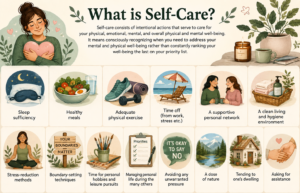
Self-care can’t be selfish. If you habitually neglect yourself, you’ll never achieve an ideal level of physical and emotional well-being.
In the meantime, it is not to excuse yourself of all responsibilities, but rather enhance your energy, fortitude, and overall mental balance for better dealing with daily tasks.
The case for self-care:
Living in the modern world has somehow made the neglect of oneself a surprisingly effortless pursuit, mainly due to a number of pressures including work, childrearing, social duties, fiscal worries, mobile-related communication disorders, home management, among many others, which fill your day before you’re even conscious of what your personal needs are.
When you continuously ignore your body and soul’s plea for attention, you might turn out to be restless, weary, easily vexed, emotionally disconnected, or unmotivated; or all. A consistent exercise of self-care practices can help develop much better coping patterns.
Self-care may potentially:
- Help reduce daily stress
- Improve your sleep cycle
- Support your body and overall physical state
- Safeguard your emotional condition
- Promote better routine patterns
- Enhance your attentional skills
- Make personal relationships a priority again
Allow personal boundaries to be drawn more effectively - Increase self-awareness regarding one’s requirements
- Streamline daily time management so you don’t get overloaded by non-urgent requirements
- Make life feel more balanced
Although it may not instantly eliminate all adversity from existence, self-care allows you several ways to counter life’s obstacles head-on whilst still regarding yourself.
One Hundred+ Ways to Practice self-care:
There’s never been a right answer as to how to implement and practice self-care for you. One person may find comfort in certain activities; another will find the same to be burdensome or bland. Use these ideas listed as a menu not a task-list to check off.
Ideas For Physical Self-Care:
Physical self-care comprises tending to and maintaining your body through exercises that use varied movement sequences; consuming appropriate nourishment; attaining ample remainder; good grooming habits; in addition to other routine activities to safeguard wellbeing.
1.Get ample sleep: Strive for constant rest-this may become quite possible if you stick to a consistent bed and sleep-awake time.
2. Maintain intake of water: Sip on water regularly all day, perhaps with help of a handy water bottle, as that constitutes being hydrated, and helps.
3. Take regular walks: These could be simple daily exercises. The body must be fit, but it does not require equipment.
4. Five-minute stretching: These brief sessions post a static job contribute a lot to relaxing.
5. Nourishing meals: In contrast to reliance solely on ready-to-eat or fast food, take some time to cook your meal and include variety like: green, proteinous food items etc.
6. Savor your meals without distraction: You may wish to take pauses to just savor the meal rather than look at your device or work during your dinner time.
7. Relaxing shower routine: Shower, as it sets up your bedtime ritual that’s not full of the stressors of the day.
8. Good personal hygiene routine: Frequent showering/bathing, maintaining oral care, grooming. Hair, skincare and keeping your clothes clean, can significantly help boost personal confidence and improve overall ease.
9.Time outside: Getting your dosage of sunshine/fresh air provides contrast to confinement.
10.Rest when weary: Rest is a requirement. There is no prerequisite. It depends much upon the time when the body itself asks you to pause.
11.Have a bit of nice low-impact work-out: Even a spot of yoga or a quick run around can invigorate a worn body!
12.Be mindful of your posture: We spend many of our days with necks hunched up against laptop monitors. You’ve to take a moment every now and again to set things straight.
13.Move through the course of the working day: You must be sure to take time for standing/stretching/taking small walks etc throughout the work hours, and it will greatly affect your physique.
14. Resist prolonged stints of inactivity. Divide and subdivide periods of doing nothing with small bursts of activity.
15. Schedule health appointments-your mind and your body won’t regret it; nothing says ‘I love myself’ more than attending check-ups.
Mental Self Care
– Don’t poison your mindset, don’t let negative mental clutter pile up, make sure to leave lots of time and space for yourself, to sit with yourself, to contemplate.
16.Screen-time-away: step away from the screen and relax, even for just five short minutes.
17. Constant screen notifications should be minimized: not all communications demand immediate action.
18. Make-a-list: of what you need to get done. This will break things down.
19. Pick your three biggest priorities: this works more reliably than taking on too many at once.
20. Pick a book and read it for pleasure: find a story which appeals more to what you want to read than simply the necessity of completing the reading task.
21. Learn a new thing, e.g., take a few minutes a day to teach yourself a new skill or information. A certain sense of discovery can do marvellous things for motivation.
22. Breathing exercises: do a short moment or two of mindful breathing, the same as this: inhale–pause–exhale and expand yourself outwards again, it takes about twenty seconds, or two minutes depending on your rhythm of breath and what suits you better.
23. Spend five peaceful minutes alone: it may not be required you spend time without electronic distractions, but it might be what you desire.
24.write in a diary. Write down what troubles you can keep in it, then dispose of it afterwards.
25. Simplify digital life: Delete unnecessary apps; organize them. Declutter your phone: eliminate those junk files that takes up memory; tidy up email: Unsubscribe for non-essential newsletter and delete spam.
26. Avoid doing different things at once: stay focus-minded always, you might try to do only one thing, say take that meeting call while it’s still on.
27. Take pauses! Do not allow yourself to become overburdened and burnt out before realizing you want to break!
28. Focus completely on whatever it is that you’re doing, right at this instant. Try it while walking, eating, or working! It can assist you immensely to manage any challenges.
29. You’re permitted to fail! Perfection has never been a mandatory element of what it takes to live an enduring life.
30. Curate a calming early part of the day: instead of running straight to emails, phones and demands right out of bed, ease your start by making yourself coffee, have a bite, and start with a short walk outdoors instead.
Emotional self-care
How to practice self-care Emotional self-care – this involves knowing how you feel, and responding with kindness instead of trying to ignore your emotions
- Identify How You Feel Instead of just say “I feel like these sucks,” try to articulate specific emotion: Are you lonely, worried, tired, annoyed, disappointed, overwhelmed, and so on.
- Connect with a Trusted Other Whether it’s a friend, family member, or another supportive loved one, sometimes talking it out is what you need.
- Allow yourself to “Zone Out” You are allowed to rest your emotions; the problem you are dealing with can wait.
- Start an Emotional Journal Get your feelings out by typing or writing down how you are feeling, what is going on, and what you may need.
- Stop Comparing Your Life to Everyone else. Social media showcases special, not-so-special occasions, and sometimes unrealistic ideals and situations.
- Be Kind to yourself Talk to yourself the same way that you talk to your favorite person or best buddy – with that gentle and understanding nature.
- Accourage progress – even a little bit. Don’t allow for the big Win alone
- Say “No” being forthright with you in order to prevent overwork, burning out, or making other people feel bad
- Try establishing limitations When another person just throws all their stress and their problems onto your lap, perhaps you can do just portion take a portion of the burden, on their issue as their own.
- Make time for enjoyment – do the things you love. You are with yourself all your waking hours, might as well do something you’re doing most of the time which would keep you content.
How to Self-Care on a “bad” day. –
When things are tough and you need more comfort self-care can look different. During the busy times in life, it’s not feasible to carve out a whole hour for self-care especially when everything feels like a lot. The trick is often to simplify.
Consider: taking 10 deep breaths drinking a glass of water eating a nourishing meal sitting outside for a few minutes changing your outfit putting your phone down taking a warm shower singing a favourite song writing down whatever is on your mind asking for help cancelling something nonessential putting your work aside and going to bed early taking a nap if your day allows even a few minutes of each of these can help reduce the pressure of an overwhelming day by meeting your fundamental needs, even if you cannot get to full blown “wellness” for the day.
Self-Care Tips for Businesspeople
You don’t need hours in the day or a dedicated “space” to incorporate self-care into your daily schedule, the trick is often simply finding small opportunities within your existing structure.
In the morning, once you wake up drink some water, open your curtains, do a 2-minute stretch, eat something if you have time (do not check any social media until you have finished eating) and determine what you would like to accomplish on this day. In the office, take breaks to move around every so often, always stay hydrated, leave your desk at work to take your lunch break (if your workplace allows it), stretch out your shoulders every now and then (with movements up and back), open a window or turn off unnecessary notifications.
In the evening: set your workday termination time, do yourself a shower, have something simple for dinner, spend time with family or friends, listen to some music, set an hour time for all screen time and go to sleep before you check anything that relates to social media, then get your house organized for tomorrow to make your morning easier. Small steps can do big things.
Weekend Self-Care:
When your week is filled, you have the weekend to catch up on sleep and take a load off.
- Try to get plenty of rest and sleep.
- Go for a walk, a longer hike or a walk to a local park.
- Cook your favourite meal.
- Try to clean out and organize one area of your home.
- Declutter the drawers and/or closet that stores your dresser and/or wardrobe.
- Catch up on your television and reading.
- Spend quality time with a loved one, whether it be in person or through technology.
- Try a new skill or get back into a neglected hobby that you once had an interest in.
- Make time to see/be with your family.
- Take an all-over long bath and give your skin the full treatment with a more special skincare process.
- Engage in a craft or creative endeavour that you feel like working on.
- Plan for the week ahead.
- Spend one hour with no phone in sight.
- Go somewhere new and discover something great
- .Listen to music and sing as loud as possible
- Take a few photographs and have some fun – You don’t have to be “doing something “productive when you rest; you have just as much a right to rest and recharge!
Self-care tips for women:
Self-care may be many things; however, it is probably most widely seen through personal grooming.
While personal grooming is certainly a vital a part of self-care for ladies, the term extends far beyond just these practices.
- Implement a basic skincare program.
- Washing as well as conditioning your hair in a periodic foundation.
- Perform common grooming routines.
- Wear clothes that you are at ease in.
- Keep individual hygiene.
- Get common moving rests.
- Cook healthy meal plans for your needs.
- Secure your sleep routine.
- Spend time with encouraging friends.
- Request health appointments if you should have them.
- Establish borders around your use of time.
- Take yourself out for coffee or lunch sometime.
- Examine something encouraging to learn.
- Create room to experience a hobby.
- Spend a silent evening to yourself.
Many individuals are in the habit of lowering the meaning of the term “personal grooming” as well as the care as an entire to nothing greater than looks, though beauty has a place in the term it does not make up the complete definition of personal care.
Male Self-Care Ideas:
Men can incorporate the general principles of self-care applicable to females across multiple dimensions – physical, emotional, mental, and social. Major aspects include regular exercise adequate sleep healthy food diet spending time outdoors basic grooming &hygiene taking breaks from work communicating honestly with other individuals having hobbies and interests limit too much screen time financial planning limiting spending money acquiring stress management techniques spending quality time with family and friends preventive care being sure that work-life balance is maintained.
Emotional Self-Care
It goes without saying, both males and females need it too
Student Self-Care:
There’s academic stress, work shifts, society’s demands, limited time for anything at school.
You can practice self-care as students through such: Prepare a reasonable study habit: Break big tasks into bite-sized parts.
Relax at study times: All night studying doesn’t help in all cases – short breaks help you keep up. Prioritize sleeping: The more you lack sleep, the harder to get things going with your daily activities. Make it a habit to eat: No need to stop caring for your needs just because you have tasks to do. Organize your space of study; a tidy place will help you concentrate better.
Avoid the study life: There’s no point in avoiding your social life or other hobbies.
Ask someone to help if you’re stuck: Teachers, academic advisers, your family, or any other acquaintance are out there for you.
Home Self-Care:
Sometimes your living space can help with relaxation without so much work on renovation. Start small: Make a relaxing spot in the house like reading, music, or just quiet contemplation by your window or a comfortable couch.
The idea of decluttering just one area, a desk, night table, etc., can make the area less daunting to use. Dim evening lights. Have things handy.
Bring in a plant, flowers, or any natural element.
The setting needs to be conducive to rest.
Beauty & Self-Care:
It doesn’t have to be an act to perform but rather taking a few moments to care for yourself and feel good. It may involve the following:
Facemask and wash
Moisturising face
Applying sunscreen
Wearing lip Balm
Wash/condition hair
Applying lotion on your body
Grooming fingernails
Taking a bath or a shower
A simple skin care regimen Styling hair A preferred fragrance Comfortable wearing Clothes
Nutrition Self-care:
Self-care: Nutrition Food is one important part of our wellness every day. It shouldn’t only be a focus when we are on diets or trying to meet health objectives.
Variety of fruits
Variety of vegetables
Whole grains
Beans or Lentils Nuts seeds
Eggs Fish Lean Meat Milk or Milk Products Other Protein Sources
The choice of food will depend on your age, activity, existing health conditions, personal tastes, and much more.
Instead of focus on one” super food”; it is better to consume an average type of diet.
Some nutrition-based self-care tips:
Prepare your food in advance; Have healthy snacks always available; Drink fluids Regularly; Pay attention when eating and; Practice eating without guilt, or with minimal guilt. In the case of any pre-existing conditions that affect your lifestyle, take advise from your physician instead of following general health advice from anywhere else.
Exercise/Self-Care:
Exercise can be thought of as self-care, not punishment. Getting exercise is a way to improve your physical, emotional and mental health, including your mobility and levels of energy. The best type of Exercise is one you enjoy; you will be much more prone to continue a program of exercise you find pleasurable.
Some of the many options for self-care through exercise: Walking Swims Yoga Dancing Biking Pilate Weightlifting, including exercises like body-weight squats and push-ups.
Stretch long hikes Bicycling Recreational sports Gardening Housecleaning tasks that can get you moving If you’re sedentary you may want to get advice from your doctor first.
Sleep Self-care
When you’re on your tight schedule, getting enough sleep is the last thing on your mind.
The solution?
An evening routine.
- Go to the same room at the same time.
- Keep electronic devices out of the room.
- Keep your place of sleep comfortable.
- Do not do demanding mental work before bed
5.Have some sort of relaxing sleep ritual.
6.limit the number of caffeinated items.
- Make sleep a relaxing atmosphere.
IF you don’t continue to experience restful sleep despite applying these efforts. Consult with a sleep doctor.
Social Self-care:
It should go without saying that human beings need social interaction, and whilst “social self-care”” shouldn’t necessarily mean being the most social person you know; there must be enough of it to maintain positive wellbeing. Social activities can include Make an “old friend” call Set up a meeting with family. Have a beverage with another. Show up at an event with club members.
Join a community volunteer group. Volunteer for an organization. Send a cheerful e-mail or text to someone. Make a schedule for going out with family or friends; Plan for quality partner time Spend some time with my pet.
Reach out to an old friend on fb etc. To reconnect You can use social self-care for: avoiding conversations, and interactions, and spaces that systematically leave you in a state of dread, vulnerability, or abject fear for the safety of you or others; Socialize enough to make your spirit happy.
Boundaries as Self Care:
Setting what you can and cannot do are critically important to take care of ourselves; they protect your space, your energy, and your relationship or family bonds.
Here are some examples.
“I can’t help you with that this afternoon.”
“I need time to consider that proposal before I respond.”
“I can’t come.”
“Please avoid yelling or talking down to me.”
” I can assist you with half a hour but then I will have to go” I don’t need to spend ages explaining why or getting defensive of my border – just state it and then be able to state it.
Your wellbeing, sanity, relationship, time, or space does not require an explanation.
Digital Self-Care Ideas:
In our world today, it is convenient to spend almost all our time on computers, phones and other screen devices; however, being constantly stimulated is often counterproductive.
Some digital self-care ideas include digital detox strategies
- Turn off unnecessary notification’s
- Unfollowing bothersome people
- avoid having your screen in your face at mealtimes
- Keep devices out of the bedroom
- Make some time to be tech-free limit entertainment app usage
- Delete apps that you don’t use
- Keep some social media apps strictly limited
- Limit your news consumption (especially before bed)
- A screen-free trip or two a week
- Have face-to-face discussions with people face-to-face instead of viewing them on a screen
Financial Self-Care
Because money causes significant stress, being organised when it comes to your money is a key practice that could help you feel more in control and less anxious, Things to think about could be: What do you spend each week? Make a realistic and flexible plan to follow for a realistic saving that you could possibly put away; review your subscriptions; stop buying things impulsively; plan what the large purchases are so you save the amount you need; pay your bills on time; educate yourself with basic knowledge on finances; set aside financial goals.
What’s more, FINANCIAL self-care doesn’t necessarily mean building a ‘nest egg’.
Rather means being conscious of your decisions which are beneficial to your overall life choices.
Spiritual Self-Care
“Spiritual self-care: This has less to do with religion, or going to church, or any kind of religion and has much to do with your connection with a belief much greater than you; and that can take many forms, such as religious or spiritual belief systems, nature, meditation, customized traditions, or gratitude practice or any meaningful creative endeavour that may bring meaning or purpose to your life. “Things you could try out in your day: Practice Meditation; Practice Prayer and Journaling; Spend Time in Nature; read a good Book; reflect on Your Values; Practice Kindness; Volunteer your Time; Spend alone Quiet Time with Yourself; connect with people within the religious faith that you adhere to; Practice Whatever Calls out to Your Heart and your Soul.
Self Care for Introverts
If you’re depleted by social interactions, then you’ll want to consider putting more time aside for doing things that you enjoy alone. Things to consider including in you time: Reading alone; having a walk alone in a peaceful and Quiet Area; listening to Music Alone; journaling about your day; Cooking a nice meal for Yourself; Paint or draw a picture; Gardening; Watching your favourite TV Show or Movie; Taking a Luxurious Bath or Shower; visit a relaxing Coffee shop; Spending Time in Nature; doing a puzzle or A Game; tidying/ organising your Room or workspace ; Solitude will recharge you as and when you practise it .
Self Care for Extroverts
If you feel energised by social interaction, then the approach that is more logical for you to consider. You need to socialise and not isolate: Take along friend or two on activities; Join group activities like a exercise class or a club; hosting a potluck or casual gather; play team or group games; Attend a local community Event; Go out for a Group walk or hike ; Visiting Family; Finding a fun new group Hobby; volunteering your Time; Planning a weekend trip Away. Choose only the practice Which will make you feel energised rather than Drained.
10Minute Self Care Ideas when you barely have a minute, just pick ONE! : drink a sip of water;do a small stretch; take 10 breaths; go out for fresh air ;Listen to JUST ONE Song you really Enjoyed ; jot town something on a scrap of paper; tidy ONE VERY small Thing; make tea; call a loved one and tell them how much you love them; Sit alone in the quiet (no phones) While it might be that 10 minutes might not solve many life issues, nevertheless it can take a break in your day to be thoughtful for a moment.
30Minute Self-care ideas If you have about thirty minutes, take advantage and consider: Go for shortfall; Do some stretches ; Yoga for Beginners Class; Read for thirty minutes ;preparing a healthy meal ; Have a long, relaxing bath or shower; Journal; Pursue a hobby that refresh the Soul; Listen to an informative podcast and chill; Talk to a friend on the telephone.
Self-Care for a Whole Day
If your schedule is looking open and clear for a whole day, that is great! The trick here is to not over book yourself, and rather schedule a moderate routine for yourself:
MORNING: Don’t grab your device the second you wake up, eat something healthy for breakfast, then go for a walk, cycle or run.
AFTERNOON: Work on an interesting hobby, spend some time in your favourite hangout spot, meet someone at their request.
EVENING: Fix your favourite dish, take a long bubble bath and pamper yourself with your favourite music before bedtime with a book in hand.Your day will probably be the most replenishing if it contains a blend of activities and pure, unproductive, enjoyable idleness.
Developing a Self-Care routine
You do not need to add dozens of new routines to your list at once, but choose at least 3 areas to start with: One that supports your Physical needs (e.g. Take a20- minute walk three days per week) One that supports your Mental and/or Emotional needs (e.g.
Practice 5 minutes of journaling per evening) One that Supports your Joyful needs (e.g.
Set aside 1hourper week to engage in a hobby of your choice) Gradually add more routines as you settle into them. A sustainable self-care routine is the key, and any successful routine will be:
- SIMPLE It’s crystal clear exactly what action you need to take and what outcome it will deliver.
- REALISTIC It fits perfectly within your existing schedule.
- FLEXIBLE It can be adjusted when life throws a curveball or situations change.
- JOYFUL It includes elements that genuinely bring pleasure.
- SUSTAINABLE So you can keep going in say, three or five years, it will STILL be good.
Morning Self Care Routine
Follow these few steps and you can start the day off great: – Wake up at or around the same time as you usually (do so for the weekdays anyway); – Drink a glass of water; – Open your curtains or step outside for some natural light. – Do all your regular grooming habits. – A few minutes of gentle stretching and movement. – If you have toe and like to, eat breakfast. – Jot down or think about any big tasks for your day ahead. Don’t check your work or social media email first thing! Not sure you should be doing your morning routine like a social media post. A perfect morning routine doesn’t exist and is always evolving with the stage of life and who you are. However, the example below is a good general guideline.
Evening Self Care Routine
Your evening self-care should create an effective buffer between work and home life. Work (if applicable), household duties, and your personal downtime. Try to… – Wrap up your work at around the same time each day (if possible); – tidy up/clean one zone of your home; – lay anything out needed for the next day. – take a shower or run a bath; – apply nightly products for your face/body; – turn down bright overhead lights; – stay offline from your phone for at least an hour (but the more the better!); – engage in a relaxing, offline activity such as reading a book or listening to music, – prepare a to-do or priority list for tomorrow; and, – set and have a consistent bedtime; Having a stable evening routine willhelp you relax and unwind which will make sleeping better.
Free Self-Care Ideas
Self-care doesn’t have to be expensive! Many effective self-care strategies are free, such as: Going for a walk; Stretching; Meditation and deep breathing; Journaling your thoughts and feelings; Reading books you already own; Listening to your favourite music; Call friends and family members; Spend time in nature; Tidying up your home; Take a nap; Cook a nourishing meal with ingredients you have on hand; Practicing gratitude; Watching the sunset; Dancing around your living room; Take a technological hiatus.
Sometimes the most invaluable forms of self-care are simply … free!
Self-Care Myths
We need to move on with this notion that only spending our pennies is good self-care. The most effective forms of self-care are often those which require none of your income and will, and should, serve to re-align rather than overload and exhaustion into your day.
You’ll be interested to know that self-care strategies should in no way feel like an added chore or a point of pressure.
Instead, they should feel like an organic ‘add on’.
- Don’t turn self-care into another obligation This often happens on two fronts: you feel as if you need to get through the list of ‘proper’ self-care tasks or else there’s something not quite right about your day. Then there is the thought of needing to achieve one self-care task to ‘earn’ the right to relaxation. This, however, should not be the case at all!
- Stop considering self-care as something only for when you achieve certain results Purchasing a lot of materials won’t help you; self-care does not require purchases!
- Please don’t ignore the basics!When you do not sleep adequate, nutritious foods and drink sufficient fluids then taking one glass of wine or enjoying a new massage is the equivalent of putting a large bandaged on top of a gaping wound.
- Make it about you do not other people Self-care plans for others usually reflect how someone would like the world to be; not how it really is for people like you.Avoid comparing the routine someone you aspire to be, with someone else’s lifestyle that’s perhaps no longer relevant in your current lifestyle, that reflects different resources to what you own.
- Self-care is not used as a distraction tool We all need to ‘unwind’, de–stress and take a few relaxing breaks throughout the day but if these breaks are used to prevent you to address the issues that worry or concern your life on significant matters then maybe it’s time to look at it in a broader sense.
- Don’t miss the feeling if you skip the habit!What you would achieve in one day by neglecting your physical and mentally health needs may come to regret in months or years to come therefore do not miss the feeling you will get from sticking to your plan, when there is temptation and it all feels rather pointless.
You do not necessarily need to include all of the following to experience benefit but, try at least 1 from each categories:
1. A physical Habit – a20 minutes’ walk (3-4 days/week);
2. A mental Habit – journal the high points and low points of the day;
3. A feel-good Habit – do a chore that is enjoyable (and you get an organised house benefit
A 7-Day Simple Self-Care Plan
- DAY ONE • REBOOT: up a small space in your home, drinking water throughout the day, taking a walk, turning in at a reasonable time for sleep.
- DAY TWO • MOVE: • 20-30 minutes of any Physical Activity that you enjoy.
- DAY THREE • CONNECT: • Reach out to a friend and/or loved one (phone, text, meet up) – and let them know you care!
- DAY FOUR • DISCONNECT: • Go device-free for a at least a part of the day or take a break from news and social media.
- DAY FIVE • NOURISH: • Make a wholesome meal and Savor the flavours
- Day 6: Enjoy. Embrace and delight in something solely for its capacity to bring you pleasure.
Day 7: Reflect. Take time to jot down what worked for you throughout the week. Identify a few of your more helpful habits and plan to carry on with those. The goal isn’t to achieve perfection with your new system of self-care habits – it’s experimentation!
Building a Long-Term Self-Care Lifestyle
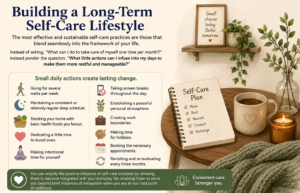
FAQs
What is some self-care practice that are easy to implement?
The range of quick and simple self-care practices you can engage in are unlimited and include drinking enough water, meeting your sleep needs, going for a walk, a brief morning stretching session, a warm bath or shower, reading a portion of a book, journaling, time in nature, calls with friends, meditating, screen breaks.
So which self-care methods are the “best”?
The sad news is there is no “best” self-care method to pick and choose from, as there will be specific periods that your body and mind need. When your physically at your limits, having a good night’s rest might do more for you, than being active, or when you’re feeling isolated, one of your friends, or family members, giving you positive feed-back about whatever will make you happier than other solitary evenings.
Can I best weave self-care practices into my day?
be able to maintain a consistent practice without the burden of reorganizing your entire existence, especially if you implement a handful of small practices and weave them into your routine. You may wish to begin incorporating a 10-minute walk each day or curating an evening routine with tea and a bit of reading, for example.
But is it selfish?
Self-properness isn’t selfish at all -it is mandatory. Practicing self-properness (sufficiently, or at the very least – reasonable amount) can fulfil your bodily as well as mental desire, for the sake of possessing strength and power within you to carry out positive role for someone else on your behalf.
How regularly do you need perform self-properness practice?
While you may believe self-care must necessarily involve a special occasion or moment out of the blue, building self-care into your daily regimen. These daily practices may not even add significantly to your already heavy task load, so there’s little doubt that there are ways to incorporate many simpler self-care practices into the structure of your day without sacrificing precious time and energy.
Can my skincare practices help with my psychological well-being?
They can certainly provide you with peace and pleasure. Regrettably, no singular element or facet within comprehensive self-care may provide the sole necessary form of medical care that one would seek if dealing with more acute, diagnostic-based mental-health concerns.
I feel like my self-care is another pressure, another task on my plate.
Can something I do to feel good sometimes truly provide comfort or bring you ease?
Self-care practice is never intended to become another source of guilt. When the things you are doing to nurture yourself become overwhelming, feel more like you’re checking boxes than truly engaging in rest, pare things down. Engage in practices that heal you and elevate your spirit; these should bring you clarity and not add extra complications or confusion to the more elaborate parts of taking care of you.
Conclusion
Self-Care is What you Make it. After everything, self-care needn’t be costly, ornate or complicated. It never needs to feature a perpetually spotless house or a rigorously structured meditation plan, nor the requirement of an unattainable diet.
The best forms of self-care simply revolve around a number of different acts such as going to bed earlier, gracefully declining if something feels too demanding, cherishing tasty food, going for a stroll, connecting with people important to you, reducing or Eliminating technology, Asking for assistance if you aren’t in a state that allows you to complete everything yourself, and cherishing who you have become.
For maximum well-being, self-care will always be what works for you and only you. It all begins with making only one step towards a bigger path. When choosing just one quick and free act of self-care to try, I would offer to pick up drinking just a single glass of water to remind you of all the wonderful ways in which you nurture and take care of you each day.