
 GoBeauty Bay
  Shaista Rafi
Beauty & Lifestyle Content Writer
in
Shaista Rafi writes reader-focused beauty
and lifestyle content for GoBeautyBay,
covering skincare, hair care, makeup,
personal care and everyday beauty topics.
Shaista Rafi
Beauty & Lifestyle Content Writer
in
Shaista Rafi writes reader-focused beauty
and lifestyle content for GoBeautyBay,
covering skincare, hair care, makeup,
personal care and everyday beauty topics.
 Mirza Ibrahim Ali Khan
Editorial Reviewer
in
Mirza Ibrahim Ali Khan contributes to
GoBeautyBay's editorial review process,
focusing on clarity, content structure,
topical relevance and reader usefulness.
Mirza Ibrahim Ali Khan
Editorial Reviewer
in
Mirza Ibrahim Ali Khan contributes to
GoBeautyBay's editorial review process,
focusing on clarity, content structure,
topical relevance and reader usefulness.
When living a life that feels healthy and balanced it is crucial to participate in physical self-care. This is deliberate in helping you assist your physical body through consistent movement, health eating, good sleep practices, and maintaining and partaking in appropriate daily routines as well as adequate hydration and rest.
The physical self-care concept isn’t driven towards the ideal body size or crazy fitness regimen but is designed to help you feel more energized, powerful, mobile, and comfortable throughout your entire daily life. Taking consistent participation in the care of your physical body may also aid with emotional health; when your physical needs are attended to, day-to-day living may become more manageable and allow for you to build positive daily routines and provide you with a sustained supply of energy.
What Is Physical Self-Care?
What it is: Taking the necessary steps for caring for your physical health. Physical self-care consists of physical action, such as walking or exercising, and recuperative actions such as sleeping or taking time to rest.
Here are some everyday examples of physical self-care activities:
- Exercise regularly
- Walk or just get out more through the day
- Fuelling your body with regular balanced meals
- Staying hydrated
- Allowing for sufficient sleep
- Practicing personal grooming
- Giving yourself rest days when your body asks for it
- Practicing good posture
- Going for routine doctors’ appointments
- Limiting unhealthy routines
Self-care should not add more stress to your day and trying to do things perfectly is counter-productive, make physical self-care manageable and practical for you by doing small, consistent actions every day.
Reasons Physical Self-Care and Fitness is important
It is good for the body to have frequent and regular usage with positive input. Our movement is beneficial for creating muscle endurance, improving our cardiovascular efficiency, improving range of motion, balance and posture as well as the physical function of our entire body.
Physical self-care is often a key component of health promotion, too. Being active on a regular basis might help with keeping your weight at healthy levels, enhancing a persons fitness and strength in bones and muscles and a person might also get sleep better.
It also represents a component of physical self-care that allows you to notice indicators your body might require attention. Ongoing exhaustion and unexplained pain or a change in one’s sleep may not be overlooked. Having a good professional in the field of health taking a look can assist determining if anything underneath the skin requires focus.
Build a Sustainable Fitness Routine
The best fitness regime isn’t one that takes hours at the gym! It’s a routine that works into your schedule and one that can be stuck to constantly.
-
Start With Walking
A simple method to start increasing your activity is walking. You can walk around outside or through the local area, during office breaks and during daily tasks such as shopping trips. For anyone who is inactive a brisk walk of 10-15 mins or more should be started with and build up speed/duration.
-
Include Strength Training
One of the most successful ways for you to build and sustain muscle power is using resistance training. Resistance is quite simply the use of any force which opposes your efforts to move muscles. This can include using your own weight, tension provided from elastic resistance bands, from barbells and free weight, and weight stacks that work against resistance.
The basic exercises such as squats, lunges, rows, presses, modified push-ups (on your knees), could be included in a beginner-friendly strength program, as all you need is technique overweight and a clear focus.
-
Improve Flexibility and Mobility
Performing stretches and mobility activities can assist you to move at ease while retaining your range of movement. Mild stretches can be quite helpful for patients who sit on their rear ends for prolonged durations or used during warm-ups and cool-down exercise.
Activities such as yoga as well as carefully controlled mobility activity are also possible combining movement along with relaxation.
-
Incorporate aerobic activity
Aerobic exercises increase the intensity of your cardiovascular rate and builds endurance. Depending on your fitness level, the type of activity can also vary depending on your lifestyle and preference- it can be brisk walking, cycling, swimming, dancing, running, or group exercise classes.
Engage in exercises that are fun. When the activity is fun it generally be easier to do an extra set.
Nutrition as Part of Physical Self-Care
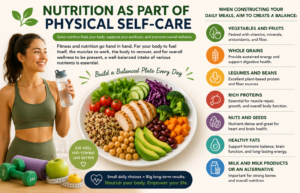
Instead of “crash” dieting (the ‘fads’) pursue a “balanced approach” that includes protein, Fiber, vitamins, minerals, etc.
It can be helpful to speak to a dietitian or doctor about suitable amounts of each based upon unique diet restrictions, health needs, and Weight loss.
Fluid and Physical health
Water is crucial for body health. Amount of liquid you will need may depend upon your lifestyle activities, surrounding environment, dietary contents, and specific medical condition.
The most convenient way to handle fluid requirement is by making water available all the time. Drink periodically from the container or a fountain, especially if you are engaged in exercising or it is too hot outside. Instead of sticking to a particular quantity to be drunk, assess your body’s thirst and physician’s recommendations, if prescribed of fluid restriction in condition.
Sleep and Recovery Are Part of Fitness
Exercise is just one aspect of physical wellbeing. Recovery is also vital. Sleep is an opportunity for the body to rest and recover after demanding situations encountered during normal daily activities. Continuous lack of sleep has been known to express itself as loss of energy and stamina, diminished ability to concentrate, a negative change in mood, and a reduced capability to engage in rigorous exercise. In order to better promote adequate sleep: endeavour to find a sleep routine; consider establishing restful rituals to promote sleep, ensuring bedrooms are not too warm, or restricting the engagement in any demanding activities a couple of hours before bedtime.
When starting any exercise regimen, rest days can and are crucial. Your schedule should allow your body to fully recover.
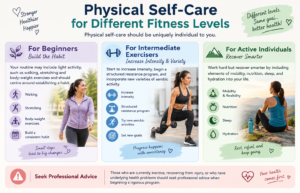
Physical Self-Care for Different Fitness Levels
Simple Physical Self-Care Habits for Everyday Life
You don’t need to overhaul your life entirely in order to implement a self-care regimen focusing on physical health. Incorporate the small acts into your day:
- Take little movement breaks during extended sittings.
- Walk and talk on your cell phone, when circumstances allow.
- Use the stairs at your convenience.
- Pack nutritious meals in advance for hectic days.
- Have a water bottle handy.
- Do light stretches after protracted sitting sessions.
- Consistently follow a sensible sleep pattern.
- Incorporate rest days as required.
- Listen to continuing or a typical ailments/issues.
Select any form of physical exercise you find particularly pleasing to perform.
These tiny changes do make a cumulative, manageable addition to an effective wellness strategy.
Common Physical Self-Care Mistakes to Avoid
There are certain steps that would just create an impossible situation as far as fitness goes. Do not make the mistake thinking every exercise session has to be extremely hard, or that every workout session is necessary.
Some other common errors are neglecting rest, disregarding discomfort, following drastic diets, comparing yourself to others, and making extreme and abrupt changes in your exercise routine.
Always make gradual change- make fitness work for you, not against.
Create a Balanced Physical Self-Care Plan
A good physical self-care plan includes movement, nutrition, hydration, rest, recovery, and maintenance health. Develop one or two realistic physical goals to get started. A typical plan might include taking your dog for a daily walk and going to the gym to build muscle a couple days a week, consistently drinking water during the day and going to bed and waking up around the same time each day. Instead of concentrating on numbers or what you look like, look to how you feel; feeling more energetic, stronger, more flexible, more endurant, able to sleep longer at night and generally more at ease throughout the day is progress toward and indicators of improvement.
Final Thoughts
Physical self-care and fitness is your body is cared for and supported through daily practical habits. Regular physical movement, eating of balanced food, drinking adequate water, good and sufficient sleep, recuperation and establishing good habits can all improve how your body is treated. You cannot do an ultra fitness regime or live a perfect and unrealistic lifestyle-instead simply begin with small and manageable habits, listen to what your body is capable of and make small improvements over time.