
 GoBeauty Bay
  Shaista Rafi
Beauty & Lifestyle Content Writer
in
Shaista Rafi writes reader-focused beauty
and lifestyle content for GoBeautyBay,
covering skincare, hair care, makeup,
personal care and everyday beauty topics.
Shaista Rafi
Beauty & Lifestyle Content Writer
in
Shaista Rafi writes reader-focused beauty
and lifestyle content for GoBeautyBay,
covering skincare, hair care, makeup,
personal care and everyday beauty topics.
 Mirza Ibrahim Ali Khan
Editorial Reviewer
in
Mirza Ibrahim Ali Khan contributes to
GoBeautyBay's editorial review process,
focusing on clarity, content structure,
topical relevance and reader usefulness.
Mirza Ibrahim Ali Khan
Editorial Reviewer
in
Mirza Ibrahim Ali Khan contributes to
GoBeautyBay's editorial review process,
focusing on clarity, content structure,
topical relevance and reader usefulness.
People using Ozempic for the treatment of type 2 diabetes mellitus and weight reduction are discussing Ozempic hair loss. People are posting that Ozempic has helped them to lose weight and get healthier. However, some of them are also noticing that they are losing more hair after several months of Ozempic usage.
Many people wonder whether GLP-1 medications cause hair loss and if the medication itself or rapid weight loss is responsible for increased shedding.
If you have noticed hair in your shower or on your hairbrush since you started taking Ozempic you are not the only one. The good thing is that Ozempic does not hurt your hair directly and for people the hair loss is only temporary.
What Is Ozempic?
Ozempic contains a hormone called semaglutide which supports to treat:
- Blood sugar levels
- How hungry you feel
- How your body uses insulin
- How you digest food
Many people that were on Ozempic said that they lost tons of weight while on the medication, but others also claim that they have lost hair due to Ozempic.
Does Ozempic Cause Hair Loss?
Ozempic does not cause hair loss. However, some patients experience increased hair loss due to:
- Rapid weight loss
- Eating calories
- Not getting enough nutrients
- Stress on the body
- Changes in the way your hair grows
- The main reason for this is something called telogen effluvium, which’s a temporary condition that causes excessive hair loss.If your hair loss began after starting injectable weight loss therapy, our article on hair loss after weight loss injections explores the most common causes and recovery timeline.
A Side Effect of Ozempic Is Hair Loss?
While using Ozempic people said they lost tons of weight, but some say that they have lost hair as well.
- Nausea
- Vomiting
- Constipation
- Diarrhea
- Stomach problems
Hair loss is not on the list of side effects.. Doctors have noticed that some people do lose hair when they lose weight quickly.
Why Does Ozempic Hair Loss Occur?
Due to Rapid Weight Loss
One of the primary causes of Ozempic hair loss is rapid weight loss. When the body undergoes a significant decrease in weight, individuals may find that their bodies do not have sufficient energy for other processes, such as hair growth and, consequently, more hair loss.
Telogen Effluvium
Telogen effluvium is the cause of hair loss for people on Ozempic. In this condition, hair starts shedding massively at one point in time and then usually stops.
Some of the reasons for developing this type of hair loss are:
- Rapid weight loss
- Illness
- Surgery
- Stress
- Nutritional deficiency
The symptoms of telogen effluvium are:
- Losing hair while washing it
- Finding a lot of hair on the pillow in the morning
- Noticeable thinning of the hair on the top of the head
- Widening of the parting zone of the hair
The good thing about telogen effluvium is that it is not permanent; thus, the hair is likely to regrow.
Causes Telogen Effluvium with Ozempic
Due to the nature of the drug, a person’s appetite is suppressed; hence, they are not able to eat enough to maintain their bodies for their overall health and the health of their hair.
If you’re looking for a complete overview, start with our GLP-1 and Hair Loss guide, which explains why hair shedding can occur during treatment with weight loss medications.
Nutritional Deficiencies
Hair needs nutrients in order to be healthy.
| Nutrient | Role in Hair Growth |
| Protein | Builds hair structure |
| Iron | Supports oxygen delivery |
| Zinc | Helps tissue repair |
| Vitamin D | Supports follicle health |
| Vitamin B12 | Supports healthy cells |
| Omega-3 Fatty Acids | Supports scalp health |
Poor nutrition can aggravate shedding and protract the recovery process.
Ozempic Hair Loss Timeline
Ozempic does not cause immediate hair loss for a major part of people.
The general timeline is provided below.
The hair loss timeline
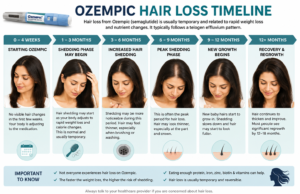
Hair regrowth has an extended cycle, typically several months or years, as such the process of recovery is gradual.
Who Is Most at Risk?
Your risk may be higher if you:
- Lose weight very rapidly
- Eat too little protein
- Have iron deficiency
- Have a history of hair thinning
- Experience high stress
- Have underlying thyroid issues
Comparison: Risk Factors for Ozempic Hair Loss
| Risk Factor | Risk Level |
| Rapid Weight Loss | High |
| Protein Deficiency | High |
| Iron Deficiency | Moderate to High |
| Emotional Stress | Moderate |
| Ozempic Alone | Low |
Is Ozempic Hair Loss Permanent?
For most people, the answer is: No.
If telogen effluvium the reason for your shedding, your hair naturally starts to grow back when you’re:
Weight normalizes
Protein levels are sufficient
General health improves
It is important to have patience because it can take more months for your hair to grow back. Limit the amount of Ozempic that makes you lose hair
Protein-rich foods should be added to the diet.
Because hair is made up of keratin, which is a protein. Some examples of foods that are high in protein are;
Eggs
- Chicken
- Fish
- Greek yogurt
- Lentils
- Beans
Avoid Crash Dieting
Very low-calorie diets can boost the risk of shedding.
Target for ongoing, sustainable weight loss whenever possible.
3.Check Nutrient Levels
Your healthcare provider may advise checking:
- Iron
- Vitamin D
- Ferritin
- Vitamin B12
- Thyroid functionSupporting healthy hair starts with proper nutrition, so explore the best vitamins for GLP-1 hair loss that may help reduce nutrient-related shedding.
-
Support Scalp Health

Troubleshooting Guide
| Problem | Possible Cause | What to Do |
| Sudden shedding | Telogen effluvium | Monitor and improve nutrition |
| Dry, brittle hair | Protein deficiency | Increase protein intake |
| Persistent thinning | Nutrient deficiency | Consult your doctor |
| Bald patches | Another condition | Seek medical evaluation |
Real User Experiences
Many people report:
I began to lose my hair about 3 months after i started to lose weight on Ozempic.”
“My hair was falling out because i was losing weight rapidly, but it started to grow back as i began to lose weight at a slower rate.”
Losing hair is not something that will definately happen to everyone who uses Ozempic, and it can be hard to predict what your body is going to do
Experiencing ongoing shedding? Learn how to stop hair loss while taking GLP-1 medications with practical nutrition and hair care strategies.
Does Hair Grow Back?
In most cases, yes.
It should begin to grow back if you have telogen effluvium because it is only a matter of time before your hair follicles receive the signal to start growing hair again.
It could be that you have an underlying hormone disorder or deficiency of some kind, extreme weight loss, a medical condition, or major stress.
Just keep in mind that hair grows slowly, so you will have to be patient and wait while your follicles begin to grow again.
If your shedding has slowed down, read our guide to hair regrowth after GLP-1 weight loss to understand when new hair growth typically begins.
Ozempic vs Other GLP-1 Medications
| Medication | Active Ingredient | Hair Loss Reports |
| Ozempic | Semaglutide | Some reports of temporary shedding |
| Wegovy | Semaglutide | Similar reports |
| Mounjaro | Tirzepatide | Temporary shedding reported |
| Zepbound | Tirzepatide | Temporary shedding reported |
Current evidence suggests that weight loss itself is the more likely trigger rather than a direct medication effect.
People using tirzepatide may also benefit from reading about Mounjaro hair loss to compare the side effects of different GLP-1 medications.
FAQS
How long does Ozempic cause hair loss?
The hair usually grows back within three-nine months after Ozempic discontinuation.
Is there hair regrowth after Ozempic shedding?
Everything indicates that it should regrow since many variables contribute to alopecia, and Ozempic is only a minor element in the process.
Is it advisable to discontinue Ozempic use?
You must not take any action on your own without consulting your doctor.
If you’re taking Wegovy instead of Ozempic, our guide to Wegovy hair loss side effects explains what you can expect during treatment.
Can a deficiency in certain nutrients hasten the side effects of Ozempic?
Malnutrition can lead to hair loss since a lack of significant nutrients might damage the hair’s keratin proteins, making it dry and weak.
Final thoughts
You should remember that many people were able to achieve their ideal weight using Ozempic and improve their health conditions in general. Even though some of them may have noticed Ozempic hair loss, there is no evidence that this medicine provokes androgenic alopecia.
Besides, it was found out that Ozempic shedding is more likely to be caused by a dramatic decrease in weight, including the lack of some vitamins and nutrients. Luckily, Ozempic hair loss is not permanent, which means that you will be able to get rid of it and regain your beautiful hair.