
 GoBeauty Bay
  Shaista Rafi
Beauty & Lifestyle Content Writer
in
Shaista Rafi writes reader-focused beauty
and lifestyle content for GoBeautyBay,
covering skincare, hair care, makeup,
personal care and everyday beauty topics.
Shaista Rafi
Beauty & Lifestyle Content Writer
in
Shaista Rafi writes reader-focused beauty
and lifestyle content for GoBeautyBay,
covering skincare, hair care, makeup,
personal care and everyday beauty topics.
 Mirza Ibrahim Ali Khan
Editorial Reviewer
in
Mirza Ibrahim Ali Khan contributes to
GoBeautyBay's editorial review process,
focusing on clarity, content structure,
topical relevance and reader usefulness.
Mirza Ibrahim Ali Khan
Editorial Reviewer
in
Mirza Ibrahim Ali Khan contributes to
GoBeautyBay's editorial review process,
focusing on clarity, content structure,
topical relevance and reader usefulness.
Most common question of People who take GLP-1 medications like Ozempic, Wegovy, Mounjaro or Zepbound often want to know how to stop hair loss ?
If you’re prescribed Wegovy, be sure to review the potential Wegovy hair loss side effects and how they compare with other GLP-1 treatments.
GLP-1 medications can cause hair loss. There is good news. In cases the hair loss from GLP-1 medications is temporary.You can often Prevent hair loss with the right food and hair care. When you are losing weight, you want to help your body so your hair follicles get the nutrients they need. The main thing is to support your body when you are taking GLP-1 medications, like Ozempic, Wegovy, Mounjaro or Zepbound.
This way your hair will keep getting the nutrients it needs from the GLP-1 medications.
If you’re looking for a complete overview of medication-related hair shedding, start with our GLP-1 and Hair Loss guide, which covers the causes, prevention strategies, and recovery process.
Comparison Table
Ozempic vs Wegovy vs Mounjaro Hair Loss
People using tirzepatide can also read about Mounjaro hair loss to understand how hair shedding may differ between medications.
| Medication | Active Ingredient | Weight Loss | Hair Loss Reports | Main Reason |
| Ozempic | Semaglutide | High | Temporary shedding reported | Rapid weight loss |
| Wegovy | Semaglutide | Very High | Temporary shedding reported | Calorie restriction |
| Mounjaro | Tirzepatide | Very High | Temporary shedding reported | Rapid weight loss |
| Zepbound | Tirzepatide | Very High | Temporary shedding reported | Nutritional changes |
Why hair loss happens on GLP-1 medications
Most experts believe the shedding is usually not caused by the medication directly.
The most common causes are:
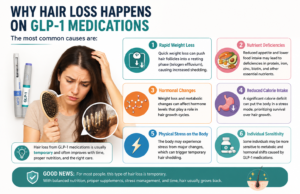
When you’re rapidly losing weight, your body will start to utilize the nutrients that would have gone to your hair elsewhere. This can cause your hair to lose its healthy glow.
Before exploring treatment options, it’s helpful to understand whether GLP-1 medications can cause hair loss and the role that rapid weight loss plays in temporary shedding.
How to prevent or reduce hair loss from being on a GLP-1
Increase your intake of protein
Hair is mainly made up of protein. Specifically, keratin, which is a type of protein. People who are on GLP-1 medications have reduced hunger or appetite which leads to low protein intake.
The recommended amount is a 1-1.6g intake of protein per 1kg or as advised by the medical professional.
- Cottage cheese
- Eggs
- Chicken
- Fish
- Beans
- Lentils
- Tofu
- Protein shakes (if needed)
- Greek yogurt
Example
Protein-focused breakfast
- 2 eggs
- 1 cup Greek yogurt
- Berries
- Nuts or seeds
This can give 25–35 grams of protein before lunch.
Avoid maximum calorie restriction.
One of the biggest causes for telogen effluvium is losing weight too fast.
If possible:
- Avoid crash dieting
- Don’t skip meals regularly
- Focus on steady, sustainable weight loss
- Work with your doctor or dietitian if your appetite becomes extremely low
Many people experience less shedding when weight loss is gradual rather than rapid.
Check for nutritional deficiencies
If hair loss is significant, ask your healthcare provider about testing:
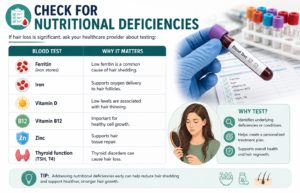
Many people discover that correcting a deficiency significantly improves shedding.
Consider taking a hair supplement but you need to get your doctors approval first.
Some people find that supplements are helpful when they are not getting nutrients from the food they eat.
Common ingredients in these supplements include
- Biotin
- Vitamin DNutrition is essential for healthy hair, so explore the best vitamins for GLP-1 hair loss to help support stronger hair during your weight loss journey.
- Iron,. Only if you are actually low in iron
- Zinc
- Collagen peptides
- Fatty acids
It is really important to remember that you should not start taking iron supplements unless you know for sure that you have a deficiency. Much iron can be bad. You should also make sure to drink plenty of water throughout the day. If you are taking GLP-1 medications they can sometimes cause you to feel sick throw up or not want to drink water.
If you do not drink water it can cause problems like
- Dry hair
- Brittle hair
- Dry scalp
Overall your hair will not be as healthy as it could be.Try to drink water all day every day.
You should also be gentle when you are taking care of your hair.
When your hair is falling out you should try not to put much stress on it.
Some good habits to get into include
- Using a shampoo that does not have sulfate in it
- Using conditioner regularly
- Being gentle when you are combing out your hair
- Not pulling your hair too tight
- Not using heat to style your hair much
- Sleeping on a pillowcase made of satin
- Using a comb with wide teeth
Think of this as a way to help your hair while your body is getting used to the changes it is going through.
If your shedding has slowed down, our guide to hair regrowth after GLP-1 weight loss explains what to expect and how long recovery typically takes.
Do not get too scared. Telogen effluvium can be really scary because your hair can start falling out all of In a lot of cases
- Your hair follicles are still alive
- The hair loss is only temporary
- Your hair will start growing once you feel better
Unless a doctor says you have a different problem you probably do not need to cut all your hair off.
You should try to reduce your stress much as you can. Stress can make your hair fall out more.
Some things that can help you reduce your stress include
- Going for walks
- Doing yoga
- Breathing deeply
- Sleeping
- Talking to a doctor
- Not trying to lose much weight too fast
Even small things can help support the growth of your hair.
You should go see a doctor if
- You start to get spots
- You are losing a lot of hair for than six to nine months
- You are feeling tired, dizzy or sick
- Your scalp is red
- You have a history of thyroid disease or anemia
- Your hair is still falling out even though you are eating well
- These could be signs of a problem that you need to get checked out.
Daily Routine
A daily routine to help prevent hair loss from GLP-1 medications might look like this
In the morning
Eat a breakfast that has a lot of protein around twenty five to thirty grams
Take the vitamins and supplements that your doctor prescribed
Drink some water
In the afternoon
Eat a meal that has protein, vegetables and healthy fats
Keep drinking water
At night
Be gentle when you are combing out your hair
Do not pull your hair too tight
Sleep on a satin pillowcase
Every week
Use a conditioner that has moisturizer in it
Check to make sure you are getting protein
Take pictures to track how your hair is doing
Will your hair grow back?
For people the answer is yes. If your hair is falling out because of telogen effluvium it will often start to get better
Many people notice increased shedding after significant weight loss. Learn more about hair loss after weight loss injections and why it often improves over time.
- You stop losing weight fast
- You are getting all the nutrients you need
- You are eating protein
- You are not as stressed
- You are feeling better overall
A lot of people notice that
- They are not losing much hair after a few months
- They are getting hair growth after about six months to a year
- Their hair is getting thicker over time.
FAQS
Should I stop taking my GLP-1 medication if I am losing hair?
No you should not stop taking any medication without talking to your doctor
In a lot of cases hair loss can be managed without stopping the medication.
Is the hair loss from Ozempic
Most of the time it is not permanent. Will get better over time.
If you’re taking semaglutide, our guide on Ozempic hair loss explains the most common causes, symptoms, and recovery timeline.
Can eating protein really help my hair?
Yes protein is really important for hair growth. It is one of the most important things to focus on when you are losing weight.
How much hair loss is normal?
It is normal to lose around fifty to one hundred hairs per day.
Telogen effluvium can make you lose a lot hair than that but it is usually temporary.
Final Thoughts
The best way to stop or reduce hair loss when you are taking GLP-1 medications is to support your body while you are losing weight.
You should focus on
- Eating protein
- Eating a diet
- Drinking plenty of water
- Being gentle with your hair
- Making sure you are not low in any nutrients
- Losing weight at an steady pace
For most people the hair loss is only temporary and their hair will start to get better once their body adjusts and they are getting all the nutrients they need.
If you are worried, about your hair you should talk to a doctor or a dermatologist to see if the hair loss is because of the weight loss, a lack of nutrients or something else.