
 GoBeauty Bay
  Shaista Rafi
Beauty & Lifestyle Content Writer
in
Shaista Rafi writes reader-focused beauty
and lifestyle content for GoBeautyBay,
covering skincare, hair care, makeup,
personal care and everyday beauty topics.
Shaista Rafi
Beauty & Lifestyle Content Writer
in
Shaista Rafi writes reader-focused beauty
and lifestyle content for GoBeautyBay,
covering skincare, hair care, makeup,
personal care and everyday beauty topics.
 Mirza Ibrahim Ali Khan
Editorial Reviewer
in
Mirza Ibrahim Ali Khan contributes to
GoBeautyBay's editorial review process,
focusing on clarity, content structure,
topical relevance and reader usefulness.
Mirza Ibrahim Ali Khan
Editorial Reviewer
in
Mirza Ibrahim Ali Khan contributes to
GoBeautyBay's editorial review process,
focusing on clarity, content structure,
topical relevance and reader usefulness.
People using Ozempic, Wegovy, Mounjaro, and Zepbound for weight loss, you wonder if their use could lead to hair loss. Most individuals report that these drugs have significantly helped them shed pounds. Nevertheless, some notice a substantial increase in hair loss after a while.
The good news is that hair loss from these medications is usually not forever. In a lot of cases the hair follicles are still healthy. New hair starts to grow again when your body gets used to the weight loss you start eating better and your hair starts to grow like it used to.
This guide is going to explain why people experience hair loss. It will also tell you how long it takes for hair to grow back. It will give you some tips on what you can do to help your hair grow healthy again.
For a complete overview of medication-related hair shedding, explore our GLP-1 and Hair Loss guide, where you’ll learn about the causes, treatment options, and recovery timeline.
Quick Answer
When people lose their hair due to medication, it is called another type of alopecia that is known as telogen effluvium. In this case, hair shedding is caused by rapid weight loss, insufficient caloric intake, and improper nutrition.
If you’re wondering why shedding started in the first place, read our guide on whether GLP-1 medications cause hair loss and what current research says.
The last one means the lack of such things as vitamins and minerals that the human body needs. Telogen effluvium is a form of hair loss that is not permanent which means that a person who experiences it will be able to regrow their hair.
- Hair usually starts to grow when:
- Your weight stops changing
- You start eating protein
- You fix any problems with nutrients that you are missing
- You start to feel better overall
- You can usually see that your hair is getting better after six to twelve months.
Why Does Hair Fall Out When You Take GLP-1 Medicines For Weight Loss?
The medicines themselves do not hurt your hair follicles.
Instead hair falls out because of:
- Losing weight fastTemporary shedding is often linked to rapid weight reduction rather than the medication itself. Learn more about hair loss after weight loss injections and the common recovery timeline.
- Not eating calorie
- Not eating enough protein
- Not having enough iron
- Not having vitamins
- Your body being, under a lot of stress
These things can make more of your hair follicles stop growing and go into a resting phase, which makes you lose hair a few months later.
Understanding the Hair Growth Cycle
Hair naturally grows in repeating cycles:
| Stage | occur | Duration |
| Anagen (Growth) | Hair grows actively | 2 to 7 years |
| Catagen (Transition) | slow Growth | 2–3 weeks |
| Telogen (Resting) | Hair rests before shedding | 2–4 months |
| Exogen (Shedding) | Old hair falls out, and new hair begins growing | Ongoing |
When you have telogen effluvium a lot of your hairs go into a resting phase at once. This is why you often start to lose a lot of hair 2 to 4 months after you start losing weight fast. Telogen effluvium is the reason, for this hair loss.
Common Mistakes That Delay Hair Regrowth
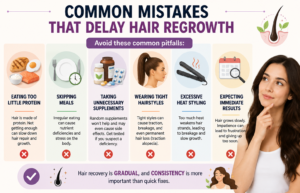
Hair recovery is ongoing, and consistency is more important than quick solutions.
Hair Regrowth Timeline After GLP-1 Weight Loss
Even many people follow a similar pattern recovery varies.
| Timeline | What You May Notice |
| Month 1 | Weight loss begins; hair usually appears normal |
| Months 2–4 | Increased shedding may start. |
| Months 4–6 | Shedding often peaks |
| Months 6–9 | Shedding slows, and new baby hairs may appear. |
| Months 9–12 | Hair density becomes more noticeable and Improved |
Hair grows slowly so visible regrowth requires patience—typically about 1 to 1.25 cm (0.4–0.5 inches) per month.
signs that your hair is getting better include:
- Fewer hairs in your brush. Shower drain
- Tiny hairs around your hairline
- Your hair is getting thicker
- You can see less of your scalp
- Your hair feels better and is stronger
When new hairs grow they are short and fine so you might not notice them away
How to Help Your Hair Grow Back?
Eat Protein
Hair is made mostly of a protein called keratin so therefore Protein is very important for healthy hair.
Foods that good to eat are:
- Egg
- Chicken
- Fish
- Greek yogurt
- Beans
- Lentils
- Tofu
Ask your doctor how protein you should eat each day.
Fix Any Nutrient Deficiencies
Ask your doctor if you should get tested for:
- Iron
- Vitamin D
- Vitamin B12
- Zinc
- Thyroid function
If you are deficient in any of these taking supplements can help your hair grow normally.
Drink Plenty of Water
Drinking water helps your whole body, including your hair and scalp.
Drink more water all day especially if you are taking a GLP-1 medication that makes you less hungry or gives you stomach problems.
Take Care of Your Hair Gently when your hair is growing back:
- Use sulfates free shampoo.
- Condition your hair often.
- Do not wear hairstyles.
- Do not use heat on your hair much.
- Use wide-tooth comb and Be gentle when you comb your hair.
- Use of satin pillowcase while sleeping
- Following these habits helps to prevent your hair from breaking.
- Do Not Crash Diet
- Very low-calorie diets can cause your hair to fall out.
- Losing weight slowly and steadily is better, for your body. Might reduce excessive hair shedding.
Nutrients That Support Hair Recovery
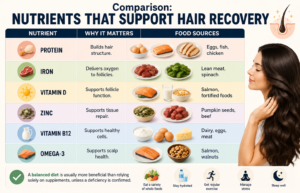
A balanced diet is generally more beneficial and more powerful than relying only on supplements, unless a deficiency is confirmed.
Nutrition also plays a major role in recovery. Discover the best vitamins for GLP-1 hair loss to help support stronger, healthier hair as it regrows.
Can Hair Regrow While having on GLP-1 Medication?
Yes. Many people see their hair grow back without stopping their GLP-1 medication.
This is because when you fix the underlying problems, such as not getting nutrients or losing weight too fast your hair starts to grow normally again even if you are still taking the GLP-1 medication.
Never stop taking a medicine before asking with your doctor once recommended
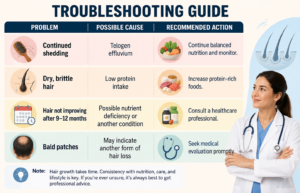
Problem And Solution Guide
FAQS
After ozempic or mounjaro will my hair grow back?
yes if you once stabilize your weight and are well nourished.
People using tirzepatide can also explore our guide to Mounjaro hair loss to compare symptoms, causes, and recovery expectations.
How long does it take for hair to grow back when on a glp 1 medication such as ozempic?
It takes between six and twelve months for their hair to grow back. It varies from person to person.
If you’re taking semaglutide, our article on Ozempic hair loss explains why some users experience increased shedding and how to manage it.
Is hair loss from GLP-1 medication
Most of the time hair loss that happens because you are losing weight fast is not permanent. It is usually something called telogen effluvium.
To reduce ongoing shedding and support healthier hair, follow our practical tips on how to stop hair loss while taking GLP-1 medications.
Can vitamins help my hair grow back faster?
If you do not have enough of a nutrient taking vitamins can help.. Vitamins are most helpful when you know you are missing a certain nutrient.
Final Thoughts
It can be really frustrating when you start losing hair while you are taking GLP-1 medication to lose weight.. Most of the time this is just a temporary problem that happens when your body is getting used to a big change in your weight.
The good news is that medications, like Ozempic, Wegovy, Mounjaro and Zepbound do not seem to hurt your hair follicles in a way that’s permanent.
If you’re prescribed Wegovy, it’s helpful to understand the potential Wegovy hair loss side effects and how they relate to rapid weight loss.
If you eat protein make sure you are getting all the nutrients you need fix any nutrient problems you have and take good care of your hair you will probably start to see it get better over time.
Growing back your hair takes time. keep taking care of yourself and be patient, then you can make a big change.