
 GoBeauty Bay
  Shaista Rafi
Beauty & Lifestyle Content Writer
in
Shaista Rafi writes reader-focused beauty
and lifestyle content for GoBeautyBay,
covering skincare, hair care, makeup,
personal care and everyday beauty topics.
Shaista Rafi
Beauty & Lifestyle Content Writer
in
Shaista Rafi writes reader-focused beauty
and lifestyle content for GoBeautyBay,
covering skincare, hair care, makeup,
personal care and everyday beauty topics.
 Mirza Ibrahim Ali Khan
Editorial Reviewer
in
Mirza Ibrahim Ali Khan contributes to
GoBeautyBay's editorial review process,
focusing on clarity, content structure,
topical relevance and reader usefulness.
Mirza Ibrahim Ali Khan
Editorial Reviewer
in
Mirza Ibrahim Ali Khan contributes to
GoBeautyBay's editorial review process,
focusing on clarity, content structure,
topical relevance and reader usefulness.
Caring for your mental health can be an important part of the greater self-care experience. The demands of daily life; stress at work; complications in relationships; financial burdens; lack of sleep; constant “digital chatter;” can take a tremendous mental and emotional toll.
A mental health, stress relief, self-care routine will enable you to make the time, assess and listen to yourself, Cope with life’s pressures and plug back in to aspects of your life that restore your balance.
Self-care doesn’t have to be hard. Spending a few minutes practicing deep breathing; going for a walk; a full night’s sleep, a check in with a trusted friend can truly become an integral part of your everyday.
What is mental health self-care?
Mental self-care practices are about activities and routine you take which help to protect your general emotional/ mental well-being. Mental self-care involves recognizing the place where your time and energy might best be used- relaxation, social connection, rest, ‘you time’, or support when necessary:
The above include: sleeping for adequate amount of time; Physical activities; Maintaining a balance diet; Mindfulness practice; Spending time with nature; Interaction with well caring people; Set realistic Boundaries; Disconnecting from screens/ technology; Engage in hobbys, Journaling, Healthy stress-management skills
Self-care is not about the absence of situations which stress you out. Rather, through practices of mental self-care you can learn a more balanced way in which you cope.
Understanding Everyday Stress
Stress is natural response to overwhelming or challenging circumstances. Short periods of this “short term stress” can be beneficial as it will prompt an appropriate response to responsibilities such as having a young baby to care for, or deadlines and responsibilities in work.
However, problems occur when stress is chronic, overwhelming or beyond an individual’s ability to cope with it. Work pressures, lack of personal time and resources (including family pressures), failed personal relationship commitments, worrying about finance and money, sleep deprivation and continuous stimulus from phone notifications can all contribute to mental overloading.
This is one of the reasons that stress management is most effective when it is part of the everyday framework instead of a crisis management strategy to be tackled when exhaustion has already set in.
-
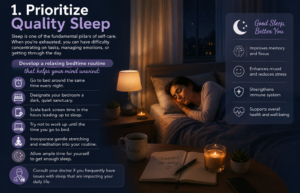
Prioritize Quality Sleep
2.Practice Deep Breathing
Simple deep slow breaths can offer an easy interruption when you’re stressed.
Sitting upright or comfortably, relax your shoulders and focus and on breathing slowly, attending to the feel of breath moving into and out of your body.
It does not take an extended length of time-even a minute or two with conscious purpose can give you room to separate yourself from a disturbing thought or scenario and have a measured response to it.
3. Try Mindfulness
When we are mindful, we are concentrating and noticing what is happening in the ‘now’ and are not living in the past and getting ready to live in the future, You don’t require any specific equipment to learn and practice to be mindful.
For example, take a few minutes of free time when drinking a cup of tea or coffee, look at the temperature and notice the feel, taste and smell. Walk outdoors, and at a conscious pace try and listen out for what sounds you can hear and the sensation of yourself being propelled.
- Meditation
- Body scan
- Mindful breathing
- Mindful eating
- Writing
- Mindful walking
This is about awareness, not how well you do it.
-
Move Your Body
Activity can be a key part of a mindful state of mind too.
You do not have to complete an intensive workout everyday; walk, stretch, do yoga, dance, swim, Cycle or lift weights in way that suits you, is enjoyable to you, within your physical capabilities and fits in with your life.
Short periods of movement can even be good during long stints at a desk- useful mental breaks.
Ensure you pick something that you like doing, for it to feel more like taking care of yourself than a ‘chore.’
5. Be Active Outside
There are many ways nature can distract you from the computer or office, or even just staying inside. Get a walk in in your favourite park or just take a nap in the backyard. Hike in the woods (even a small patch of woods is nice too) or get outside and breathe in the fresh air. Exercising and being outside will begin turning a brief respite into something longer lasting.
-
Set Healthy Boundaries
In part, stress is a result of always being able to reach.
- Using boundaries is important for protecting your own time and energy:
- Disabling notifications at work after a certain hour.
- Telling people that you’re busy and can’t help at the moment.
- Saving time for rest
- Limiting conversations that drain you
- Not replying immediately to every single text.
Boundaries aren’t about shutting down the world completely. It’s about making a little room for you, too, to take care of your own needs
-
Connect with loved ones
Connect with loved ones. Your journey of self-care may not include time alone. Close relationships will also help to provide comfort, companionship, and emotional support.
Try to schedule time, in the form of a phone call, with a good friend, family dinner, or meet a friendly acquaintance for a coffee or a walk, or just for a casual chat with a close friend.
You just want to get what’s on your mind out and you don’t always need an answer — just listening makes even a bad day a little easier to endure.
-
Use Journaling to Organize Your Thoughts
It can help when your mind feels overloaded to write down what’s actually wrong with you to figure things out.
Answer a few uncomplicated questions.
- What am I feeling?
- What is causing me to feel stressed?
- What can I control?
- What can I release?
- What is one thing that I can accomplish tomorrow?
It can also be a journal of thankfulness writing down events or items of a more positive nature from your day.
There are no stipulations of what form your journal needs to take and this space should contain only your most open self
-
Take Regular Digital Breaks
The incessant deluge of push notifications, social feeds, e-mails and web content makes it really tough for us to mentally disengage.
Try carving out mini ‘unplugged’ periods throughout the day. This might include:
- Eating one meal phone-free
- Not checking social media immediately upon waking
- Turning off all non-essential push notifications
- Keeping devices out of sight when relaxing
- Having a pre-sleep screen-free period
You don’t have to go completely ‘off grid’; rather, you’ll use technology by choice and let it take over your every waking hour.
-
Make Time for Things You Enjoy
Self-care shouldn’t necessarily mean taking on a whole host of more responsibility.
Carve out time for something you truly enjoy! Thinking about your:
- Reading,
- Gardening,
- Cooking,
- Photography,
- Painting,
- Listening to music,
- Dancing,
- Spending quality time with a beloved pet,
- Watching a much-loved film,
- Skincare regime, or
- Discovering a new skill,
will leave you with a happy anticipation of these healthy breaks
A Simple Daily Stress-Relief Routine
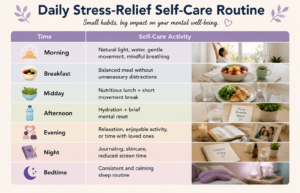
This is only a framework. Your routine should be adapted to your schedule, responsibilities, preferences, and individual needs.
When you might need additional support
Everybody has tough day. However, some continuing problem (emotional, social,) have to be solved or supported, so why not to get help if some of below things happen repeatedly?
It might be time for additional support when you:
- Persistent feelings of sadness or despair
- Feelings of constant overwhelm
- Extreme feelings of irritation
- Isolation and withdrawal from others
- Problems concentrating
- Major changes in your sleeping routine
- Loss of interest in and enjoyment from activity that you traditionally enjoy
- Difficulty carrying out necessary everyday tasks
Practicing self-care can be an effective part of a broader therapeutic process but should not be a replacement for seeking the proper mental healthcare.
If you are suffering from critical emotional despair and or having thoughts of self-harm call immediately for support or contact your area’s emergency/crisis number.
Last thoughts
The point of Mental Health & Stress-Relief self-care: You are focusing on making the good choices and making smart, consistent, healty, manageable habits that will help your mind and your emotional well-being.
This doesn’t need to be a long, overwhelming and complicated list of things; it can be made up of only a couple things, and then you build on it: Sleep and Rest, Move and Play, Get Outside, Unplug and Step Away, Relate to Other People, Live in the Moment and Enjoy What You Love