
 GoBeauty Bay
  Shaista Rafi
Beauty & Lifestyle Content Writer
in
Shaista Rafi writes reader-focused beauty
and lifestyle content for GoBeautyBay,
covering skincare, hair care, makeup,
personal care and everyday beauty topics.
Shaista Rafi
Beauty & Lifestyle Content Writer
in
Shaista Rafi writes reader-focused beauty
and lifestyle content for GoBeautyBay,
covering skincare, hair care, makeup,
personal care and everyday beauty topics.
 Mirza Ibrahim Ali Khan
Editorial Reviewer
in
Mirza Ibrahim Ali Khan contributes to
GoBeautyBay's editorial review process,
focusing on clarity, content structure,
topical relevance and reader usefulness.
Mirza Ibrahim Ali Khan
Editorial Reviewer
in
Mirza Ibrahim Ali Khan contributes to
GoBeautyBay's editorial review process,
focusing on clarity, content structure,
topical relevance and reader usefulness.
Foundation is mainly a makeup product. The formula you pick can change how your skin feels all day long. The ingredients can impact texture and coverage well as hydration, oil control, how long the makeup lasts and how the product works with your skincare.
Selecting the right foundation can be the difference between makeup that feels amazing on your skin and makeup that feels uncomfortable. Your skin type, formula, ingredients and even how your skin behaves with it all affect a foundation you choose. There isn’t one ingredient combination that works for all skin types; knowledge of what common ingredients do would be more beneficial than chasing makeup products labelling their ingredients as ‘clean’, ‘natural’ or ‘non-toxic’.
Foundation ingredients; do they matter?
Formulation of a foundation is an emulsification between different kinds of ingredients; not the pigments themselves but emollients, humectants, silicones, preservatives, film-formers, powders etc. The various ingredients of a foundation perform certain functions:
Some help the foundation:
- Spread on the skin
- Create a smooth feel
- Control extra shine
- Improve moisture
- Last longer
- Give a certain look
- Keep the product safe from germs
- Provide color and coverage
Your skin reacts based on the whole formula not just one ingredient.
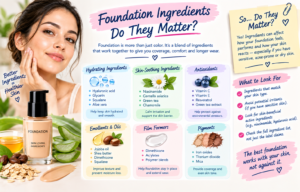
Hydrating Ingredients in Foundation
If you suffer from dehydrated skin you could opt for a foundation that is enriched with the right ingredients so your skin can retain moisture and remain comfortable and ‘happy’.
For the problem of dehydrated skin those might be pleased with makeup that contains enriching and retaining ingredients which will not only take away the dryness and leave it looking less tight but will also add to the feeling of comfortable skin too.
A combination of Glycerine, Hyaluronic acid, Squalane and multiple emollients can usually be found in skin-care products which sometimes appear in makeup also.
Glycerine:
Glycerine is a Humectant. Humectants draw moisture to the skin layer; thus, it can be seen in many makeup products. One could have an enjoyable experience with a Glycerine-filled foundation.
Hyaluronic Acid:
Another Humectant often seen in products and applied in cosmetic formulations to aid with hydration. Make the skin look smoother and plumper.
Having a skincare ingredient in foundation doesn’t mean the foundation replaces a skincare routine.
Squalane and Emollients
An emollient ingredient will likely provide a more glide-able foundation application and a softer texture.
Emollients are typically found in foundations designed to be the more “dewy” or “radiant” look.
Silicones in Foundation
Silicones like dimethicone are common in foundation formulas.
They can have a silky touch and ease makeup application. A few silicone based ones offer a soft-focus finish which helps to diffuse the look of pores and tiny lines.
Even though some people worry about silicones they are widely. Not always bad for the skin.
Whether a silicone-based foundation works for you depends on the formula and how your skin reacts.
Oil-Control Ingredients
People with combination skin might prefer formulas that help reduce shine.
Powder foundations and some liquid foundations may have ingredients that absorb or manage oil.
These can give a more matte look. May help makeup last longer.
Too much oil control can sometimes make dry areas feel uncomfortable. If your skin feels tight or flaky after applying foundation maybe the formula is matte for your skin.
Mineral Ingredients in Foundation
In makeup products, Mineral pigments are commonly used. Iron oxides, titanium dioxide, zinc oxide such as ingredients can impart colour, opacifying effect or any other properties for the cosmetics products. Many consider the mineral makeup to be gentle. In addition, term mineral used for makeup does not signify to all sensitive skin type.
The whole formula and your personal reaction still matter.
Fragrance and Essential Oils
Fragrance can make makeup smell nice. It can also be a problem for people with sensitive skin.
If you often get irritation from makeup you might want to try fragrance- products.
Essential oils are scents and can cause irritation or allergies in some people.
For skin simpler products can make it easier to see what your skin can handle.
Preservatives Are Important
Preservatives often get reviews, but they do an important job in many products.
Without preservatives some ingredients in foundation can grow bacteria. Preservatives help keep the product safe and extend its life.
Of thinking all preservatives are bad think about whether the product is properly made and good for your skin.
Non-Comedogenic Foundation
If you get pores or breakouts easily you might find foundations labelled non-comedogenic.
This usually means the product was made or tested to reduce the chance of clogging pores.
Non-comedogenic” doesn’t mean it will never cause breakouts. Everyone’s skin is different.
If you keep getting breakouts after using a foundation stop using it and see if another product is the issue.
Foundation Ingredients for Different Skin Types
Dry Skin
When formulas are smooth, hydrating or rich, then it is often a formula to go for. Ingredients such as glycerine, hyaluronic acid, and emollients can work. The make up can create an anti matt/natural-look or satin, shimmering/dewy finish Skin
You may want light formulas with oil control and a matte or natural look.
Powder foundation can also help control shine.
Combination Skin
A balanced formula with a satin finish might work.
You can also use setting methods putting more powder on oily areas and less on drier parts.
Sensitive skin
Do not wear many make-up products; select what your skin has been used to and could tolerate.
Try to use fragrances in your product, it is preferable to avoid these as much as possible in the presence of fragrance sensitivity.
Always try products carefully.
Mature-Looking Skin
heavy or very matte foundation can make fine lines and texture more obvious.
Lightweight, hydrating or satin finish formulas can look softer and more natural.
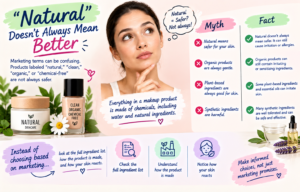
“Natural” Doesn’t Always Mean Better
How Foundation Can Affect Your Skin Barrier
Your skin barrier helps stop moisture loss and protect the skin from things.
A foundation on its own usually doesn’t hurt the barrier. Problems can happen when makeup is used with harsh cleansing, too much exfoliating, irritating skincare or not enough moisture.
If your skin feels tight burns feel very dry. Is irritated after removing makeup think about simplifying your routine and using gentle cleansing and barrier-supporting skincare.
Makeup Removal Is Part of Skin Health
Choosing a kind foundation is part of it. Removing makeup properly at night is also important.
A simple routine can include:
Remove makeup → cleanse → Moisturizing skincare → Moisturizer
Be careful not to apply too much pressure when you remove your makeup. Over-rubbing can contribute to irritation; this effect is particularly pronounced for eyes and other delicate areas.
The Never Forget: Make-Up Hygiene
Wipe off all your make-up products, oils, and germs on your tools will remove make-up build-up when used properly.
Wash all your foundation brushes regularly, and all your make-up sponges as directed.
Change. Tools when they are old, broken, dirty or not good anymore.
Don’t share foundation tools that touch the skin.
Foundation and Sunscreen
Some foundations have SPF. Makeup with SPF should not take the place of actual sunscreen.
If you use sun protection in the morning put on a broad-spectrum sunscreen before makeup.
A simple order is:
Skincare → Sunscreen → Primer if needed → Foundation → Other makeup
Let skincare and sun screen settle into your skin, then apply foundation to avoid pilling and patchiness.
Buying a Skin-Healthy foundation
Before picking up foundation, answer the following questions:
- What is my skin type?
- Do I need moisture or oil control?
- What coverage do I want?
- What finish do I like?
- Is my skin sensitive to scent?
- Does the formula work with my skincare?
- Is it comfortable for use?
- Does it cause irritation or pimples?
You don’t need the list of ingredients or the most expensive foundation. A good formula that works for your skin and makeup needs can be better.
Final Thoughts
Foundation, ingredients and skin health are connected through the way the product is made your skin type and how your skin reacts. Ingredients like glycerine, hyaluronic acid, silicones, emollients, pigments and oil-absorbing materials each have a job in makeup.
Of looking for the perfect foundation focus on finding a formula that feels good on your skin.
Good skin prep, foundation choice, gentle makeup removal and regular cleaning of tools can all help make your makeup routine healthier and better.