
 GoBeauty Bay
 Shaista Rafi
Beauty & Lifestyle Content Writer
in
Shaista Rafi writes reader-focused beauty
and lifestyle content for GoBeautyBay,
covering skincare, hair care, makeup,
personal care and everyday beauty topics.
 Mirza Ibrahim Ali Khan
Editorial Reviewer
in
Mirza Ibrahim Ali Khan contributes to
GoBeautyBay's editorial review process,
focusing on clarity, content structure,
topical relevance and reader usefulness.
Finding the curly hair products can feel like a big challenge. Step into any store. Scroll through online shops and you will see countless options. Shampoos, conditioners, leave-in products, curl creams, gels, mousses, oils, masks, cowashes, clarifying shampoos… All these product categories promise to make curls more defined, shiny and healthy-looking.
However, it is not every product that works with any curly hair type. The buttery smooth cream that is a Godsend for tight coils may flatline fine waves, or a rich butter that helps coils may form a buildup in looser curl types. A high-hold gel that makes waves defined might leave hair feeling tight and dry if it does not deliver any moisture.
This is not solely about choosing a product but about identifying which products work with your curl type, the hair density, porosity and thickness, as well as your scalp condition, and concerns.
According to the American Academy of Dermatology, curly and coily hair textures are more prone to be dry and brittle. One of the ways to prevent breaking is by keeping curls hydrated with a daily moisturizing product routine, regular combing/detangling without breakage of existing knots and less frequent washing when not necessary, as well as protecting the hair from heat and friction.
This also exhibits how to get and maintain a hair routine keeping your curls defined, manageable, soft and looking healthier.
What products are most effective for curly hair?
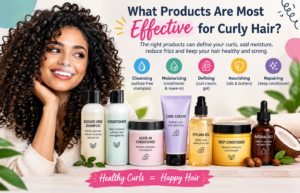
The best products depend on your hair. Good curly hair routines often contain some of the following two to three basic formulas:
- Moisturizing shampoo
- Hydrating conditioner
- Deep conditioner or hair mask
- Leave in conditione
- Curl cream
- Curl mousse or foam
- Curldefining gel
- Lightweight hair oil
- Clarifying shampoo
- Heat protectant
- Detangling product
- Scalp care product when needed
You don’t need every product. Finer curly hair might just require just shampoo, a light conditioner, a leave-in and a spray, with some mousse for definition. Tighter coily hair might need heavier conditioners, leave-ins, creams and a styling gel. The objective should be a well-defined curl without heavy buildup or overly drying them with hair styling products.
Why curly hair requires products
Curly hair has a structure than straight hair. The bends and curves in the strands make it harder for natural oils to travel from the scalp to the ends. This means curly hair can dry out easily.
The American Academy of Dermatology says curly hair should be conditioned along its length. It additionally suggests that products for dry hair should be used, in which are common the use of argan oil, Glycerine, fatty alcohols (e.g.) among others that help maintain the hair soft, shine.
Curly hair also tangles easily. Rough brushing, much heat, rough towel drying and too much manipulation can cause breakage and frizz.
That’s why the best curly hair routine focuses on:
- Gentle cleansing
- Consistent conditioning
- Moisture retention
- Careful detangling
- Curl definition
- Frizz control
- Protection from heat and friction
- Scalp health
How to Choose the Best Curly Hair Products
Start by figuring out what your hair really needs.
1. Identify Your Curl Pattern
Curl patterns are often grouped into four types:
Type 1: Straight
Type 1 hair has no curl. It’s not technically curly. Some people with straight hair get waves from humidity or styling.
Type 2: Wavy
Type 2 hair shows an Sshaped pattern. It can range from waves to tighter waves that almost curl. Wavy hair often does best with products. Heavy creams and oils can make it look flat.
Type 3: Curly
Type 3 hair has curls or ringlets. It usually needs moisture and conditioning than straight or wavy hair.
Type 4: Coily or Tightly Curled
Type 4 hair has tight coils, curls or zigzag patterns. This hair type can be very dry and fragile. Moisture retention and gentle handling are especially important.
Many people have curl patterns on different parts of their head.
2. Consider Your Hair Thickness
- Curl pattern is not the factor. You also need to think about how thick or thin your hair strands Fine
- If hair tends to be heavy by butters creams or oil, your curly hair, particularly your very fine curly hair could suffer from these products weighing it down.
- Medium hair: This kind of hair can usually bear many different kind of hair care products.
- Thick or coarse hair; you usually want conditioner and even oil and a cream or leave-in to be richest to keep curl definition on your hair.
- Oily, limp or flat curly hair often means you are using way too much product, or that the product that you have been using too heavy for hair type or structure, or both:
3.Take the porosity of hair into account
Porosity is the state of how effectively your hair takes moisture. Online tests can vary, Watching how your hair behaves can help.
Low porosity
Hair takes longer to get wet. It may resist absorbing products. Lightweight conditioners and styling products work well. Avoid applying much at once.
Medium porosity
Hair generally holds moisture pretty well. Shampoo, conditioner, leave-ins and styling products generally do the trick within a balanced routine.
High porosity
Your hair generally drinks moisture rapidly but at the same speed also needs to retain its moisture so some conditioners, leave-in creams and on occasion oils/serums will help hold the moisture.
Best Curly Hair Shampoo
Part of your curly hair routine, good curly hair shampoo’s rinse and remove the dirty impurities without stripping and causing dry or frizzy hair.
Look for this when choosing a curly hair shampoo:
Look for formulas labeled as:
- Moisturizing
- Hydrating
- Curl friendly
- Sulfate free (if that works for you)
Made for dry or textured hair
Common ingredients in good moisturizing shampoos include:
- Glycerine
- Aloe vera
- Panthenol
- Argan oil
- Coconut derived conditioning ingredients
- Mild cleaning agents.
Even if your shampoo is labeled “sulfate free” it might not work for you, you still have to get your hair clean.
The Society for Paediatric Dermatology says some strong cleansing agents can dry hair out if used often. Milder cleaners may be better for hair.
How often should I shampoo my curly hair?
The answer is it really varies… It’s a matter of your hair type, scalp type, lifestyle (activity, etc.), hairstyle, and how fast your hair builds up.
According to the AAD, you should wash hair types if needed, not every single day, they advise washing it on the scalp, not all the way through the hair.
Your scalp if oily orbuilds up easily will need washing much more frequently than dry and comfy hair, this often means very seldom
Best Curly Hair Conditioner
Shampoo cleans. Conditioner makes curly hair manageable.
A good conditioner helps:
- Add softness
- Reduce tangles
- Improve manageability
- Reduce friction
- Help retain moisture
- Improve shine
- Make detangling
Curly and dry hair usually needs conditioner along the full length not just at the ends.
Ingredients to Look For
Some helpful conditioning ingredients include:
Glycerin
This is a humectant. It pulls moisture into the hair. Helps it stay there.
Argan Oil
This oil gives softness and conditioning without feeling heavy like some oils.
Fatty Alcohols
(such as cetyl, and stearyl alcohols) will show up in conditioner. These are not drying alcohols. They provide a creamy feel.
Conditioning Agents
Ingredients, like behentrimonium compounds and certain conditioning polymers can reduce friction. Make detangling easier.
The Top Deep Conditioners for Curly Hair
Deep conditioner or mask is generally understood to be a rinse-off condition that is much deeper than other conditioners that are rinse off. They may also be especially helpful in the event that you possess: Super dry hair Brittile hair Frizz Chemical treatments, Heat style your hair often, The type of hair that’s a struggle to deal with Difficult to get a softening effect It’s absolutely not crucial for you to condition your curly hair a day that you wash it; it depends entirely on your curly hair “How often ought you condition curly hair?”– Curly hair – Health & Fashion. Curly hair you may wish to continue conditioning every one or more washing or if hair starts getting flat as well as weighty after deep conditioning, then lessen regularity or a light formula might be just the thing to consider How Often Should CurlyHair BeConditioned, Curly Hair,Health and Fitness And Fashion.
Commercially a Curly Hair deep conditioners vary in cost; there are luxury options in addition to far more economical models.
BestLeave-In Conditioner for Curly Hair
It’s been estimated that a leave-in Conditioner might be among the best conditioners available to curls. By definition, compared with the rinses out conditioner above, it will remain in the hair, providing ongoing conditioner as well as easier manageability. The American Academy of Dermatologists claims that “Leave-In Conditiners are useful in managing a number of concerns such as frizzy, curly, dry brittle, chemically straightened, damaged by heat, and too-long, Tangled hair… They may also keep hair from drying out too quickly and also make Styling much smoother.” How to use Curly Hair leave-In Conditioner after washing and moisturizing the hair. Scrape excess moisture out gently: you still want hair damp.
Apply sparingly… work product in on the lower lengths of hair towards the ends Detangle gently Styling products (optional) use the smallest amount you can, and attempt to stay away from placing leave-in Conditioner right onto your scalp, as it causes build-Up”says the Academy of Certified Hair Professionals.
Curly Hair Creme
Curl cream can be used for conditioning along with for curling the hair for a curl look more define; smoother; also helps with frizziness and also shape of curl and also holding all the moisture that you’ve placed in through your previous conditioners and washes Curly creme use The particular ‘Curl Cream ‘ is certainly handy with Curly hair especially for type 3, curly and thick hair and even curly hair that seems to struggle to be able to get a curl out rather than it getting defined curls in. However do apply moderately with fine waves and also thick/ dry wavy hair “just put tiny amount or not use any more at all if curls getting flattened.”
CurlyGels.
If defining the curl hair lengthily and also more defineably, gels can have the capacity to assist significantly. It’s essential however for curls to be really… wet not a small bit moist and it’ll offer: Strong hold Defined curls Reduced Frizz Definition, longevity, Clumps, Cast– curly hair definition products. A bit like other gels, it could leave hair somewhat coarse but you can soften “the Cast”, by using a technique of gently scruping the hair, when it’s completely dry.
CurlyMousse & Curly foam
A mousse/foam is a perfect, ideal lightweight and volumizing, defined mousse with movement as well as movement for curl hair. It’s very best with fine curls as they do not always grab very weightier products as good and could be utilized underneath a more powerful hold type product if needed. Curly hairstyle gels… curly-hair gels for definition … gel for curly hair… CurlyHair mousse as well as Foam CurlyHair mousse & Curly Foam What About Curl Curly Moisturizers Moisturizers actually act more like conditioners on Curly hair when compared with water-and-water-base products, so they need to be utilized instead of Moisturizing your hair “If curly hair feels as if dry or rough it’s just ‘conditioned’ not moisturized “curly- Moisturizer. It’s all depending on just how poor the condition the curly hair is.”
Curl Styling Products Oils
For Curly Conditioner Oil is great at conditioning, shine as well as making more manageable curls.
Common curly products include
Argan oil,Coconut Oil and Shea Butter for curly hair . Oils should not be expected to deliver moisture to your hair – they should be seen more as a conditioner.” Curly Oil as well as Serums Curly hair oil, … Most curly hair Products… curly-hair treatment … Products That Tend to Address Curly Hair Frizz There are numerous reasons your curly hair frizz’s .
This could be brought on by Humidity in air, Damaged or very porous curly hair, Dry as well as over-clean curly hair (lack of a rinse out deep conditioner). Best anti Frizzing routine Shampoo and conditioner (Hydration focused), Leave in Conditioner, Curl cream and a little bit of curly hair gel if hair is going to be styling. Don’t constantly scrub Dry hair with curly hair,” it breaks curly hair.”
How Curly hair Product to use Best Curly Hair Shampoo
Best Curly Hair Products for DRY Hair: DRY Hair Requirements hydration!
Hydration Moisturizing Shampoos, “heavy conditioner” leave in Conditioner, deep moisturizing conditioner and also some hair products – Glycerine Aloe Vera panthenol – Argan Oil Shea butter; etc. It’s necessary to keep in mind – don’t go overboard with the heavy products if your hair does not really seem to need them It will just end up creating build up and makes the curly hair flatten”–,”curlyhair.com The particular products that curly hair have to be dry- moisturizers for the specific hair.. As it needs all the Moisture that it can absorb from you” and also conditioner to have the “moisture effect” curly hair “Curly- Moisturizer, Argan oil. “Do not overuse heavy items for curly hair for dry hair”,.
Curly hair for Thick Curly Hair
For the best condition impact with Thick curly hair a moisturizer product is suggested.
These types of moisturizers need to be applied in segments covering head to end to allow the product the chance to condition the hair properly,”. Curly hair “thick wavy hairstyles and products”. Best for Curl Hair growth While not all products marketed as ‘hair growth’ will add density and length at the rate we dream of, some can increase the overall length of the curly hair more than others by preventing the amount of hair you naturally lose during conditioning, “
Best conditioner for curly-hair-length-RETENTION”, Curly Hair, Black Curly Hair It varies the quantity curly hair Black Curly hair comes in.
Most of those who have extremely tight coils seem to enjoy moisturizers that maintain a hair clean, also having conditioner deep down in the conditioner for a prolonged period of time.
Best Curly hair Products for Black Curly Hair– Hair Salon of Dallas
Which products work best for curly black hair?
It’s important to remember that black hair can encompass many kinds of coil patterns. If you have very tightly coiled, curly hair, you probably want a routine which uses lots of:
- Moisture
- Sulfate-free shampoo
- Deep conditioner
- Leave-in conditioner
- Low manipulation styles
- Gentle detangling techniques
- Heat protection
- scalp nourishment
It is by no means a safe assumption that every black hair care product is right for everyone. Your hair’s texture, porosity, density, if it is treated chemically, condition of your scalp will always need to be taken into consideration when selecting products, and what works for your hair may not necessarily work for somebody else’s.
Best Curly Hair Products for Low‑Porosity Hair
Low‑porosity hair can easily feel weighed down by heavy product layers.
Try:
- Lightweight conditioner
- Water‑based leave‑in
- Lightweight curl cream
- Mousse
- Light gel
Use butters and oils sparingly.
Pay attention to buildup.
If Low‑porosity hair looks coated than moisturized simplify your routine.
Best Curly Hair Products for High‑Porosity Hair
High‑porosity hair may benefit from a focus on conditioning and moisture retention.
Consider:
- conditioner
- Conditioner
- Leave‑in conditioner
- Curl cream
- Styling gel
- Small amounts of oil or serum
If High‑porosity hair is damaged from chemical processing or excessive heat reducing those sources of damage is just as important as adding more products.
Best Curly Hair Products for Humidity
Humidity can cause curls to swell and frizz.
A humidity‑resistant styling product can help maintain definition.
Good options may include:
- gel
- Anti‑frizz cream
- Styling mousse
- Lightweight serum
- Humidity‑resistant styling spray
Do not rely entirely on oils to fight humidity
A good styling product that creates a film around the hair can be more effective for maintaining curl shape.
Best Curly Hair Products for Curl Definition
If definition is your goal build your routine around layering.
A common combination is:
Leave‑in conditioner → curl cream → gel
For hair:
Light leave‑in → mousse → gel
For thick dry hair:
Leave‑in cream → curl cream → gel
Apply products while Low‑porosity hair is wet or very damp.
This helps curls form clumps.
Scrunching can encourage curl formation without manipulation.
Best Clarifying Shampoo for Curly Hair
Curly hair can accumulate residue from:
- Gels
- Creams
- Oils
- Butters
- Leave‑ins
- Styling sprays
- Dry shampoo
- Environmental pollutants
When buildup becomes excessive curls may feel:
- Heavy
- Sticky
- Limp
- Difficult to style
A clarifying shampoo can periodically remove buildup.
Which you don’t necessarily need to apply before your moisturizing shampoo.
Once your hair is clarified and feels dry to the touch, layer a conditioning moisturizer and/or deep conditioning treatment. AAD states people who use gel, oils, creams, and pomades may want to include a periodic clarifying wash in their moisturizing regimen.
Best Curly Hair Products for Scalp Care
Curls begin with a healthy scalp.
Watch for:
- itching
- Excessive flaking
- Redness
- Pain
- Scalp buildup
- Unusual shedding
If you have dandruff the AAD recommends applying dandruff shampoo to the scalp rather than the full hair length because some dandruff shampoos can be drying to the hair.
If symptoms continue consult a dermatologist.
Avoid applying oils and styling products directly to the scalp unless they are intended for scalp use.
Ingredients to Look for in Products for Curly Hair
A little ingredient knowledge will help ease your shopping journey. Glycerine A humectant; works by drawing moisture towards the hair. Aloe Vera Known to have soothing and moisturizing effects on hair
Shea Butter Used as a conditioner; may benefit those with dry, coarser, highly coiled hair.
Argan Oil – Provides conditioning. Can improve softness and shine.
Coconut Oil – Can provide conditioning. Is commonly used in products for dry or textured hair.
Jojoba Oil – A lightweight‑feeling oil commonly used in hair conditioning products.
Conditioning – Panthenol; softness and manageability would likely improve.
Fatty alcohols – for conditioners: cetyl alcohol and stearyl alcohol are just a couple of examples.
Conditioning Polymers – These ingredients can help reduce friction improve detangling and smooth the hair surface.
Ingredients and Product Features to Use
Not every ingredient is automatically bad.
However Low‑porosity hair may react differently depending on concentration, formula and frequency of use.
Be cautious with:
- heavy oils
- Excessive protein treatments
- Strong hold products
- Excessive fragrance if you have a sensitive scalp
- Heavy waxes and butters if buildup is an issue
- Frequent high‑heat styling
A product can be excellent for one person’s hair and completely unsuitable for another.
Protein vs. Moisture for Curly Hair
Protein treatments are often discussed in hair communities
Hair products may contain proteins such as:
- Hydrolyzed wheat protein
- Hydrolyzed rice protein
- Hydrolyzed kerati
- Hydrolyzed silk protein
Some damaged or chemically processed hair may benefit from conditioning formulas containing proteins.
However using multiple protein‑heavy products at the time may make some hair feel stiff or less flexible.
If Low‑porosity hair becomes unusually rough or rigid after repeated protein treatments simplify your routine. Focus more on conditioning.
How to Build a Curly Hair Routine
You do not need a 10‑step routine.
A simple curly hair routine can be highly effective.
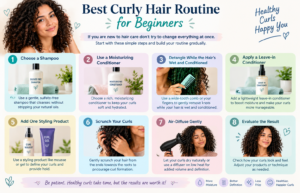
Step 1: Cleanse – Use a shampoo appropriate for your scalp and hair. Focus shampoo on the scalp. Let the lather move through the lengths during rinsing than aggressively scrubbing them.
Step 2: Condition – Apply conditioner throughout the hair. Allow it to sit according to the product instructions.
Step 3: Detangle – While Low‑porosity hair is wet and conditioned gently detangle with your fingers or an appropriate wide‑tooth comb. Start at the ends. Gradually move toward the roots.
Step 4: Apply Leave‑In – Apply an amount of leave‑in conditioner to damp hair.
Step 5: Define – Choose:
- Curl cream
- Mousse
- Gel
- . A combination based on your hair’s needs.
Step 6: Scrunch – Gently scrunch Low‑porosity hair upward to encourage curl formation.
Step 7: Dry – Allow Low‑porosity hair to air‑dry. Use a diffuser if appropriate. Avoid rough towel drying. The AAD recommends wrapping hair with a towel or T‑shirt rather than aggressively rubbing it dry.
Curly Hair Product Routine by Hair Type
| Hair Type | Shampoo | Conditioner | Leave-In | Styling |
| Fine waves | Lightweight | Lightweight | Spray | Mousse |
| Loose curls | Moisturizing | Medium | Lightweight cream | Gel |
| Medium curls | Hydrating | Rich | Cream | Curl cream + gel |
| Thick curls | Moisturizing | Rich | Cream | Curl cream + gel |
| Tight coils | Gentle moisturizing | Rich | Leave-in cream | Cream + gel |
| Dry/damaged curls | Hydrating | Intensive | Rich leave-in | Cream + gel |
How to Apply Curly Hair Products Correctly
Product application can make a difference.
Apply Products, to Wet Hair – Many curl products work best when applied while the hair is wet or very damp. This encourages curl clumping. Makes product distribution easier.
Use Sections – If you have dense hair divide it into sections. This helps distribute products
Don’t Overapply – Start small. Add more when necessary.
Use the Right Technique – Try:
- Raking
- Scrunching
- Praying hands
- Finger coiling
- Brush styling
Not every style will work with your curl pattern, though. I recommend trying out techniques until you find the look you prefer.
Common Curly Hair Product Mistakes
-
Using Much Product
More products does not always give better curls.
Excess product can build up. Weigh down the hair.
-
Using Heavy Products on Fine Hair
Fine curls usually need formulas.
-
Avoiding Conditioner
hair usually benefits from regular conditioning.
-
Brushing Dry Curls
Dry brushing can break up curl clumps. Add frizz and breakage.
-
Using Much Heat
Often and high heat on your hair may weaken the cuticle leading to dry, brittle hair. The AAD advice you should reduce the use of heat as well as use low or medium settings with use of heat protectant.
-
Ignoring the Scalp
Healthy-looking hair starts with scalp care.
-
Changing Products Frequently
Give a routine enough time to see if the routine works.
Changing products at once makes the change hard to see what is helping or causing problems.
How to Revive Curls When You Can’t Wash Your Hair
Hair washing isn’t the only answer when your curls are losing life.
Try:
- Lightly mist curls with water.
- Apply an amount of leave-in conditioner if necessary.
- Add an amount of curl cream or gel.
- Scrunch gently.
- Allow curls to dry.
Avoid repeatedly adding amounts of product every day.
If you continually layer styling products without cleansing buildup can eventually affect curl definition.
Curly Hair Care While Sleeping
Nighttime care can make your morning routine easier.
Consider:
- Satin or silk pillowcases
- Satin or silk bonnets
- Loose pineapple hairstyles
- Loose braids
- Loose twists
The AAD notes that reducing friction while sleeping can help preserve curls and reduce frizz and breakage.
Avoid tight hairstyles.
Excessive tension can contribute to hair breakage. Over time hair loss.
Best Curly Hair Products for Damaged Hair
If your curls are damaged from:
- Bleaching
- Coloring
- Relaxing
- Perming
- heat
- Mechanical damage
focus first on reducing further damage.
A routine may include:
- Gentle shampoo
- Rich conditioner
- Leave-in conditioner
- Occasional conditioning treatment
- Heat protectant
- Lightweight oil or serum
It’s best to try not to brush aggressively or use high heat too often for the health of your hair. It is also important to bear in mind that while products will make damaged hair look and feel healthier than if you used nothing at all, “damaged hair can never be cosmetically restored to entirely undamaged status.”
How to Know if a Curly Hair Product Is Working
A product is probably a match if your hair becomes:
- Softer
- Easier to detangle
- More defined
- Less frizzy
- More manageable
- Comfortable at the scalp
- Neither excessively greasy nor excessively dry
A product may not be suitable if you notice:
- Heavy buildup
- Greasy roots
- Limp curls
- Excessive stiffness
- Increased dryness
- Scalp irritation
- Persistent itching
But don’t forget that your products’ efficacy really relies on your whole ritual, not solely one ingredient.
How Curly Hair Products Do You Really Need?
You do not need a bathroom shelf of products.
A basic routine can be built with:
Minimal Routine
- Shampoo
- Conditioner
- Leave-in conditioner
- One styling product
Definition Routine
- Shampoo
- Conditioner
- Leave-in
- Curl cream
- Gel
Dry Curly Hair Routine
- Moisturizing shampoo
- Rich conditioner
- Deep conditioner
- Leave-in
- Curl cream
- Gel
- Lightweight oil
Start with the routine that solves your main problems.
Then add products when you identify a specific need.
Best Curly Hair Products: Quick Buying Guide
When choosing products ask yourself:
Is my hair fine or thick?
Fine hair usually needs products.
Thick hair may tolerate formulas.
Is my hair dry or oily?
Dry hair may need conditioning.
An oily scalp may require frequent cleansing.
Do I need moisture or hold?
Moisture comes primarily from water and conditioning ingredients.
Hold generally comes from styling polymers and gels.
Do I want volume or definition?
Mousse and foam can provide volume.
Creams and gels often provide definition.
Do I have buildup?
If yes, consider whether you need a clarifying wash and a simpler styling routine.
Is my scalp irritated?
If you have scalp symptoms consider professional evaluation rather than simply adding another cosmetic product.
Best Curly Hair Routine for Beginners
If your curls are dry increase conditioning.
If they are flat reducing products.
If they are frizzy experiment with hold and gentler drying.
If they feel coated, clarify and simplify.
In conclusion:
Best products for curly hair
What are the best curly hair products? The products that are not too expensive, most viral and heavily advertise?
They are the products that solve your hair problems.
If your hair is dry prioritize conditioning and moisture.
If your hair is fine choose formulas.
If your curls don’t have definition try using curl creams, mousses and gels.
If frizz is an issue focus on conditioners. Be careful what you do with your hair and the right hold when styling.
If your hair feels coated or heavy, trim down your routine.Think about using clarifying products sometimes.
Above all keep in mind that curly hair care is about being consistent of trying to be perfect.
A good curly hair routine should clean the scalp add moisture to the hair reduce rubbing and breaking offer the right support for styling and keep the curls safe from too much heat and bad weather.
Doctors who specialize in skin say that curly and tightly coiled hair needs care because it can be more likely to get dry and break. With the mix of products and methods you can make your curls easier to manage look better feel softer and look nicer overall.
Begin with a routine watch how your hair reacts and change one product at a time.
Your curls don’t need all the products that’re on the shelf.
They need the products, for your hair.