
 GoBeauty Bay
  Shaista Rafi
Beauty & Lifestyle Content Writer
in
Shaista Rafi writes reader-focused beauty
and lifestyle content for GoBeautyBay,
covering skincare, hair care, makeup,
personal care and everyday beauty topics.
Shaista Rafi
Beauty & Lifestyle Content Writer
in
Shaista Rafi writes reader-focused beauty
and lifestyle content for GoBeautyBay,
covering skincare, hair care, makeup,
personal care and everyday beauty topics.
 Mirza Ibrahim Ali Khan
Editorial Reviewer
in
Mirza Ibrahim Ali Khan contributes to
GoBeautyBay's editorial review process,
focusing on clarity, content structure,
topical relevance and reader usefulness.
Mirza Ibrahim Ali Khan
Editorial Reviewer
in
Mirza Ibrahim Ali Khan contributes to
GoBeautyBay's editorial review process,
focusing on clarity, content structure,
topical relevance and reader usefulness.
It can be tough to find a decent moisturizer for oily skin. Most people with oily/acne prone skin believe a moisturizer would make your skin greasier or clog pores and would thus cause more breakouts. They will thus entirely avoid moisturizer or opt to use something too drying/harsh.
Oily skin requires moisturizing regardless.
You need something light and oil-free which would make your skin feel comfortable and sooths to skin. Try to find out a moisturizer you fit in as far as possible. Lightweight gels, lotions, emulsions and non-comedogenic formula can generally work well for oily skin type, but depending on each person’s needs varies.
Moisturizer actually helps to promote skin barrier function, and improves comfort, reduced tightness induced by cleansing or allows sunscreen and makeup sit on skin more effectively.
In this complete guide you will learn which kind of moisturizer can better suit oily skin type, which ingredients are most suitable, which ingredients and texture will more or likely suit oily skin, how to properly apply moisturizer and basic skincare routines suitable for oily skin.
What Is Oily Skin?
Oily skin occurs when the skin produces more sebum, a natural oil which is naturally secreted by sebaceous glands. The purpose of sebum is to protect and to prevent dehydration of the skin, but excessive oil production will thus lead your skin to:
- Shining
- Greasy appearance
- Slimy texture
- Bumpy/uneven surface
- Potential clogged pores
Oily skin occurs either the whole face or only concentrated on certain part. Often oily skin appears on Forehead, Nose, Chin, cheeks etc. Oil can also appear on any area of skin, including under the eyes although this is rarer.
Oily skin may be innate or you can acquire it from circumstances such as your changing hormone cycles, temperature and weather condition, or genetic trait or environmental exposure (air pollution, humidity levels). Sometimes some certain medications or unhealthy lifestyle too contributes to greasy skin. You can have oily and dehydrated skin simultaneously.
What is the difference?
Oily skin has overproduction of sebum on the surface of skin but in contrast dehydrated skin lacks adequate water in the outer layers of the skin. So, oily skin needs a moisturizer.
Is Oily Skin Required to Use moisturizer?
There’s a great myth when we’re concerned about skincare — it is that oily skin does not need to use moisturizer. You are not correct. It is true that over-usage of inappropriate type of moisturizer will makes you feel discomfort, yet some people of oily skin do experience uncomfortable dry sensation or even more sensitive especially on their skin surface after cleansing and/or the use of certain active ingredients. In such cases applying a moisturizer can:
- Support the skin barrier
- Reduce dryness and tightness from skincare (or other factors)
- Ensure the skin’s soft nature is maintained
- Promote comfortable skin feel overall
- Reduce the temptation to over-compensate with dryness
- Allow cosmetic products application such as foundation and makeup smoother
- It cannot promote further excess oil secretion and make skin greasier after correct moisturizer application; alternatively, it is an essential aspect of a balanced skincare regime and helps complementing acne-focussed skincare routine for skin that aims to clear acne.
What Is the Best Moisturizer for Oily Skin?
There is no single one Moisturizer type suitable to ALL individuals with oily skin; the most ideal formulas vary and depend on your oil-levels, skin-sensitivity, acne concerns, climate, age, condition of the skin barrier and preferred cosmetic look, etc. Nevertheless, for people with oily skin, lightweight moisturizers serve as a good starting point. Here are some types of moisturizers that you can check on the labeling and packaging:
- Light weight moisturizer
- Oil free
- Non-comedogenic
- Gel based
- Water based
- Lightweight lotions
- Lightly concentrated formula
- Fragrance-free if you are prone to sensitive skin
Again product labels can only be taken as a guideline, it is only how your skin react will tells you if it is truly suitable.
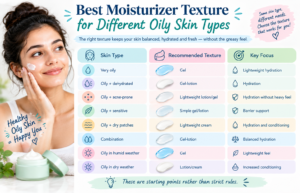
Gel Vs. Cream Vs. Lotion: Which one for oily skin?
Texture of the moisturizer could directly impact comfort of the skin oily skin type:
Gel moisturizer
Gels moisturizers tend to be light, water-based texture which many people with oily skin will particularly enjoy it so much. Gels will never clog your pores and will not create greasy feeling. Gels could be very helpful for:
- Oily type skin
- Combined oily type skin
- humid region
- Those with dislike for heavy creams
- daytime routines
The water-based properties are efficient in making you feel a bit more plump without excessive product.
Lightweight lotion
Lotions tend to be a tiny bit richer in conditioning ability compared to gels so much. Therefore, if your skin is oily and dry at the same time, or it’s very sensitivethe time you are on active treatment, it could be useful to use moisturizer of this type. Or for dry cheeks while T- zone is oily.
Cream moisturizer
Creams, the richest formula of all moisturizers, are not automatically excluded. The key are those “lightweight” ones. Really rich formulas could potentially clog pores of some oily-type skin and not suit you very well. Otherwise, if skin barrier looks weak and dry, or you do experiences patches of extreme dryness despite having a T-zone and cheeks combination, using a cream might be the best solution for your skin.
Water based moisturizer
Water based moisturizers are widely praised among people who have oily or combination type skin for their lightweight and comfy finish of application. Usually consists of mostly of water combined with active hydrators and emollients like hyaluronic acid or glycerine.
Top beneficial ingredients for a moisturizer for oily skin:
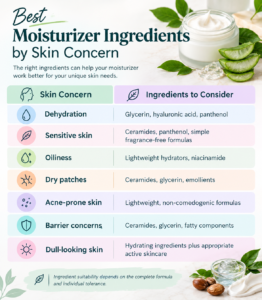
When shopping for a moisturizer that would be appropriate for your skin, you’ll generally be searching for ingredients that hydrate the skin in a nongreasy, heavy way and looking at the list of ingredients will yield much better information about the ingredients than will the description on the product itself.
Hyaluronic acid:
Hyaluronic acid is a humectant, meaning that it will pull moisture from the air around it and from deeper within your own skin to bind itself to your skin. Due to the immense amount of moisture it will hold, HA is a good one for your consideration should you skin be feeling dehydrated while also still being oily; Hyaluronic acid encourages hydration without concentrating heavy oils.
Glycerine
Glycerine is also one of the most universally used humectants in skin care products; it moisturizes and smooths skin and you will recognize its hydrating nature in the right texture if you want something not overly creamy, like, some HA serums have it.
Niacinamide
niacinamide, a B vitamin also known as niacin, or vitamin B3, is one of those “do-it-all” ingredients and one of the key ingredient for oily and blemish-prone skin type in various product formula which supports the skin barrier, and its inclusion often aimed to targets concerns such as the signs of uneven tone or over-oilyness; always remember to introduce it slowly if you have very sensitive skin and carefully monitor its affect on your skin.
Ceramides
ceramides are long fatty acids that form lipids on our skin barrier; it can assist repair skin barrier thus it is a valuable ingredients if your oily type skin is showing signs of becoming dry and sensitized, also it can be helpful when you are using drying, or very harsh acne treatments and products which strips oil and water on the skin surface.
Panthenol
panthenol can be beneficial for sensitive or dry skin to provideconditioning to the skin with their lightweight and water absorbing qualities.
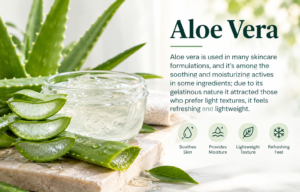
Aloe vera
Squalane
Squalane is a very popular emollient found in so many lightweight skincare products nowadays; even though squalane is related to natural squalene the sebum produced by human skin, it does not create a greasy and heavy feeling on skin, but its effect on oily skin would depend greatly on a formulation as well as the skin type of individual user; consider it for testing if you are comfortable trying the ingredients.
Oily Skin: Oil-Free Moisturiser or not?
Oil-free moisturisers could be suitable for you if you just don’t like a greasy feel on your skin or become oily quite quickly.
However, oil-free does not automatically mean better.
Some oily skin types tolerate lightweight emollients very well.
Of avoiding every oil or lipid-containing ingredient consider the complete formula.
Ask:
- Does it feel heavy?
- Does it absorb comfortably?
- Does it cause congestion?
- Does it leave shine?
How does your skin feel all day long? So ‘Oil-Free’ isn’t the absolute way either – you want something your skin is content to carry with it for the entire day!
What exactly does non-comedogenic mean?
This is something you will often hear described in moisturisers to combat acne-prone skin. It is a product, that has been formulated not to clog the pores-and in theory at least this cannot promise.
People can respond differently to skincare products.
If you are particularly acne-prone introduce products gradually and avoid changing several products at the same time.
Best moisturizer for oily and breakout-prone skin:
If you have oily skin that also tends to break out your moisturizer should preferably be
- Lightweight
- Non-comedogenic
- Easy to layer
- Appropriate for your skin sensitivity
Try to ensure the formula contains a good percentage of hydrating agents, such as:
- Glycerin
- Hyaluronic acid
- Panthenol
- Ceramides
• Niacinamide
Acne prone skin doesn’t need to be dehydrated.
Moisturizer added to routine if the acne treatments dehydrate your skin.
Top Moisturizer for sensitive skin
Oily skin can be sensitive too.
If you experience:
- Burning
- Stinging
- Redness
- Tightness
- Itching
- Irritation
You might opt for a milder moisturizer:
What “sensitive skin” Moisturizers can be like:
- Fragrance-
- Alcohol-free or formulated without potentially irritating drying alcohols
- Minimal in unnecessary ingredients
- Barrier-supportive
- Lightweight
You can also patch test new products.
Moisturizer to use when your skin is dehydrated Best Moisturizers to hydrate your skin.
This is also a dilemma to an oily and dehydrated skin person choosing a moisturizer.
You may notice:
- An forehead
- Shiny cheeks
- Tightness after cleansing
- Flaky areas
- Makeup settling into dry patches
- A rough skin texture
In this situation aggressively removing oil may make the problem feel worse.
Instead focus on hydration.
Try a moisturizer containing humectants such as:
- Glycerin
- Hyaluronic acid
- Panthenol
The same also goes when it’s about to repair skin barrier. Think of ceramides if the skin barrier needs some boost up too!
Recommending summer oil-free moisturizer?
Oily skin and humidity not good combination, more greasy feeling.
During summer you may prefer:
- Gel moisturizers
- Water-based formulas
- Lightweight lotions
- Absorbing products
You may also realize you require a lot less moisturizer than you did during the winter.
You should not abandon moisturizing.
Apply an amount and adjust according to how your skin feels.
Importantly use sunscreen during the daytime.
Top Oily Skin Moisturizer in Winter
The dry weather may transform your oily skin. Your oily skin can sometimes be dry or inflamed. During winter an emollient and thicker moisturizing cream can be applied.
A lightweight cream containing:
- Ceramides
- Glycerin
- Panthenol
- Hyaluronic acid
- Other skin-conditioning ingredients
may be more comfortable than a lightweight gel.
Adjust your moisturizer according to your skin than following the same formula year-round.
How to Choose Moisturiser for Oily skin?
Tick this chart before you buy!
Step 1: Test its consistency
Select cream gel, light cream or lotion!
Step 2: Focus on the Problem
Are you primarily concerned about:
- Oiliness?
- Acne?
- Dehydration?
- Sensitivity?
- Uneven texture?
- Dry patches?
Choose accordingly.
Step 3: Consult the ingredients list.
Look for any ingredients that hydrate the skin and support the barrier
Step 4: Consider Your Other Products
If you already use hydrating or active products you may not need an extremely rich moisturizer.
Step 5- Begin
Introduce new products slowly and in order that you can see if it helps you.
How to moisturize oily skin
application is simple.
Morning
- Cleanse your face gently.
- Apply any treatment products.
- Apply moisturizer.
- Finish with sunscreen.
Night
- Remove makeup and sunscreen.
- Cleanse your skin.
- Apply treatment products if part of your routine.
- Apply moisturizer.
You do not need an amount.
A thin even layer is generally sufficient.
If your skin still feels dry you can adjust the amount than immediately changing products.
Is it necessary to moisturize damp skin?
Using some moisturizers on damp skin may indeed help prevent loss of moisture from the surface of your skin.
But you don’t have to use moisturizer immediately after every wash.
Apply the moisturizer in accordance to its use. Discover the one that agrees with your sense of touch
How Moisturizer Should You Use?
Using little may leave your skin under-moisturized.
Using much can leave oily skin feeling unnecessarily greasy.
A small amount spread evenly over the face is usually a starting point.
You can adjust based on:
- Product textur
- Skin size
- Climate
- Time of day
- skincare products
You want comfortable coverage not heavy saturation.
How much and how often should you moisturize your oily skin?
For most it can and should be done at least once to twice per day depending on your schedule and skin’s needs. Applying moisturizer in the morning will also aid in preparing the skin for sunscreen application and makeup. Your nighttime moisturizer will offer protection and moisture as well.
Since oily skin can be very oily over the course of the day this does not necessarily mean you have to avoid moisturizing on an on-going basis.
Instead, look at reformulating what your using currently, as that perhaps it is a bit to nourishing for your skin type.
Will my oily skin become greasier by moisturizing?
Applying a moisturizer to your oily skin doesn’t necessarily mean it will create more sebum in the skin. However, an over rich and occlusive or wrong formula for you, will more then likely make your skin feel and look more greasier then it already did.
You don’t necessarily have to stop moisturizing but as mentioned before in the above section, it’s about how it makes you feel and appear after you have moisturized.
Use a smaller amount
Try something lighter
Switch from a cream to a gel formula
Look at the rest of your skincare regime
Do not try to layer too many rich products on the skin
Does moisturizer cause acne?
This is a very common myth! Moisturizer in and of itself does not cause acne.
You want comfortable coverage not heavy saturation.
How much and how often should you moisturize your oily skin?
For most it can and should be done at least once to twice per day depending on your schedule and skin’s needs. Applying moisturizer in the morning will also aid in preparing the skin for sunscreen application and makeup. Your nighttime moisturizer will offer protection and moisture as well.
As oily skin can become extremely oily throughout the day, this doesn’t necessarily mean you shouldn’t moisturize throughout the day.
Try re-evaluating your current moisturized as it might be a bit too rich for your skin.
Some products may be unsuitable for acne- individuals and certain formulas can contribute to congestion, for particular people.
If you see breakouts after you start using a moisturizer:
- Stop the product if the reaction is bad.
- Go back to products that your skin already likes.
- Introduce products individually.
- You could try visiting your doctor or a dermatologist if you have very persistent acne.
- If you are prone to clogged pores, due to acne it is best to use products that are non-comedogenic.
Oily Skin and Night Creams-Can I still use or one?
Yes, but you probably don’t need to invest in a rich and thick moisturizer! If your oily skin is settled and in balance there should be no need for separate daytime and nighttime moisturizers, your light daytime one should cope well in the nighttime, too. If your oily skin should become irritated or dry, an additional nurturing nighttime moisturizer will be good, then. What works for oily skin depends more on its condition than on the marketing as “night cream.”
Oily Skin and Facial Oil-Should I use it?
Oily skin may be able to tolerate facial oils, but you don’t necessarily need to use them if you’ve found a good day-time moisturizer. However, if you want to give facial oils a go, make sure to start with an extremely small amount and see how your skin reacts. People with acne prone skin particularly should use extreme caution when adding more occlusive/oily-rich products.
Oily Skin-Moisturizer to use before makeup?
The right moisturizer should help makeup lay better on skin and avoid looking streaky or cakey. Use an ultra-light formula that: Absorbs easily Is comfortable on the skin Doesn’t leave excess residue Doesn’t pile when combined with sunscreen Does not feel heavy underneath a foundation Wait a few minutes for all your skincare to absorb completely before applying makeup. If foundation looks especially greasy it might suggest your moisturizer or even your sunscreen is too rich.
Oily Skin-Moisturizer to use before sunscreen?
Your sunscreen should always be the last layer of your morning routine. Depending on your sunscreen, the moisturiser may not be strictly necessary if the sunscreen contains enough moisturizing elements. Alternatively, if the SPF is mattifying and drying, a light layer underneath will be beneficial. Some of the modern sunscreens really are quite moisturising and may be so hydrating that only the thinnest layer is needed.
Oily Skin Routine-How do I manage it?
Let’s break down what may be a simple yet affective skin care routine: Morning Routine: Gentle cleanser Followed by treatments as desired. Followed by a lightweight moisturizer. Followed by SPF.
The evening-or bed routine- cleanser takes away sunscreen, makeup, and oil- followed by treatments that are desirable
Followed by a suitable moisturizer. What combination of products in the routine and what treatments suit oily skin skin will however still differ depending on its needs, like with all skin types.
Moisturiser and ACNE Treatments:
Some acne treatments commonly prescribed by dermatology doctors can leave the skin feeling: Tight and dry Peeling irritated and raw This will most definitely be made better by adding moisture back into skin; especially gentler formulations. While moisturiser is not effective when used in place of appropriate acne products, its inclusion can really improve skin’s comfort while using targeted formulas. If you’re dealing with painfully cystic or scarring acne, please see a qualified professional as we can’t assist beyond what general products can offer.
Oily Skin and large pores-which moisturiser should I use?
As your pores aren’t something that can grow smaller, your aim isn’t to find a pore-closing moisturiser (no such thing). But in providing the skin with balanced hydration, and the correct skin care products the larger pores may look smaller as the skin becomes much more balanced. The skin care routine should be holistic; no moisturiser can “close pores”. Certain cosmetic ingredients have risen in popularity for both acne prone and oil control skin types like Niacinamide.
Oily Skin and BLACKHEADS- Any moisturiser recommendations.
These are a type of pimple formed when skin cells/sebum become lodged within the pores. Moisturiser will never solve the blackhead problem however, a good cleanser along with an exfoliant (e.g containing salicylic acid) might assist. Your moisturizer will, however, help your skin and the treatments needed stay comfortable as this condition can cause it to be dry, irritated and red. Cystic acne like blackheads cannot be removed in the same way as regular spots and will need to be examined by a health care professional.
Oily Skin and WHITEHEADS. What moisturiser to use?
These’ closed pores’ are sometimes called ‘come domes ‘ however they are different in the sense that they become inflamed; cannot be squeezed or popped. If you are having persistent outbreaks, you need professional treatment to ensure skin looks clear and well. Over-exfoliation is very bad for inflamed blemishes, while gentle cleansing and moisturizing coupled with treatments may alleviate discomfort for oily prone breakouts.
Top Common Mistakes people with oily skin make regarding Moisturiser.
Skipping moisturizer. Oily doesn’t mean ‘hydrated’ your skin might still need to supplement. Extremely rich creams. If you have an oily complexion, heavy creams will feel unpleasant against your skin and will clog up pores, causing increased breakout problems. Using too much product. More means better, right? Not always with moisturizer as all you may be doing is piling the product onto skin making it too greasy. Over- layering of skincare products. Combining too many treatments and creams might be too much for you skin to absorb in one sitting leaving your face glistening and flaky. Compromised skin barrier. Ingredients like salicylic acid and Vitamin C can weaken skin barrier; listen to your skin and apply moisturizer to soothe it. Solely looking at oil free products. They may work, but they are not the magic wand that every oily skin type needs. Changing your routine too often. Unless skin is sensitive or a product isn’t working for you, stick with it for a few weeks to see how your skin can truly benefit or negatively react. Forgetting SPF. Never use moisturizer as a substitute for sunscreen, particularly with oil free ingredients or acne treatments.
Oily Skin Is Not Dirty Skin!
This is a huge misconception: a few people believe oily skin requires aggressive cleansing to remove all of its natural oils. Not true: oily skin may look a little greasy, but it doesn’t need to have every oil removed since sebum is essential for protecting and maintaining your healthy skin. Over cleansing your skin to strip it of oils leaves your skin feeling tight, dry and irritated instead. Your target should always be healthy skin rather than oil-free skin.
Reducing Oil Shine in Oily Skin:
If excess shine is the main thing, you are worried about: Morning: Gently cleanse your face and apply your daily moisturizer then a high SPF moisturizer during the day. During the day: If the skin becomes too shiny dab away on excess surface oil with blotting paper instead of rinsing your face throughout the day. Make-up: Consider applying a water-based foundation with a light coverage or even mineral foundation or powder to help make-up last longer and look less heavy. Avoid reapplying powder regularly, in the hope of avoiding skin becoming oilier during the day.
Trying a new moisturizer Before you change from the moisturizer you use every day and switch it for a new one, test a small amount of product onto an area of the skin. “A small pea sized drop onto a little test area,” says Dr. Perisho.
Patch test by leaving this on the skin and monitoring it over the course of a day or two. Watch for increased amounts of burns irritated reddening blackhead accumulation pimples and break outs
If reaction is quite dramatic then obvious discontinue, “as Dr Perisho points out. People who suffer from very sensitive skin that is irritable and reactive may do very well and find benefit of talking to their dermatologist before they start layering too many new products to treat skin.
So When will I start to notice my moisturizer is working?
Benefits of moisturizer in connection with hydration ” you might already be seeing” relatively quickly; Dr Perisho says to notice slightly less softness, less tightness on the skin, skin has smoothed itself out and is now more comfortable
Usually “most moisturizers are not going to improve acne, darker pigmentation, wrinkled skin or any inflammatory conditions on your face and that part is dependent on the active ingredients and whether the routine contains ingredients necessary in order for them to work long term.
Can men use moisturizer for oily skin?
Yes! You as a man have no gender barrier on what is or isn’t acceptable for oily skin. Any lighter formulator can do just fine; more it is “concerned and what types of ingredient there is in addition to textures someone is tolerant to” that determine if they are using best for oily skin, “shaving of the skin is an irritant, for people who do need to shave their face and find a smoother result”, a moisturizing product including a lotion/light moisturizing cream would provide added comfort.
Should Teens use a moisturizer too with oily skin?
Definitely! For teens with oily skin, they should maintain simple basic routine:1. Mildly cleansing product 2. Light moisturizer 3. Sunscreen. “You’ll add active ingredients if acne needs treatments”. Teenage users with sensitive skin will see that acne ingredients help both concerns. In this instance, there is NO “big ole stack” of ingredients to consider.
Spending the Most Luxurious Moisturizer at a Small Price for Oily Skin?
“Good moisturizers are not overpriced,” Dr. Perisho says of moisturizing oily skin. “Look for comfortable texture basic hydration, The consistency when applied, the ingredients You’re tolerating that is non-comedogenic is recommended If you’ve been breaking out with blackheads.” “Spend money on those ingredients because it uses some fashionable ingredients, however. It should be applied regularly the long-term skin beneficial moisturizer,” she says. For a natural moisturizer for oily skin the following are some commonly used natural-leaning moisturizers, namely;
jojoba oil the following oils the following plant-derived extracts the following plant extracts such as aloe vera, plant milks Shea butters Plant butters, “You should not assume the ingredients derived from plant are necessarily better or safer.” said Perisho “because plant-derived extracts can irritant and damaging some persons.
” Natural does not promise safety. You should pay more attention to the product itself and formulate it regardless of whether it is natural or synthetic. With regarding to Selecting the moisturizers for oily skin There are not any certain products you need to actively run away from “However, said Dr. Perisho be sensible to the product.
If you think that your skin will experience problems after applying extremely heavy formulations If you feel comfortable with it the use of extremely dense emollient ingredients and products like a slog must be avoided
Any product which has been applied and result in a damaged and plugged skin must not be used again.” Moisturizer Daytime moisturizer and night moisturizer you may want to use a same product both in day and night; otherwise use different products given below:
Daytime Moisturizer you need to apply a gel; the gel-lotion, a non-sticky fast absorption cream on your skin in the day to layer suncream on your face safely.
Night Moisturizer you can apply either light lotion, a gel-cream or thick emollient moisturizer for night application.
Will my oily skin need a hydrating serum?
Simply put yes! But as experts in hydration, they will tell you “You don’t need to. If you’ve been feeling like you are “hydrating great with” your humidifier, then it may do us no good to apply hydration to our serum. Just “enjoy it all at once,” or whatever works for you!
Moisturizers for Oily Skin: A Basic Routine
Start out using: 1 cleanser 2 moisturizer 3 sunscreen
If your face feels comfortable, continue! If it still feels like something is missing, feel free to add something based on the specific concern you have and your needs! It can be frustrating “my skin’s condition has been great,” “it’s going to be awful.”
However, getting “confused” will leave your routine looking messy, and “less is more.”
When your face feels sticky and gunky 24/7, then your skin can really become “hard for myself to assess the effectiveness of my.” skincare
When your moisturizer is too much:
Notice when you see a lot more shininess than you are used to, or feel the residue is a bit much. As well, you could notice that “your foundation simply does not look right on,” your face and your skin feels much more prone to clogged pores and acne. Especially if you’ve been feeling “grosser in warmer climates.” They ” recommend trying gel-cleanser and gel-moisturizer or lotion” (1, 2).
Does the skin “feel tight” after you apply moisturizer?
Does your skin have-
- Flaky patches
- Rough texture
- Areas that are painful after you cleanse your face
- Don’t cope well in warmer weather?
Signs and symptoms “you are using the right amount and product if your skin appears radiant, is not tight feeling and if there are minimal flaky patches” (2,3). The Best moisturiser for you depends ‘wholly on you, Dermatologist ‘tries’ to give some blanket answers as best as they can for general needs’. Needs such as…
- Have your oily skin and also get a breakout, sensitive to it?
- Have your oily skin, but have areas where it’s dry?
- Consider your seasonal differences.
Key questions regarding moisturiser for oily skin
Should I moisturise oily skin?
Absolutely! Oily skin still needs hydration and using the right moisturiser can really help support and comfort your skin barrier and shouldn’t make you feel greaseball like.
Which moisturiser should I use for oily skin?
This really comes down to skin but as general rule, light gel and water-based moisturisers, or lotion based options are safe, or a cream with a higher richness factor for oily/dehydrated skin.
Are gel moisturisers good for oily skin?
They are perfect! Especially in warm/humid weathers as it’s always nice to have light gel-based moisturiser on your skin.
Is an oil-free moisturizer essential for oily skin?
If you’re going to use the right texture of moisturizer you could use one that contains a small percentage of oil but what it boils down to is the way the product is constructed and its performance. An oil-free moisturizer is a safe bet though and good for an ultralight feel.
Can the right moisturiser make oily skin worse?
Normally, moisturising a normal to oily type skin shouldn’t encourage oil production since it has a neutral fat content (fat in moisture doesn’t contribute directly to oiliness of the skin). Use an appropriate formula and your skin will enjoy it: overly rich ones can lead to a greasy feel and appearance.
Can oily skin types use cream moisturizers?
Yes oily skin type CAN use a cream moisturizer if its experiencing dryness and irritation or it has dry patchy areas. Avoid too rich options and opt for slightly higher ones.
Is moisturising beneficial for oily and breakout prone skin?
Lightweight, non-comedogenic moisturisers will benefit blemish-prone skin greatly. Your skin barrier needs looking after at all times of skin type, and the dryness from acne treatments can require a good cream.
What moisturising agents work for oily skin?
Some great ingredients are niacinamide, hyalyronic acid, panthenol, ceramides, glycerin but ultimately depends upon each specific skin type.
Will oily skin types handle the inclusion of Hyaluronic Acid well?
Yes. HA is a humectant which draws water into the skin and it is a greatly popular ingredient.
Will a niacinamide formula really benefit oily skin types?
Niacinamide formulas have very widely been accepted for oily/blemish prone skin types and skin barrier integrity. Individual response to the formula may differ slightly.
Can oily skin types moisturise at night?
Sure, light formulas are beneficial throughout the day.
How often do I moisturise oily skin?
Most will use moisturizer either once or twice day and may include morning and night application but use depends on whether you climate your climate of origin, your specific skin type and your cleanser routine, for example.
What sort of moisturizer for oily skin types is best in the summer months?
For summer a very light gel or gel-cream would give much comfort, with none of the weight if desired for oily skin types.
What type of moisturizer should a dry, but oily type use in the winter?
An oiler cream or a richer gel formulation or even thicker gel cream would benefit it, if the skin barrier starts to show signs of tightness dryness in winter.
Does moisturizing reduce oily skin?
Monostearic acid etc, and not fatty acid have no direct effect on controlling oil in the skin’s normal operation. Supporting this the barrier allows the skin feel like its not dry and less of an oil produced to “compensate”.
Should oily types wear a sunscreen if moisturizing oily skin types?
Yes there is nothing inherent in moisturizers which offers adequate protection for skin for the summer/any time of the day! Sunscreen is essential in every instance regardless.
Is moisturizing appropriate for teen oily skin types?
Yes, simple routine for the adolescent with oily skin includes cleaning, moisturising and sunscreen application. Extreme conditions require seeing a doctor.
Final thought for your oily skin moisturizer of choice.
The goal of oily skin + moisturizers is to adequately hydrate while not adding any more oil to your skin. There’s no need to eliminate a moisturizer altogether but instead try to find one that will suit your skin as best as possible by giving it what it needs. Lighter gel based, lotions, and water based are a good start. Key ingredients that will strengthen the skin barrier are Glycerine, Hyaluronic Acid, Niacinamide, Panthenol & Ceramides. If oily and acne prone, oil-free, non-comedogenic cream!
Use gentle and simple formulas for oily & sensitive skin. Oily & dry skin will do better with formulas that retain moisture and should avoid the emphasis on stripping skin from the oils it already has in abundance.
Most importantly, don’t just buy something just because it has “oil-free” written on it, check how your skin feels after application as well as all through the day.
Good moisturizer will leave you with a comfortably balanced skin and not tight or very oily. Maintain a minimalistic approach to your routine. Don’t make drastic changes but gradual, observe and adjust depending on season, surroundings and your skincare routine to meet your skin changing needs.
A balanced, healthy face with an oily skin type doesn’t necessarily have to look entirely matte; having a well-supported skin barrier and adequately treating your conditions would be the perfect scenario.