
 GoBeauty Bay
  Shaista Rafi
Beauty & Lifestyle Content Writer
in
Shaista Rafi writes reader-focused beauty
and lifestyle content for GoBeautyBay,
covering skincare, hair care, makeup,
personal care and everyday beauty topics.
Shaista Rafi
Beauty & Lifestyle Content Writer
in
Shaista Rafi writes reader-focused beauty
and lifestyle content for GoBeautyBay,
covering skincare, hair care, makeup,
personal care and everyday beauty topics.
 Mirza Ibrahim Ali Khan
Editorial Reviewer
in
Mirza Ibrahim Ali Khan contributes to
GoBeautyBay's editorial review process,
focusing on clarity, content structure,
topical relevance and reader usefulness.
Mirza Ibrahim Ali Khan
Editorial Reviewer
in
Mirza Ibrahim Ali Khan contributes to
GoBeautyBay's editorial review process,
focusing on clarity, content structure,
topical relevance and reader usefulness.
Among all the products that comprise a makeup routine, a foundation is one of the biggest pieces and, strangely, one of the hardest to get right. There are literally hundreds of foundations-different finishes, formulations, coverage levels, shade matches, so why is it so much trickier than simply selecting a color in the bottle? When you’re trying to buy a foundation, you need to have in mind: your skin type, undertones, skin concerns, your lifestyle, how you typically wear makeup, as well as the kind of finish you want.
Because a foundation that looks flawless on someone with dry skin could turn greasy on the same person with combination skin, or a mattifying finish great for your wedding could look heavy as your daily wear.
Whether it’s your first brush with foundation or a quest to enhance your current look, we’ve covered it all from finding your shade and decoding undertones to natural application techniques and tips for make it last.
Why Is Foundation Important In Makeup?
Foundation is the basis of so many makeups looks. But apply that right, you’ll then get an evener platform to begin applying concealers, blusher, bronzer, contour and highlighter etc. It is by no means meant to get rid of absolutely all your skin.
One of the biggest foundation mistakes you can make is to assume more is always better.
When foundation is over-applied, it can accentuate lines, dry patches, large pores, texture, flakes, expression lines, and shine. One swipe of the right formula and you’ll look more polished than you would layering a completely wrong match in heavy coats.
Skipping Foundation When You Want A Polished Look
You may not wear foundation every day, and that’s totally normal! But for an event or for professional photos or whenever you want a more refined even and just overall polished look for your makeup skip on your foundation may do just more harm than good to your makeup look and make the makeup over top blotchy and uneven.
Choosing The Right Foundation
To simplify, there are five main types of foundations to consider, and these make choosing the right one for you simple: Skin Type, Skin Tone and Undertone, and the amount of coverage you want and the finish. Look at your lifestyle. A quick and dirty 5-minute routine necessitates an entirely different foundation formula than wedding makeup meant to last 16 hours straight.
Foundation For Different Skin Types
How your skin responds to various foundations is critical in the selection process.
Foundation For Dry Skin
Moisturizing &/or skin-like finishes are a great option for dry skin. Pay attention for words and phrases that include hydrating, moisturizing, luminous, dewy, radiant and skin-like finishes when seeking a product. Foundations that have a very matte finish may emphasize patches of dry skin.
If you have very dry skin, take adequate time to “buffer” the skin with a rich moisturizer before applying foundation; pressing foundation too quickly onto thick moisturizer may cause pilling.
Best application method for dry skin: A damp makeup sponge or soft brush will ensure you can apply the product in thin layers without having to go back and forth over the same area excessively.
Foundation For Oily Skin
A good base for an oily skin should allow you to apply makeup without feeling caked up. Use any of the following types of formulas: transfer resistant, long-wearing, oil-controlling, Matte, soft matte, natural matte, or powdery finish. A thin layer of trans-proof, setting powder under where makeup is typically placed (forehead, nose, chin) will help a foundation wear throughout the day without excess shine-but don’t feel the need to totally flatten out the skin-a hint of dimension will keep skin looking more natural.
Foundation For Combination Skin
Combination skin presents a challenge to foundation application since areas of the face behave differently. For oily T-zone concerns and dry cheeks, it may be best to apply a moisturizing preparation to the dry sections of skin, an oil-controlling primer to the oily sections and apply a lightweight formula all over, topped by powder in needed spots. This strategy ensures more-balanced application of all formulas.
Foundation For Normal Skin
Your foundation preferences won’t likely be as governed by the needs of a skin type. Perhaps you will find experimenting with the skin-like, satin, dewy, matte, medium, full or light coverage formulations the most enjoyable depending on your makeup day and aesthetic!
Foundation For Sensitive/Reactive Skin
If you’ve sensitive skin or one that is highly reactive to products, keep your formula relatively simple. Introduce one new product at a time to see which, if any product makes your skin irritated. Stop using the product that causes irritation/ redness repeatedly and contact a board certified cosmetic or medical dermatologist for chronic and / or severe reactions.
Understanding Skin Tone and Undertone
Confusion over whether to select foundation that closely matches skin tone or undertone is probably the most significant cause for foundation shade match mistakes!
Your Skin Tone
Refers to the overall lightness or darkness of your skin color.
Your Undertone
Is the subtle colour that lies just beneath the skin.
- Cool
- Warm
- Neutral
- Olive
How To Find Your Foundation Undertone
There is not a universal solution when it comes to discovering your skin’s undertone, but here are a few ways to get a general sense:
Check out your skin in natural lighting. Your face’s hue may look significantly different under indoor lights than outdoors! Stand near an uncovered window for a look at the real you without any artificial glow.
How much do your favourite jewellery pieces flatter your skin tone?
Often the appearance of gold complements yellow and peach hues in warmer skins, and the gleam of silver works wonders against pink and reddish-blue complexions. Although a jewellery colour match is not a definitive guide to skin undertone-it’s a good place to start as a point of comparison!
Notice the colour of your actual skin. While many refer to the colour of their wrist veins to indicate their undertone (e.g., blue or green means cool, while visible green often points to warm undertones) this isn’t an entirely accurate measurement for foundation shades, which are based more on visible skin pigmentation and colour across the entire complexion. Your face may look a bit red, or your darker skin tone may obscure this sign from notice.
How To Find Your Perfect Foundation Shade
The best, most natural looking way to find your foundation shade? Remove those wrist swatches; your hands’ skin is likely a different hue from your face and can be misleading. Test foundation colours along the jawline or up the side of your neck for the best, most natural foundation and face shade match-as that space most resembles the tone of the bulk of your face and can help to see if a shade is looking pink, yellow, golden, or too Gray. Allow your foundation a few minutes to ‘dry down’ because many foundation formulations darken as they absorb into the skin.
Should foundation match your face or neck?
Ultimately, your foundation should match your overall complexion in the areas of both your face and neck-since these areas can appear a few shades different because of factors like hyperpigmentation, rosacea, sun damage or simply how the light hits those areas. The skin of your face can often appear darker or redder in appearance when compared to the skin of your neck and if you choose foundation shade by match alone the product may be either too red or too deep. Use your eye to judge if a colour matches well in the natural light or to compare your face colour to your neck tone as a guide.
What does foundation coverage mean?
In the simplest form, foundation coverage is determined by the amount of your actual skin colour that shows through. Coverage can generally be categorized into four levels.
Sheer Coverage
Sheer formulas create an even complexion by allowing natural skin to shine through and only faintly colouring, or obscuring to an extent, any imperfections like redness, minor discolorations or a sallow complexion. Generally, the ideal option for no-makeup makeup. These are often appropriate for all skin types.
Light Coverage
Lightweight-coverage foundation works to gently even out redness, tone, and a lack of radiance without fully covering it. The finish is usually natural and the complexion looks improved, not masked.
Medium Coverage
The medium coverage Foundation evens skin tone and reddening visibly; although it’s not totally clear. Majority of the medium coverage Foundations is buildable, which means that you could apply the foundation two or three times over if more coverage is needed.
Full Coverage
Full coverage Foundation offers opacity, camouflaging anything from significant discoloration to acne to hyperpigmentation. Full Coverage Foundation may also be utilized in professional photographic or video environments. Full Coverage foundation does not necessarily appear cakey or heavy and can still have a smooth and skin-like texture if formulated properly and applied meticulously.
What Is Buildable Foundation?
Buildable foundation means applying an amount at a time to slowly build coverage.
Of putting a thick layer all over start with a small amount.
Then add product only in spots that need more coverage.
This makes the skin look more natural because places that need coverage stay light.
Foundation Finishes Explained
Foundation finish tells how the makeup looks on your skin after you apply it.
Matte Foundation
Matte foundations have little shine.
They are often chosen for skin and for makeup that lasts long.
However a very matte formula can make dryness or texture stand out if the skin is not properly prepared.
- Dewy Foundation ( fresh look ) best for skin type: Dry and normal Skin good for you want the glowing effect
- Satin Foundations Satin has the right balance of matte and dewy. They achieve a beautiful skin-like look that typically suits you best during your daytime looks.
- Natural Finish Foundations Natural finishes attempts as closely as possible look like skin and never appear too dry nor too overly shiny.
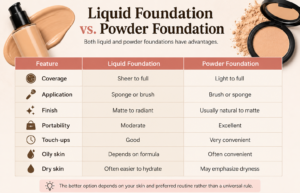
Liquid Foundation vs. Powder Foundation
Cream Foundation
Cream foundations usually feel richer than liquid formulas.
They can give medium to coverage and are often liked for:
- Mature-looking skin
- Glamorous makeup
- Photography
- Dry skin
- Special occasions
Because cream formulas can be thicker careful application is needed.
Stick Foundation
Stick foundations are small and handy.
They can be:
- Easy to travel with
- Simple to apply
- For targeted coverage
- Buildable
You can swipe a small amount straight onto the face and blend with a brush or sponge.
Avoid putting stripes all over the face unless you really want heavy coverage.
Serum Foundation
Serum foundations usually feel light. Aim to give a natural look.
They appeal to people who do not like the feel of foundation.
Coverage changes a lot between products so always check the formula.
Cushion Foundation
Cushion foundations come with a sponge- cushion that holds liquid makeup.
They are popular for:
Quick application
Travel
Touch-ups
Lightweight makeup
Their coverage can go from light to fairly heavy depending on the product.
Mineral Foundation
Mineral foundations usually use mineral ingredients.
They can be loose or pressed.
People with skin should still read the ingredient list because “mineral” does not guarantee the product will suit everyone.
Foundation vs. Skin Tint
Foundation usually gives coverage and correction than a skin tint although the two can overlap.
A skin tint usually prioritizes:
- Lightweight texture
- Natural skin appearance
- Sheer coverage
Foundation is usually better when you want control over coverage. Neither is automatically better.
Foundation vs. BB Cream
BB creams mix coverage with skincare or cosmetic benefits depending on the product.
They usually give coverage than regular foundation.
Choose BB cream when you want a casual coverage.
Choose foundation when you want more shade precision, coverage or finish choices.
How to Prepare Your Skin Before Foundation
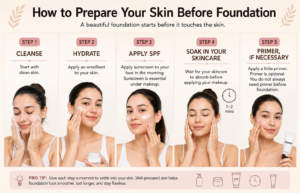
Do You Need Primer Before Foundation?
No. Primer can help, It is not required.
The right primer can help address makeup concerns, such as:
- Excess shine
- Makeup longevity
- Dry-feeling skin
- Visible texture
- Uneven makeup application
Instead of always putting primer everywhere think about whether you truly need it.
How To Apply Foundation Step by Step
You can use a technique and get a refined look while using only a little bit of the products.
Step 1: Use a small portion
Put an amount of foundation on the back of your hand on a mixing palette or straight on the face depending on the formula.
Starting small helps control coverage.
Step 2: Apply to the Centre of the Face
Start around spots where you want the coverage.
These may include:
- Around the nose
- Centre of the cheeks
- Chin
- Centre of the forehead
Step 3: Blend Outward
Blend toward the edges of the face. The amount should thin out as you move toward the hairline and jaw.
Step 4: Build Coverage Where Necessary
If spots or discoloration stay visible add a little foundation there.
Step 5: Check Your Jawline
Check that there is no line between the face and neck.
Step 6: Inspect in Natural Light
light can show problems that indoor light hides.
How to Apply Foundation with a Makeup Sponge
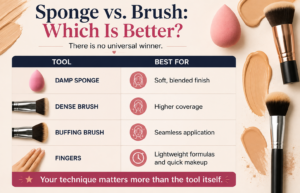
A sponge can give a soft blended finish.
Lightly bounce the sponge over the skin of rubbing hard.
Use the end, for smaller areas around:
- Nose
- Eyes
- Mouth
- The larger surface works for:
- Cheeks
- Forehead
- Jaw
The goal is to press and blend not drag product over the skin times.
How to Apply Foundation with a Brush
A brush can give coverage and precision.
Start with an amount.
Use strokes to spread foundation then lightly buff the edges.
Dense brushes usually give coverage while lighter brushes can give a softer finish
Sponge vs. Brush: Which Is Better?
How Much Foundation Should You Use?
Use less than you think! You really want to start low, then apply more to where it’s needed,” explains one pro artist. “One thing people struggle with is putting on too much product and trying to spread it out.
Think about a thin layer blend assess add only where you need coverage.
This allows the foundation to look like skin.”
How to Prevent Foundation From Looking Cakey
Cakey foundation may result from a range of issues including:
- Too much product
- Dryness
- Over-powdering
- Incompatible skincare
- Wrong foundation type
- Too many layers of product
- Poor blending
- Makeup on top of unsettled skincare
How to fix it: Use thin layers and targeted coverage, avoiding piling on extra foundation if an area already feels dry or you want to de-cake a patch. Lightly damping your sponge can sometimes help melt away excess powder.
How to Make Foundation Last Longer
If you find foundation wears away throughout the day, it’s often a reflection of the entire application, not just the foundation itself.
The Keys to Lasting Foundation:
- Prepped Skin: A smooth canvas creates an even base.
- The Right Formula: Certain foundation formulas offer long wear.
- Strategic Powder: Concentrate setting powder where you get oily, instead of all over the face.
- Setting Spray: Can help meld layers together for an all-day finish (though it may be optional for some formulas).
- Don’t Touch! Resist the urge to constantly touch your face.
Foundation for Everyday Makeup
If you keep makeup routine relatively simple for a day-to-day wear, you’ll likely reach for:
- Moisturizer
- Sunscreen
- Optional Primer
- Lightweight foundation
- Concealer (only where needed)
- Blush
- Powder (only where needed)
- Optional Setting spray
The goal for everyday makeup is to enhance and even the complexion, not completely cover skin.
Foundation for Special Occasions
For an important event or a long day out, you can opt for a longer-wearing foundation and focus more on your skin prep.
- Prepped skin
- Long-wearing foundation formula
- Targeted concealing
- Carefully applied powder where needed
- Blush and bronzer
- Setting spray
The important thing when choosing a foundation for a special occasion is ensuring it won’t budge or look obviously worn before the event ends. Avoid testing too many new products right before an event.
Wedding Makeup Foundation
Choosing the right wedding foundation involves balancing longevity, comfort, photography-friendly finishes, and skin-like appearance. A heavy, opaque formula isn’t necessarily the answer. Look for coverage that can be built and tests well in front of a lens, so don’t skip tests in the lighting where photographs will be taken.
Photography Friendly Foundation
When it comes to foundation for photos, avoid significantly over or under-applying your typical foundation shade for fear it will appear differently on camera, as lighting conditions are the real driver. It’s more important to balance skin evenly with a comfortable shade and formula that looks natural in the intended lighting setup. Always test your entire makeup application before the event.
Foundation and Flashback
Certain ingredients in cosmetics can reflect light and cause a noticeably brighter and sometimes paler appearance under direct, harsh flash photography. Testing your final application under lighting that mimics photography conditions is essential. Do not assume it will perform the same way in natural daylight as it will in artificial or flashing light.
Why Foundation Gets Darker (Oxidation):
Foundation color changes post-application-is it a dud or a dirty trick? Usually, it’s more about how the foundation, skin, and environmental factors interact. If this happens consistently, get a shade-match in-person, as brands’ online shade descriptions don’t always tell the whole story, and it’s also crucial to let a product settle in to see its true hue.
Foundation for Mature-Looking Skin
As we age, skin may reveal fine lines, texture or have a naturally more dry tendency. Foundation technique becomes a bit more crucial to avoid settling or looking heavier than necessary:
- Use thinner layers.
- Choose a comfortable finish that doesn’t look tight or dry.
- Prep skin with moisture.
- Minimize powder, focusing it where necessary.
- Use targeted concealer.
- Blend carefully.
- Light, hydrated skin typically reads younger and fresher than thick makeup coverage.
Foundation for Acne Prone Skin
There are foundations out there that work great for even breakout prone skin. Simply check for the product you like and that best suited for your needs (and be sure to analyse the ingredient list, if you’re sensitive to certain things) as well as removal so that the product doesn’t clog your pores.Foundation will never truly “treat” acne so consult with a dermatologist if skin condition is severe or persistent.
Foundation and Skin Texture
Foundation doesn’t erase pores, lines, or texture (nothing can actually remove them!), but rather subtly or more obviously changes how they appear. Heavy makeup can often emphasize these details. To create a smooth visual effect:
- Prime if needed
- Apply in light, thin layers
- Avoid excessive powder application
- Blend carefully
- Concentrate coverage
Good foundation application means working with your skin, not against it.
Common Foundation Mistakes
1. Applying Wrong Shade
This is often a dead giveaway that you’re wearing foundation. Your face and neck should match the foundation, so always swatch on your jawline.
2. Testing Only on the Hand
You wear makeup on your face, not your hand. Swatch on your neck or jawline for an accurate match, as your hand shade differs greatly from your face and neck.
3. Using Too Much Product
More coverage doesn’t equate better foundation application, and often ends up looking cakey and unnatural, as too much product will just settle into fine lines.
4. Ignoring Undertone
The wrong undertone can leave even the right depth foundation looking off, either too yellow or too pink. Look at the veins in your wrist to gauge or rely on in-store consultants.
5. Forgoing Skin care Prep
If your skin is extra oily or extremely dry, your foundation either won’t blend out, will feel too sticky or will wear off throughout the day.
6. Using Too Much Powder
Powders are essential to keeping foundation in place, but overdoing it might make your foundation look cakey or feel tight while dulling that skin like finish.Focus your powder on specific zones like the T-zone.
7. Not Checking Natural Light
Many indoor lights and makeup mirrors can misrepresent foundation colors and how they’ll look when you walk outside.
How to Choose Foundation Online
Buying foundation online is notoriously difficult. It’s tough to get a sense of the shade’s true tone and undertone on a screen. To increase your chances of a good match:
1.Figure out the shade (light or dark it is).
2. Figure out the Undertone of your foundation. This could be Warm, Neutral or Cool.
3. Find reviews. How to brand shades different shades describe their foundation shades. Do they lean neutral, orange/tan, pink/coral?
4. Find swatches of shades to skin colour that are alike to your own.
5.Use the brand/retailer makeup matching application.
6.Find out more about the store’s/online company’s return policy.
If you have a matched foundation in a different brand that you really enjoy wearing take it and match a different brand up with it as a guide and see if they have similar shades.
But DO NOT take this for granted shades across brand names are never the same!
Should You Have More Than One Foundation?
Do you need to wear the same foundation shade as you wear every day. Of course, not! Just because you must find one foundation colour doesn’t mean you have to own only one foundation that you like and wear often.
To have everyday comfortable cover simply have one foundation for this purpose.
To be more prepared for evening events that may last longer where a higher endurance and fuller coverage makeup has a need and could save your night!
During seasons like summer where there are more moisture and a tendency to sweat or become oilier you might need something that has a mattifying base.
During colder seasons, you might not need as high of the same wear endurance because dryness is not a factor; instead, you may need something more moisturizing. Owning over two foundations sounds like a lot unless your lifestyle is consistently changing or drastically changing your skin each season and there is absolutely no way your foundations will work, and they are two extremely different foundation product types to avoid.
Can you mix foundations together?
It’s ok to mix foundations! You might have a desire to get coverage levels or alter the colours to match a tan. For example, you can put more warm pigment into a neutral shade to create a summery, tan colour. Be warned however because if the formulas are too far off, they can mix and alter their texture and longevity! Start in little amounts, though.
How to Refresh Your Foundation Through the Day
If your foundation starts to look a little off throughout the day, it’s time for a refresh. Don’t automatically just layer more product:
If you’re oily: First, blot away any excess oil with blotting paper. Then, you can apply a little setting powder where needed and only add more foundation if a coverage area is completely gone.
What If your Foundation is looking dry: Try as hard as you can not to smother the powder on straight away. In this case, spritz with the spray to help melt the product down and then lightly re-apply if necessary.
How To Remove Your Foundation.
Always take your foundation off before you go to bed and take it off before cleaning the house
Step one: Work an oil-based makeup remover (some swear by a double cleansing method if you wear heavy duty foundation. The first one should break down your products, but you could do this one to make sure you’ve got everything off)
Step two: Use your cleanser, with the water, to take the rest of.
Step three: Proceed to the rest of your nighttime routine. Keep it gentle around the eye area.
Foundation vs. Skincare: What goes first?
If you’re going out for the day it goes in order:
- Cleanser
- Skincare Treatments (serums, treatments, etc.)
- Moisturizer
- Sunscreen
- Primer (optional)
- Foundation
How Foundation Fits Into a Complete Makeup Routine
Foundation is one piece of the puzzle when it comes to makeup for your face. A complete routine doesn’t rely on one product. Instead, it builds layers that work together. Instead of covering them, you can emphasize them subtly and gracefully.
A complete oval makeup routine will generally feature:
Base
This starts with foundation and concealer. These products create a even base across your face. They help conceal redness, blemishes or discoloration without covering every detail at once.
Dimension
Next comes bronzer or contour. These tools shape your face by adding shadows and highlights. When used properly they give your features structure. They add depth. Make your face look more defined.
Color
Blush brings life to your cheeks. It adds warmth. Gives the skin a subtle healthy radiance. Blend a suitable tone with the tone of your skin, if it blends- whether it is soft pink, peachy tone or berries, all works as per desired mood.
Glow
Highlighter is optional. Can make a big difference. It shines where light naturally hits your face—like cheekbones, brow bones and the bridge of your nose. A little goes a way here. Too much can look too shiny or artificial.
Set
Finally setting powder or setting spray locks everything in place. Powder helps reduce shine and keeps foundation from moving. Setting spray refreshes the look. Makes the makeup last longer. Both are important for wear.
The result should feel like your skin— better. You want it to look unified, not thick or layered. Each step supports the others, so nothing feels out of place.
Natural Foundation Makeup Look
For a everyday look aims for something that blends into your skin instead of covering it completely.
– Use lightweight coverage foundation.
– Apply it mainly around the centre of your face—forehead, cheeks and chin.
– Let some of your skin show through. This keeps the look fresh and real.
– Only use concealer where needed—under eyes around the nose or over spots.
– Choose cream blush. It melts into the skin. Gives a dewy lived-in look.
– Use powder sparingly. Just on areas that tend to get
The purpose isn’t to hide your skin. It’s to balance it—to make it appear clean even and polished while still showing your texture and color.
Full-Coverage Foundation Makeup Look
If you’re going for a dramatic look full coverage works well. The key is to build it up carefully.
- Start with prepped skin. Prime if needed.
- Apply a layer of foundation. Don’t go heavy away.
- Blend it thoroughly. Use a sponge, brush or fingers—whatever helps it spread smoothly.
- Add coverage only where necessary. Focus on problem areas like blemishes or uneven tone
- Use concealer selectively. Spot-conceal than trying to cover everything.
- Set targeted areas with powder. Avoid baking the face unless you need long wear.
- Finish with setting spray. This seals everything in. Prevents creasing.
The trick is layering smartly—not piling on one coat. Build slowly and blend between each step.
Foundation for Different Makeup Styles
Foundation doesn’t have to be one-size-fits-all. It adapts to styles and occasions.
Soft Glam
Choose a buildable formula with a satin finish. It provides coverage without appearing chalky and the formula is flawless. Suitable for those occasions where a little more sophistication is in order!
Minimal Makeup
Go sheer or lightweight. These formulas let your skin breathe while giving a correction. Ideal for days when you don’t want to look made-up.
Bridal Makeup
Longevity matters most. The foundation should stay put all day—and especially under lights. Comfort and a flawless finish are key because photos will capture every detail.
Editorial Makeup
This depends heavily on the vision behind the look. A matte heavy-coverage formula works best. Other times, a glowing liquid finish fits the theme. Lighting plays a role here.
Everyday Office Makeup
Practicality wins. A lightweight looking foundation suits busy schedules. It hides redness. Evens the tone without drawing attention
Evening Glam
You may prefer medium-to-full coverage. Wear something that lasts through dinner, dancing and partying. Longer. A radiant finish keep you looking fresh all night long.
Frequently Asked Questions About Foundation Makeup
Is foundation necessary for makeup?
No. It’s not required. Many people skip foundation. Still get beautiful results using only concealer, powder, blush or other products. You can achieve a look without foundation.
Should foundation be lighter or darker than your skin?
Ideally it should match your skin tone very closely. Test it along your jawline and neck. It should disappear into your skin. If it stands out it’s likely too light or too dark.
Can I wear foundation every day?
Yes, as long as the formula suits your skin type. Some foundations irritate skin or clog pores. Always remove it thoroughly before bed. Cleanse well. Follow your skincare routine.
Is matte foundation better for skin?
Matte options can help control shine.. Not all matte foundations work for everyone. Some dry out the skin. Look patchy. Try types until you find one that balances oil without making you feel tight.
Is foundation good for dry skin?
Dewy or hydrating formulas often suit skin better. They add moisture. Give a lit-from-within glow. Still prep your skin first. Hydrated skin holds foundation better.
Why does my foundation look cakey?
Cakeiness usually happens when much product is applied. Dry skin using much powder or choosing a formula that doesn’t suit your skin can cause this. Also blending poorly leads to buildup.
Why does foundation separate on my nose?
Separation can happen due to the oils in the products, ingredients in skin products, too much product or the areas being rub. Also, be careful that your foundation does not interact with you moisture product or sunscreen. Consider using a de-tanning moisturizing primer and a fluid formulation.
Why does foundation look orange?
It could be due to a mismatch in undertones. For example if your skin has tones and you pick a foundation with cool undertones it can turn orange.. The formula might shift after application. Always test shades in light.
How can I make foundation look natural?
Use amounts. Blend well. Build coverage slowly, where needed. Avoid applying. The real goal should be to improve skin, not to cover it.
Does concealer go before or after foundation?
Order works. Applying foundation first lets you see what needs coverage. Then you can target those spots with concealer. Some prefer to do concealer especially for under-eye circles.
How long does foundation last?
That varies. Check the packaging. Most say “use within 12 months after opening.” If storing, put it back in its pot to maintain freshness. Don’t leave it open, keep it away from heat, and avoid touching with unwashed hands. If there is any change in smell, color or texture, throw it away.\
Foundation Makeup: Your Simple Selection Checklist
Before buying any foundation ask yourself a question.
What coverage do I want?
Sheer, light, medium or full? Decide based on your comfort level. How much correction you need.
What finish do I prefer?
Matte, satin, natural or radiant? Matte reduces shine. Satin gives a sheen. Radiant adds glow. Pick what matches your style and environment.
What is my undertone?
Cool warm neutral or olive? This affects which shade will blend seamlessly.
Where will I wear it?
Everyday work, parties, weddings, photography or special events? The occasion shapes how coverage and longevity you need.
How long do I need it to last?
A few. All day? If you’re staying out late or taking pictures choose something wearing.
Answering these questions narrows down hundreds of choices. You’ll end up with options that truly fit your needs.
Final Thought:
The Right Foundation for You The perfect foundation isn’t necessarily going to be the most expensive or the most popular. The foundation that works for your skin, is the exact color match, matches the undertone, and can suit your lifestyle will be perfection for you. Begin by determining what skin type you are and what type of finishing product do you prefer? Then find a shade that blends perfectly at your jawline and neck. When applying resist, the urge to use much. Begin with a layer and add more only where needed. Importantly remember that foundation serves a purpose—it enhances your complexion. It shouldn’t erase your personality or individuality.
Great foundation makeup allows your skin to still look like your skin. It should feel comfortable and natural even if it looks polished.
Whether you love their base for daily wear, soft glam for nights out or high-coverage makeup, for big events understanding foundation gives you power. You can create a look that feels intentional, confident and beautiful—without losing who you are.