
 GoBeauty Bay
  Shaista Rafi
Beauty & Lifestyle Content Writer
in
Shaista Rafi writes reader-focused beauty
and lifestyle content for GoBeautyBay,
covering skincare, hair care, makeup,
personal care and everyday beauty topics.
Shaista Rafi
Beauty & Lifestyle Content Writer
in
Shaista Rafi writes reader-focused beauty
and lifestyle content for GoBeautyBay,
covering skincare, hair care, makeup,
personal care and everyday beauty topics.
 Mirza Ibrahim Ali Khan
Editorial Reviewer
in
Mirza Ibrahim Ali Khan contributes to
GoBeautyBay's editorial review process,
focusing on clarity, content structure,
topical relevance and reader usefulness.
Mirza Ibrahim Ali Khan
Editorial Reviewer
in
Mirza Ibrahim Ali Khan contributes to
GoBeautyBay's editorial review process,
focusing on clarity, content structure,
topical relevance and reader usefulness.
Selecting the proper foundation makeup to work best for your makeup throughout the course of an entire day. Correct foundations depend on much more than just tone of your skin. Different factors will affect certain foundations would work for each individual such as:skin type, desired coverage, finish, application method, how much you are able to care for it and personal preference.
What Is Foundation Makeup?
Foundation is a makeup to the skin for evening out your complexion. You can diminish any blotches of redness or discolouration, any uneven tones and any other visual imperfections that occur. Foundations range in coverages and consist of: –
- Sheer
- Light
- Medium
- Buildable
- Full coverage
They also come with many different finishes to match your look, they are:-
- Matt
- Natural
- Satin
- Radiant
- Dewy
The preferred foundation is often the one that naturally enhances and complements the skin rather than achieving a greater degree of cover.
-
Liquid Foundation
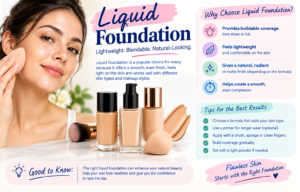
This is the most adaptable, commonly used foundation. Types exist for all different skin types and finishes, though generally liquid foundations exist that offer light-sheer coverage or full coverage.
Most suited for:
- Normal skin
- Combination skin
- Dry skin
- Buildable coverage
- Both special occasion and everyday makeup
Liquid foundation can be applied with a sponge, brush or clean fingers depending on formula. You may prefer hydrating formulas for dry skin and oil control versions for oily skin.
-
Powder Foundation
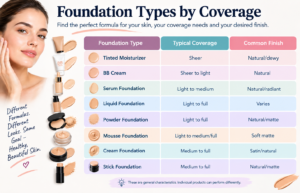
A pressed or loose powder-based make-up, the coverage is from light to full depending on the formulation.
Perfect for those who want a quick application and for whom reducing excess shine is a priority.
Who it is ideal for:
- Dry skin
- Combination skin
- Fast application
- Finishing your look
- Light covering
The dry skin is emphasized sometimes so prepare your skin well when it is dry.
-
Cream Foundation
Cream foundations tend to be richer and thicker compared to many liquid foundations.
They usually offer medium-full coverage and produce a very natural and ‘even’ completion. Some creams may feel moisturizing, but finish results can vary with each product.
Ideal for: Normal – dry skin, mature looking skin, medium-full coverage, evening makeup, special occasions.
Due to it being richest, applying an appropriate amount is key – a heavy complexion is due to too much cream foundation.
-
Stick Foundation
Stick foundations typically come in a solid formula which may be applied by drawing the stick onto the skin or picking the product up on your brush and applying it by brush. They are excellent for travel and can provide buildable coverage. Several stick foundations may be applied strategically to parts of the face requiring more coverage.
Stick Foundation is:
Best for: Travel Quick coverage Medium to full coverage Touch ups Selective coverage
If you have dry skin apply a moisturizer to the skin first; this should help to prevent it from catching or highlighting the skin text
-
Serum Foundation
What it is: a hybrid complexion product that works as foundation but can include skin-benefiting ingredients (in some formulations) like the product it is named after. These types of foundations have light to medium coverage and produce a more natural skin like look.
Best For: Everyday looks, a barely-there makeup looks, normal to dry skin, a natural-looking finish, if you don’t like cakey foundations. Serum foundations are great to use when your natural skin needs to shine through rather than completely hide with a matte finish.
-
Mousse Foundation
Mousse foundation tends to be a light, whipped formulation. Despite having a light finish, you can sometimes get more coverage from mousses compared to some sheer foundations. Mousse foundations come in both soft-matte and natural finishes, but it really depends on the formulation.
They generally work best for; Combination skin Normal skin Mousse foundations offer you lightweight to medium coverage with a soft-focus finish.You can have a soft focus or natural looking finish so always have a look at the specific finish of a Mousse foundation as they can be quite different from one another.
-
Tinted Moisturizer
Tinted moisturizers are much sheerer than normal foundation, with moisturizing qualities added to it. They are useful when you want to unify the look of your skin but keep it very natural and not have it fully concealed.
Ideal use: ‘no-makeup-makeup look’, dry/normal skin, everyday wear, light coverage, beginners. If it contains an SPF, please remember make-up products should never be the only sun-protection measures applied, instead apply an actual broad-spectrum SPF sunscreen accordingly.
-
BB Cream and CC Cream
BB and CC creams are do-it-all complexion products. BB creams tend to be targeted at a combination of light coverage with a moisturized or beneficial feel/skincare boost. CC creams are often colour-correcting.
They tend to have a slightly different targeted benefit as well-for example, targeting redness or uneven skin tone. SPF, coverage, and ingredients differ on individual products. Do not assume BB or CC cream is one of a kind!
Foundation Types by Coverage
How to Choose Foundation for Your Skin Type
Dry Skin
You might prefer a hydrating or moisturizing foundation that finishes on the natural, satin or radiance side. Formulas in cream liquid, hydrating liquid, serum and tinted moisturizer textures could feel comfortable on the skin. Moisturize the skin appropriately and let it settle after your skincare application, before adding foundation.
Oily Skin
You might find powder foundations or oil-controlling liquid foundations to work comfortably on your skin. A foundation with a formula in an oil-free and long-wearing consistency might work well to resist makeup break down throughout the day.
Combination Skin
Try finding something balanced that does not excessively dry the cheeks and at the same time won’t over-oil the T-zone. In terms of formula a light liquid or natural-finish foundation might be a versatile approach to this complexion type.
Sensitive Skin
As far as foundation is concerned it is beneficial not to over- complicate the skin’s routine and just use what your skin likes. Products without any fragrance might work well if you have any issues with such an ingredient. It would be advisable to test any products you might want to apply on any part of the body before using it directly to skin.
Foundation Finish Matters Too
Coverage isn’t the only thing you should consider when choosing foundation. The finish the makeup will give is another.
Matte-minimizes a shiny-looking complexion.
Natural-the most realistic, aims to mimics the look of fresh skin.
Satin-a compromise between the two other finishes.
Dewy-this finish makes the skin appear luminous and well-hydrated.
What finish to choose may depend on your skin type, and the effect that you aim to achieve with makeup.
Make-up foundation looks natural
A great foundation, however, will look heavy on prepared skin.
Cleanse skin and apply suitable moisturizer. Sunscreen will need to be applied prior make up application during day, and skincare will have to sink into skin prior.
Then:
- Find your exact shade match.
- Start with no more than the half the amount of foundation you would usually apply.
- Apply from inner of face, outwards, with blending to outer parts of face.
- Blend and fuse your foundation into your hair line and jawline correctly.
- Dab only extra foundation into patches which appear red or have pigmentation.
- Selectively set where you feel that foundation will either cake or not last.
Ultimately your make-up should improve your face, not completely alter and cover the whole skin.
Conclusion
Ultimately, there is no best type of foundation makeup; fluid, powder, cream, stick, serum, mousse, tinted moisturizer, BB cream, and CC cream each have a unique finish, coverage and texture, and may not work in your favour. Start by asking yourself what it is you want and what you need; coverage, finish, ease of application, longwear, or simplicity. Next, determine your skin type, and use this information to pick a formula perfect for your day to day needs.
Whatever foundation makeup formula you decide on should feel comfortable on your face, easy to work into your skin, complement your skin’s tone and help you attain the desired make-up appearance.If part of your complex routine, consider having this page printed along with your Foundation Makeup pillar page, How to Prep Your Skin PreFoundation, and the foundation application tutorials: