
 GoBeauty Bay
 Shaista Rafi
Beauty & Lifestyle Content Writer
in
Shaista Rafi writes reader-focused beauty
and lifestyle content for GoBeautyBay,
covering skincare, hair care, makeup,
personal care and everyday beauty topics.
 Mirza Ibrahim Ali Khan
Editorial Reviewer
in
Mirza Ibrahim Ali Khan contributes to
GoBeautyBay's editorial review process,
focusing on clarity, content structure,
topical relevance and reader usefulness.
Comparing moisturizers for oily skin is hard because some product descriptions sound so close: One will say it will hydrate, another will say it will suppress oil, the third will say it supports your skin’s barrier. The comparisons that are helpful look past that – and into a typical skincare routine.
What to Look for in a Moisturizer Review
A helpful moisturizer review should talk about more, than how the moisturizer feels.
- Texture
- Absorption
- Hydration
- Finish
- Ingredients
- Fragrance
- Skin‑type compatibility
- Packaging
- Makeup compatibility
- Value
- Long‑term routine suitability
This information gives readers an idea of whether this moisturizer may fit their needs.
Compare Texture First
Texture is especially important if you have oily skin An oil-control gel might be just right for someone with very oily skin, while a gel-cream might suit someone with oilier, dehydrated skin. Texture comparisons for those with oily skin can help you avoid the most popular mistake of grabbing whatever says it’s great for oily skin.
Compare Hydration
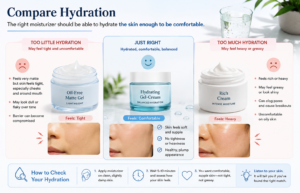
Compare Ingredients
Look at the ingredients based on the skin concern you have.
For hydration ingredients, like glycerin, hyaluronic acid and panthenol can make a difference.
For barrier support, ceramides and other skin-conditioning ingredients are worth considering
For skin issues niacinamide is often found in light products
Don’t decide on a product because of one ingredient. The whole formula is important.
Compare Finish
The finish can determine whether you enjoy using a moisturizer every day.
Common finishes include:
| Finish | Often preferred by |
| Matte | Very oily skin |
| Natural | Oily and combination skin |
| Soft dewy | Dehydrated oily skin |
| Rich | Oily skin with dry areas |
These categories are not absolute. A product can behave differently depending on the amount applied and the climate.
Compare Makeup Compatibility
Does the moisturizer leave a tacky film that can affect layering? If you wear makeup, think about whether the product applies well under foundation or other products on the complexion. A moisturizer that leaves a heavy film can make the makeup “move” or pill when you put other products on top of it.
Compare Moisturizers by Skin Concern
| Concern | Look for |
| Excess oil | Lightweight texture |
| Dehydration | Humectant-rich formula |
| Acne-prone skin | Lightweight, comfortable formulation |
| Sensitivity | Simple, gentle formula |
| Dry patches | More nourishing gel-cream or lotion |
| Humidity | Fast-absorbing gel |
| Barrier concerns | Ceramides and supportive ingredients |
How to Read Online Reviews
Individual reviews can be helpful. One person’s experience does not mean the same result will happen for someone else.
Think about whether the reviewer has a skin type life in a similar climate and follows a similar skincare routine.
A moisturizer that feels just right for skin might feel too thick for very oily skin. In the way a product that works well in a dry climate might feel too rich in humid weather
What a Good Product Comparison Should Include
A useful comparison should look at products using the set of features:
Texture: Is it a gel, lotion, gel-cream or cream?
Best for: Which type of skin is it most suited for?
Hydration: Is it light and quick-absorbing or more deeply nourishin
Finish: Does it leave the skin matte dewy?
Key ingredients: What ingredients help the product do its job
Potential drawbacks: Could fragrance, heaviness or active ingredients cause issues?
Value: Does the price match the amount you get and how well it performs
Don’t Choose Based on “Oil-Free” Alone
Just because a product says it is oil-free does not mean it is better for skin
An oil-free formula can still feel heavy or greasy. At the time a moisturizer with emollients might feel surprisingly light.
The texture and formulation matter more, than a single label
Moisturizer Reviews: What Readers Should Know
Online reviews may be helpful for texture, application, fragrance, finish and personal experience, but not for clinical evidence. A product that is comfortably light to one individual may feel greasy and under-hydrating to another. For instance:
| Review Area | Questions to Answer |
| Texture | Is it lightweight enough for oily skin? |
| Hydration | Does it prevent tightness and dehydration? |
| Oil control | Does it leave skin excessively shiny? |
| Acne suitability | Is it labelled non-comedogenic/oil-free? |
| Sensitive skin | Is the formula fragrance-free or otherwise simple? |
| Makeup | Does foundation sit smoothly over it? |
| Weather | Is it comfortable in hot, humid conditions? |
| Value | Is the price reasonable for the amount? |
A Useful Rating System for Your Reviews
of saying one moisturizer is the best you can look at specific details:
– Texture: gel, gel‑cream, lotion or cream
– Best for: very oily acne‑prone dehydrated, sensitive or combination skin
– Hydration: light, moderate or rich
– Finish: matte, natural or dewy
– Fragrance: yes or no
– Non‑comedogenic: yes, no or not stated
– Layering: good, variable or may pill
– Climate: better for humid, moderate or dry weather
– Price: budget, mid‑range or premium
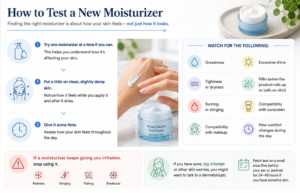
It’s a way to help you tell between the versions and prevent you from assuming one moisturiser will suit all oilskin folk. Testing a new moisturiser
How to Test a New Moisturizer
Final Thoughts
Good moisturizer reviews, for skin show how the product really works instead of just repeating marketing words.
When you ompare moisturizers look at texture, hydration, finish, ingredients, skin concerns, climate, makeup compatibility and price. This way you can pick a moisturizer that matches your routine of just picking the most popular one.