
 GoBeauty Bay
 Shaista Rafi
Beauty & Lifestyle Content Writer
in
Shaista Rafi writes reader-focused beauty
and lifestyle content for GoBeautyBay,
covering skincare, hair care, makeup,
personal care and everyday beauty topics.
 Mirza Ibrahim Ali Khan
Editorial Reviewer
in
Mirza Ibrahim Ali Khan contributes to
GoBeautyBay's editorial review process,
focusing on clarity, content structure,
topical relevance and reader usefulness.
Generally, it’s easier to select a good moisturizer for oily skin when you identify the product type and texture first, rather than go by specific brand names. And the very best moisturizer for very oily skin. Moisturize oily skin. Better a “drying” cream moisturizer or no moisturizer at all, and you are left with that dry, itchy feeling, as if you were in the bathroom and you had just thought, “Yes! I can use five more of these -and that’s just to make up for all that oil I don’t want”. Selecting a moisturizer for oily skin To Wear You have to be a little careful here as well – you want to wear something which can give you enough moisture without that slimy, sticky feeling.
Factors to consider: The best moisturizer for very oily skin will depend on how oily your skin is as well as whether it’s dehydrated, acne-prone, sensitive, is cleansed frequently, and the climate you live in.
Types of moisturizers.
Gel moisturizer, gel-cream, light lotion, oil-free moisturizer, water-based moisturizer-but those are just the names.
The formulation and how your skin feels after are just as important.
Why Oily Skin Still Needs Moisturizer
If you think you are using a moisturizer to combat oily skin, I would like to clear that up, First, your skin produces more oil (Sebum) than most skin types, water and oil are different. Sebum is an oily substance that your skin secretes, and hydration is relative to the water content in the skin. This means you can have oily skin and be dehydrated or feel tight.
The increased use of an oil-free product or skipping a moisturizer, can make your regimen uncomfortable, if you also use:
- Foaming cleansers
- Salicylic acid
- Benzoyl peroxide
- Retinoids
- Exfoliants
– Any other treatment Products that focus on acne
A moisturizer can keep your routine easier to tolerate, while also providing water and strength to the skin barrier.
The goal is not to remove the oil from your skin, the goal is balanced, comfortable hydration.
Gel Moisturizers for Oily Skin
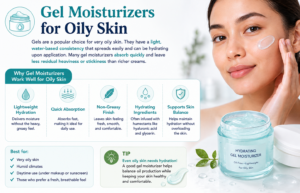
Who might like a gel moisturizer?
- EVery oily skin that breaks out in the heat
- Oily skin in humid weather
- Individuals who dislike heavy creams
For the following: Want a light moisturizer to use during the day. 6. To hydrate your skin prior to make-up or sunscreen for day wear your skin is quite hydrated, and this means you might be able to get away with using a gel formula when you don’t require an emollient (moisturizing agent). What ingredients should you keep an eye out for? A gel moisturizer could include:
- Glycerin
- Hyaluronic acid
- Panthenol
- Betaine
- Water-binding substances
As a result, formulas with humectants may provide moisture, but without that feel of a rich moisturizer. That doesn’t mean any one category of humectants is perfect or appropriate for everyone. The Whole Formula Is the Key Why a Gel May Not Be Enough A super lightweight gel may not be enough to restore some dehydrated, irritated, or dry areas of your skin.
You will find you get a better feel from a gel-cream or a lightweight lotion if, shortly after applying gel moisturizer, your skin feels tight-and not by more gel (you may want to find an oil-free gel for oily skin).
Gel-Creams for Oily Skin What is a gel-cream?
Gel-creams are neither gels nor creams.
Gel-creams are somewhere in the middle.
Gel-creams generally have less oil than a standard cream, but more comfort and hydration than a gel.
They are flexible enough to work well on oilier skin which needs a little extra barrier support but not heavy enough for skin that wants a cream.
Gel-creams are especially good for:
Oily, tight skin Oily, dehydrated skin Slightly flaky skin Discomfort after cleansing More sensitive skin during seasonal transitions Dry skin from using acne-forming ingredients There’s no need to sacrifice your moisturizer simply to avoid a cream or gel.
Consider whether your skin might benefit from something a bit more supportive, instead of defaulting to an ultra-light gel. Gel-creams will usually deliver that without ever feeling quite as rich as a traditional cream.
Seasonal Functions
Sometimes your skin changes: it’s more sensitive when the weather changes, your air-conditioning feels dry, it’s hot and humid or you find yourself using drying acne ingredients. Or one season you use a gel, another a gel-cream.
Changing the consistency of your moisturizer based on the seasons can be way more effective than the same moisturizer all year long.
Lightweight Lotions for Oily Skin
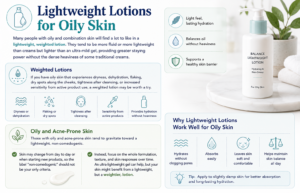
Top Oil-Free Moisturizers for Oily Skin
Oil-Free Moisturizer A moisturizer that does not include oil. Oil-free formulas may be more appealing to those who:
- Don’t like feeling that the moisturizer makes the skin oily
- Have very oily skin
- Prefer a lighter texture
- Feel uncomfortable with a rich cream
want a simple moisturizer for daily use
But just because a product is labelled oil-free, it doesn’t necessarily mean it will be better for oily skin. Moisturizers can contain a variety of humectants, emollients, occlusives, and other ingredients. Not all formulas are equally effective at keeping the skin comfortably moisturized, just because they don’t contain an emollient oil. An oil-free formula may be just as thick feeling as one that does contain an emollient oil, while the latter may comfortably work for another person with oily skin. What’s key is whether the formula provides sufficient moisture without making the skin uncomfortable.
Water-Based Moisturizers
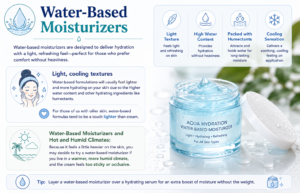
Oily Skin (Lightweight Creams) Can I use a cream with oily skin?
- In the presence of conditions and conditions such as dry areas the barrier does not seem to be sealed dry seasons your skin is irritated by the ingredients it lacks moisture. The significant difference here is between light cream and very thick, rich, cream that is occlusive.
If cream does not seem to be oily and cause discomfort, then a gel-cream or gel moisturizer is best.
Gel-lotion Moisturizers for Combination Skin
In combination skin, it is challenging because the entire face is not the same: your T-zone may become or act as if it is oily, while your cheekbones may be unbalanced or become somewhat dry.
- Light enough to keep hydration levels up
- Easy to spread
- Relatively comfortable
- Less heavy than a typical cream
more hydrating than typical gels some people are able to experiment with decreasing the amount of product in T-zone areas instead of using a tremendously lightweight moisturizer everywhere.
Moisturizer Texture by Oily Skin Profile
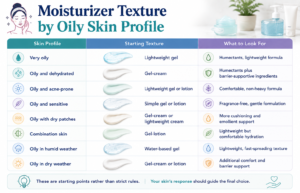
How to Select a Gel, Gel-Cream, or Lotion
Not sure which texture to select? Think about the way your skin feels post-wash. Select a Gel If…
- Your skin quickly becomes oily.
- You’re not a fan of heavy textures. You reside in a humid environment. You prefer an easily absorbed day texture. Your skin does not usually feel dry or tight.
- Try a Gel-Cream If…
- Your skin is oily but lacks sufficient hydration. Your skin occasionally feels tight and parched. Your face feels tight post-wash.
- You use more drying active ingredients. A simple gel product isn’t enough to bring you comfort. Choose a lightweight lotion if…
- You have combination/oily skin.
- You require more prolonged hydration. Your cheeks are parched but your T-zone remains oily. You would like a texture between a gel and a cream.
How Much Moisturizer Do I Need?
Using too little moisturizer results in under-hydrated skin, while using too much of a heavy formulation results in excess product on oily skin that does more to weigh down your skin than to benefit it.
Start with a reasonable amount and distribute it over your entire face and neck while your skin is clean.
You can vary the amount by:
- Texture of the product
- Your face’s size
- Climate
- How your skin feels now
whether you’re using a second product on top of it
The optimal amount is a quantity that adequately hydrates your skin without leaving an excessively thick or heavy film of product behind.
How to Tell If Your Moisturizer Is Too Heavy
If you generally find that your moisturizer is too much for you, you may experience:
- Excess greasiness
- A coating feeling that is not comfortable
- Heavy residue
- Persistent shine that you dislike
Difficulty applying sunscreen or makeup over your moisturizer
If that is the case, you may want to try a lighter option. Just don’t confuse shiny skin with uncomfortable skin-it is common for oily skin to produce more sebum, so your goal does not necessarily need to be a completely matte face.
How to Know if Your Moisturizer Is Too Light If you tend to feel that your skin is too comfortable you may experience:
Tightness
The feeling that your skin is dry
Dry or flaky skin
Relaxing A Few Minutes After Moisturizer Use Because you’d prefer to replace the ultra-light gel moisturizer with a gel-cream or lotion. When you’re dry, check whether the one among the opposite steps of your routine (more frequent exfoliation, scrubby cleanser) may be doing your more harm than good. Can I Use Different Moisturizers for Different Areas? If you’ve got combination/oily skin, you’ll want to use different textures in different areas.
For example:
A lightweight gel moisturizer on the oilier parts of your face (“T-zone”)
A gel-cream or lotion on your drier skin
This isn’t something that everyone needs to do, but if you have areas that are significantly different and need different textures, this might be something to try.
You could also simply use the same moisturizer on your whole face and apply a very thin layer on the oilier parts and a thicker layer to the parts of your face that are dry.
Conclusion
Not always the lightest you find, nor necessarily the one that ‘feels’ the most ‘soothing’. Something you can have a little nourishment without it being too heavy or ‘greasy’ feeling on the face. Normally gel moisturizers are great if you are very oily (particularly in humid weather), though they might be a little ‘light’ for those whose skin is ‘dehydrated’ or sensitive.
Gel-creams would be good for a ‘middle ground’ if you are oily (but also dry or sensitive) while lightweight lotion would be perfect for if you want the ‘feel’ of an oil-free product.
As a general rule, if you want a lighter moisturizer that is focused on weightlessness in feeling and contains no oil – look for oil-free, water-based moisturizers, a step up in nourishment (still no oil) is usually a lotion, and if you are more concerned with dry patches and a compromised barrier, choose a slightly richer formula. And don’t forget to think about the rest of the ingredients in your moisturizer – not just the texture! – before you settle on a final choice.