
 GoBeauty Bay
 Shaista Rafi
Beauty & Lifestyle Content Writer
in
Shaista Rafi writes reader-focused beauty
and lifestyle content for GoBeautyBay,
covering skincare, hair care, makeup,
personal care and everyday beauty topics.
 Mirza Ibrahim Ali Khan
Editorial Reviewer
in
Mirza Ibrahim Ali Khan contributes to
GoBeautyBay's editorial review process,
focusing on clarity, content structure,
topical relevance and reader usefulness.
It is important to remember that even if you have oily skin, not all moisturizers will work the same. Oily skin can be accompanied by dehydration, spots of sensitivity, increased appearance of pores, textured skin or dry patches. So your moisturizer can and should be dictated by what you need based on your oily skin (i.e. Oily, dry and sensitive) not on what your label reads.
While a light gel might be just right for your very oily skin during the hot weather, your not dehydrated oily skin might require a a little more nutritive gel-cream, your oily yet acne-prone patient may prefer and oil-free or non-comedogenic cream while your oily sensitive skin patient might require a very plain, fragrance free product. Note: Also some acne medicines such as benzoyl peroxide, salicylic acid, adapalene, tretinoin, isotretinoin etc. you may need some facial moisturisation for dryness and irritation. Here is a quick guide to choose a good moisturiser for oily skin.
Best moisturiser for very oily skin
Choose Oily Skin – Because too much oil is produced in our skin, it is greasy fast- even on the T-zone (forehead, nose and chin).
Creams may feel a little heavy, especially during the heat or when it is humid.
A water-based moisturizer or a gel is a great place to start.
- Lightweight textures
- Glycerin
- Hyaluronic acid
- Panthenol
- Lightweight humectants
- Oil-free products if you like them
- Non-comedogenic formulas as needed
You don’t want to eliminate all the oil. You just want a product that’s hydrating, but not too emollient, greasy or heavy. If Your Face Feels Tight… Don’t assume your skin needs a lighter weight moisturizer right away.
If you are tight shortly after applying a super-lightweight gel, your face simply needs to be a little more comfortable. In this case, try a slightly richer gel-cream or lightweight lotion.
Moisturizer for Oily and Dehydrated Skin
Dehydrated, Oily Skin. This is trickier because it appears shiny, but can also be tight or uncomfortable. Remember, you can have dehydrated, oily skin, even though it looks good. There’s plenty of oil, but not enough water, and your skin still needs a little something.
Signs dehydrated, oily skin may share are:
– Tightness after cleansing
– Temporary appearance of fine lines that easily disappear after resting
– Raughness
– Flaking in some areas
– Discomfort despite oiliness
– Makeup does not apply smoothly
In this type of skin, you might prefer a gel-cream or light lotion to an extreme thin gel. Choose: our combination of humectants and one or more of the following for a comfortable, protective skin barrier: – glycerin – hyaluronic acid – panthenol – ceramides – other effective emollients Don’t assume that the thinnest lotion possible is always better. The right one is the one that provides enough moisture without making your face extra greasy.
Moisturizer for Oily and Acne-Prone Skin
1.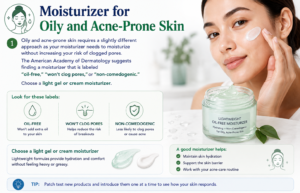
Why a moisturizer Still matters Oily skin can actually lead to avoiding the application of moisturizer because people don’t want to add any extra oil to their skin.
2. You might also experience dry, irritated skin from your acne treatments. Using a moisturizer to combat dry skin can make it easier to tolerate and easier to stick to your acne treatment routine – especially if you are using one of these products: Salicylic acid Benzoyl peroxide Adapalene Tretinoin Any other acne product
3. Things to think about – Light texture – No harsh stinging or irritant ingredients – “Non-comedogenic” label – Oil-free formula (if you like) – Hydrating ingredients helpful hints: A moisturizer isn’t a treatment for acne. If your skin still has persistent, painful or scarring cystic acne, you should get help from a doctor.
Moisturizer for Oily and Sensitive Skin
Oily skin can also be sensitive. When this is the case, a moisturizer should not be selected based on weight alone.
You also need to pay attention to how easy and tolerable the formula is.
A simple gel or light lotion may be a good place to start.
Look for:
- Fragrance-free
- Keep out the extraneous irritants
- Mild moisturizing ingredients
- Easy feel
What ingredients you know your skin has tolerated before
Avoid any fragrance if you have sensitive skin – fragrance isn’t problematic for everybody, but it’s not one to try to accommodate if your skin is sensitive (” fragrance-free ” is generally recommended for sensitive skin by most dermatologists).
Attempt merely One Item at a Time
When you have delicate skin, do not attempt a bunch of products simultaneously. Beginning with just one will allow you to understand what works well for your skin.
Moisturizer for Oily Skin with Dry Patches
Moisturizer for Oily Skin with Large-Looking Pores
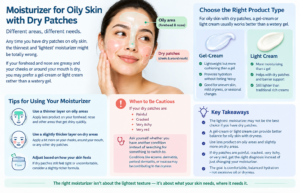
As tempting as it might be, it doesn’t work to use a moisturizer that doesn’t value to shrink. What you can do is find one that will help your skin apparent or feel off balance. If your oiler, and you see a larger appearance of your pores: A gel or light lotion may feel better than a thick film of something.
Consider ingredients that often substitute in oils, such as niacinamide.
Avoid over-purging your dirt by scrubbing every grain of dirt to death or parching your skin out. Irritation may inhibit your overall grand scheme.
Moisturizer for Oily Skin with Too Much Shine
Moisturizer for Oily Skin and Uneven Texture
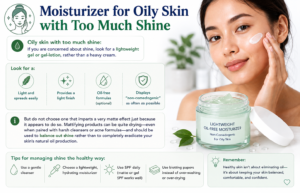
Uneven texture can be caused by various factors such as clogging, acne, dehydration, irritation and natural variation of the skin.
A moisturizer’s role is mainly to hydrate and nourish your overall routine, not necessarily to treat every texture concern on its own.
Light lotion or gel-cream might be a good idea if dehydration causes the roughness.
If a product containing exfoliating acids or retinoids is already part of your routine, don’t usually add more actives to your moisturizer. Too many actives may be irritating.
Having a solid routine is more of a winning proposition than constantly adding new products.
Moisturizer for Oily Skin with Blackheads and Whiteheads
Oily Skin Moisturizer with Blackheads and Whiteheads If your skin is oily and you suffer from clogged pores; you can benefit from a light moisturizer that doesn’t clog your skin. Do not think of your moisturizer as the one product that will help eliminate your blackheads or whiteheads. Think of your moisturizer as being part of your routine.
For example: Cleanser acne medication if suggested moisturizer sunscreen in the am
You may want to use a moisturizer if your skin care acne medication is drying. Don’t over-cleanse or scrub to try to get rid of the blackheads. Acne-prone skin is sensitive skin, and irritation can make the acne worse, according to dermatologists.
Salicylic Acid for Oily Skin Moisturizer
Moisturizer for Oily Skin Using Retinoids
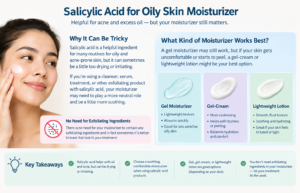
Retinoids may be prescribed for a wide variety of reasons – such as acne and aging – but they can also dry and irritate the skin, especially when someone is starting to take it. If you’re noticing your oily skin becoming flaky after using a retinoid, and you’d like to keep skin feeling comfortable, added moisturizer may be welcomed. A gel-cream lotion or a light cream/gel may be more comfortable than a very light gel.
Moisturizer for Oily Skin With a Damaged or Uncomfortable Skin Barrier
What if Oiliness Already Exists? Oily skin can also become irritated or stressed by the barrier. This can occur after:
- Too much cleansing
- Over-exfoliating
- Many acne treatments
- Multiple active products in the routine
- Abrasion from scrubs
- Lack of moisturization
For now, you might be better off applying a straightforward regimen instead of introducing an additional oil-absorbing product. If irritation, burning, and stinging continue or if your skin looks very distressed, seek expert advice.
Oily Skin Moisturizer for Hot & Humid Climate
Here, you may even be better off for now, ditch the complicated routine and use a more straightforward one instead of an extra oil absorbing product. Seek an expert if you still notice irritation, burning, or stinging or see your skin to be in a serious mode.
Price and Buying Guide Oily Skin Moisturizer in Hot & Humid Climate
Conditions Will Affect How Your Moisturizer Feels –
In hot, humid weather a rich, heavy cream may be a little too much for the skin.
– It may be better to use a lightweight gel-cream, gel-lotion, or moisturizer – which may be more comfortable – which- – feel lightweight – absorb quickly – have hygroscopic humectants – feel comfortable – not negatively affect the sunscreen. A different observation to note in this situation is that your skin could require less moisturizer than it did in cooler or drier environments. But don’t go to the extreme and use too little so that your skin is stretched and uncomfortable.
Temperature has an amazing effect on what your moisturizer will feel like.
– In consistently cold weather or when skin is exposed to cold air, dry air, indoor heat, or switching to another product regimen, your skin can appear to be parched and malnourished. – When this occurs, if your gel still doesn’t provide what you need, consider a direct conversion to a gel-cream, light-weight lotion, or light-weight cream for my specific dry areas. The goal is to accommodate to your existing circumstances rather than forcing the skin to endure with the very same moisturizer, no matter the season.
Moisturizer for Oily Skin by Skin Concern
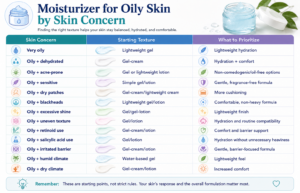
Choosing a Moisturizer When You Have Multiple Concerns
Most people don’t have only one concern. You might have oily + acne-prone + dehydrated skin, for example. In that case, treat your ‘worst’ concern for comfort and ease of your routine.
Oily + Acne-Prone + Dehydrated Start with a non-comedogenic, water-based moisturizer with hydrating ingredients.
If a very lightweight gel dries up tight, opt for a gel-cream and not a moisturizer. Oily + Sensitive + Acne-Prone – Read the label and buy a no-nonsense, simple product. Avoid selecting an oil-free, non-comedogenic moisturizer just because it has an abundance of ingredients designed to combat acne. Your acne medication and moisturizer don’t need to perform the same function.
Oily + Dry Patches + Active Ingredients A gel-cream or light lotion may be more comfortable than a very light gel.
You may also need to reassess the number of products you’re applying, especially active skincare ingredients.
How to Apply Your Oily Skin Moisturizer
Get too much of any product and it’s not going to feel good. For simplicity, try it this way:
- Gentle cleansing.
- Layer on treatment products if you use them.
- Moisten skin a little when you can before applying your moisturizer.
- Layer moisturizer lightly and evenly without piling on a heavy coat.
- Layer on your sunscreen in the morning.
Moisturizing even if you have oily skin is recommended by the American Academy of Dermatology; they also say applying moisturizer when your skin is damp can help keep skin water where you want it.
In Conclusion
Although everyone wants an oily-skin-friendly moisturizer that lets them get on with their lives, it ends up being whichever kind you can put on your skin once and find that it’s happy. This could be a very light gel, gel-cream, or oil free /noncomedogenic formulation, or something a little richer if you suffer from in-and-out oiliness, dry patches, or dehydration. Don’t bother trying to remove all oil or trying to find all-matte finishes.
Just find something that strikes a balance between comfortable and not-fattie.
Make a product choice based on how your skin is naturally more or less oily, dehydrated, the area of treatment, your environment, your skin’s response, and the ebb and flow of your skin, rather than obsessively trying to find an oil free or matte finish.