
 GoBeauty Bay
  Shaista Rafi
Beauty & Lifestyle Content Writer
in
Shaista Rafi writes reader-focused beauty
and lifestyle content for GoBeautyBay,
covering skincare, hair care, makeup,
personal care and everyday beauty topics.
Shaista Rafi
Beauty & Lifestyle Content Writer
in
Shaista Rafi writes reader-focused beauty
and lifestyle content for GoBeautyBay,
covering skincare, hair care, makeup,
personal care and everyday beauty topics.
 Mirza Ibrahim Ali Khan
Editorial Reviewer
in
Mirza Ibrahim Ali Khan contributes to
GoBeautyBay's editorial review process,
focusing on clarity, content structure,
topical relevance and reader usefulness.
Mirza Ibrahim Ali Khan
Editorial Reviewer
in
Mirza Ibrahim Ali Khan contributes to
GoBeautyBay's editorial review process,
focusing on clarity, content structure,
topical relevance and reader usefulness.
Beyond your skincare and work-out regimen-what’s one step you’re taking in your “self-care strategy”? Is this about having a day away from the madness? I understand as the whole notion can be perceived as lavish pampering sessions or exclusive getaways – or simply a day of not having to do stuff.
For me, though, true self-care is really the practice of really looking within understanding our emotions, nurturing meaningful connections, upholding our personal boundaries, and making time for the things we find genuinely uplifting.
That’s where this definition of emotional, social, and personal self-care comes in-these three vital spheres form the foundation of how we feel, relate to others, and care for ourselves as an integrated whole, when practiced regularly can help facilitate a life where you feel more resilient to the stress of everyday life and are able to nurture strong relationships and well-being. Read on to find out how you can effectively include emotional, social, and personal self-care in your life.
What are Emotional, Personal and Social Self-care?
It sounds like it all merges, right? Well, these are three different categories of how you take care of yourself, and though interconnected, each holds a specific meaning.
Emotional Self-Care
Emotional self-care is defined as the processes you’re engaged in when processing your emotions, recognizing your triggers, and developing the capability of responding to the emotions. It is the act of taking care of all your feelings. Other related concepts could be:
- Accepting how you are feeling.
- Self-compassion.
- Journaling your thoughts
- Giving yourself space and time when you feel overcome.
- Communicating with someone trustworthy
- Experiencing rest through meditation or yoga
- Working on healthy ways of processing stress
Social Self-Care
Social self-care is expressed by how you support and develop interpersonal relationships in your life that bring you a connection, joy, respect, and motivation. These relationships may either be the few special friends you call your “inner circle”, or an extended group of casual friends, or even family members.
The following practices may contribute to a stronger social support system:
- Remember to surround yourself with positive influences.
- Don’t be afraid to reach out to your friends and loved ones.
- Be honest with all your relationships.
- Make time to socialize.
- Set boundaries with certain friends.
- Set boundaries with your family.
- Seek support.
Personal Self-Care:
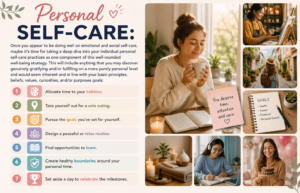
The Importance of Emotional Self-Care
We all go through some amount of adversity and emotional difficulty in our lives, and it is only natural. The fact that we stress about situations, experience frustration or disappointment, sometimes feel lonely or insecure is part of the universal Human experience, but we do not want that the same emotional pain lingers for an excessive period.
Emotional self-care is less about evading or escaping from our difficult or negative emotions for an extensive period of time for our mental health but quite on the contrary, the more we attempt to disregard these kinds of sentiments or emotions for long we do not only increase the risk of our becoming mentally exhausted or detached from ourselves.
Ways to practice healthy and authentic self-care are:
Identify Your Feelings
Don’t say, “I am in pain”. Instead try to label your emotion: “I’m feeling frustrated”, “I’m worried”, “I’m lonely”, or “I’m mad.” Set Aside Some Time There is really no need to rush and to attempt to sort out all your problems right at this second, there is always some time to address what bothers you. Write Down Everything If it helps you organize the feelings and thoughts that are overwhelming you, writing them down in a journal is one practice of emotional and personal self-care.
Self-Compassion
Instead of harsh words to yourself while you are going through an episode/struggle of pain & anger or distress take the perspective from how you would offer comfort, support & understanding to a good friend in the same situation. You deserve that same grace & kindness in your self-treatment.
Give Yourself A Break
Take A Breather At the moment during a stressful situation in your life, take a moment from your current duty or action to just stop for few minutes.The physical activity you may choose to focus your attention may range from the quiet contemplation to an upbeat listening experience music or even just taking deep and intentional breath to restart your mind.
1. Recognize your personal emotional needs
Are you feeling overwhelmed Lately?
Am I ready for a day off?
What the stressor in my life this week?
Am I lonely or stressed?
How about in the next phase?
Am I to open when i do not want to have certain conversations with others in my circle of influence or acquaintance?
What I need in terms of emotional support?
By constantly check on us we realize some important aspects of self-care.
2. Manage your healthy boundaries with the relationships that you value most
Healthy boundaries help us to manage conflict with others and to protect ourselves from becoming overwhelmed.
Some Examples Of Healthy Boundaries are not to answer work text
Messages once working hours are over.
No” is a powerful choice, and even if other parties are not thrilled by your refusal, your physical or emotional health should always prevail over other people’s wishes or expectations.
Not to socialize when you really need a little time to recharge and to reconnect with yourself and the people close to your heart.
It is easy to be persuaded when you care for another person, but at the same time, you need to protect yourself with healthy boundaries.
3. Socialize with people that lift and excite you
Building supportive and satisfying relationships is a huge part of overall wellness. Choose the people who bring joy and balance to your life as your close allies.
The most supportive friends or family will: Honor your boundaries
Love and support you
Allow you to be yourself
Ask questions in the Spirit of concern and support
They will be a healthy influence in your life;
so, it is important for us to build these bonds and to nurture them for we only need only few positive influences to keep Us emotionally balanced.
4. Spend quality time with friends and family
Taking part in everyday experiences or simply checking-in with loved-ones via phone or texts creates social connections. Even when you’re pressed for time, schedule brief get-togethers or chats for positive impact. Consider “Let’s grabbing” a cup ofcoffee” or ‘Let’s share dinner” or “Let’s go” out for a walk together.”
5. Build up the courage to ask for help
Sometimes self-care is about not trying to get all your problems addressed all in one, alone.
The truth remains, reaching out for assistance from friends, family members, or a mental health professional (therapist or coach) helps to ease the process.
Remember, having trouble is not a symbol of shame, it merely indicates that you have life that the challenges you face as human.
6. Carve out your own space to practice
You will begin taking time out for yourself each day without anyone’s company; you could include: a chapter of book, a relaxing bath, a soothing music, a few minutes of journaling , or even a walk outside . Taking a few quiet minutes for yourself, whether alone or quiet music in headphones can leave you with improved sense of personal centeredness.”
7. “Reconnect with activities that spark joy.
Your drive, motivation, creativity and confidence will bloom and thrive if you can connect with your passions. Whether you’ve had that a creative outlet, photography or writing, or a hobby such as cooking; give it a go. You’ll be surprised how beneficial “Any activity that fulfils you that you are able to explore during your downtime will prove very rewarding.
8. Treat yourself with respect
If you promised yourself something, then go through with what you stated. Protect yourself against behaviours or actions that will bring shame upon you or bring you disservice. Identify what behaviours and people put limitations on your ability to live life to the fullness of its capabilities and refuse to entertain these influences.
9. Cultivate a healthy relationship with social media.
There is really no need to deny yourself the joy that social media can bring. But do the following to manage well with what they generate.
Limit time with your phone and turn down the volume of notification, or mute sounds and also “follow” or “friend” accounts with contents to inspire, Educate, Motivate , and enrich the feed that you consume.
10. Celebrate tiny wins
Sometimes all our struggles can make it hard for us to be excited about something. A little appreciation goes a long way; be happy of achievements big or small: finishing a task, going to the Gym, getting a good night’s sleep, buying something nice for yourself, talking with someone in a healthy way, taking a little extra time to do things that can recharge us, as you can see from above It is really not so “fancy” to take care of oneself.
Here is sample of daily, weekly plan:
Plan – Daily check my mood, give time for rest, and then unplug from my digital life and plan for the rest of the day. After work I make sure to connect with people and do some sort of relaxing things before sleep.
For Weekly I take a time off from work to be with my friends/family. I also set boundaries for work tasks or clients for work as need. I do make sure to allot some time just for me!
When you might need more self-care
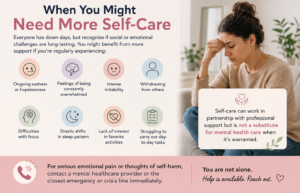
Emotional, Social & Personal Self-Care Checklist
Tick this brief checklist to see how you’re doing:
I make time to become aware of how I’m feeling.
I get enough personal time to decompress and refuel.
I cultivate and invest in quality friendships and relationships.
I communicate my needs effectively and clearly to other people.
I have established personal boundaries that feel good to me.
I make room for things that interest me.
I step away from the stress.
I’m mindful to stop scrolling social media when I can see how many hours, I’m spending doing it.
I notice and celebrate success.
I reach out and ask support from people that matter-friends, family members, confidantes etc.
Summary
Healthy emotional, social, and personal well-being are key components of a holistic approach to supported health living. Physical self-care, mental, emotional, and interpersonal well-being can include many things, from balanced nutrition and adequate rest to active observation of one’s feelings, meaningful interpersonal engagement, the protection of one’s personal boundaries, and attention to life beyond-before-responsibilities.
Start small – a short chat, a moment of fun, a task that is exclusively your own, a healthy boundary, or a modest personal goal.
These seemingly small efforts, over time, can become a robust system of self-care that bolsters your emotions, connections, assurance, and quality of life.