
 GoBeauty Bay
  Shaista Rafi
Beauty & Lifestyle Content Writer
in
Shaista Rafi writes reader-focused beauty
and lifestyle content for GoBeautyBay,
covering skincare, hair care, makeup,
personal care and everyday beauty topics.
Shaista Rafi
Beauty & Lifestyle Content Writer
in
Shaista Rafi writes reader-focused beauty
and lifestyle content for GoBeautyBay,
covering skincare, hair care, makeup,
personal care and everyday beauty topics.
 Mirza Ibrahim Ali Khan
Editorial Reviewer
in
Mirza Ibrahim Ali Khan contributes to
GoBeautyBay's editorial review process,
focusing on clarity, content structure,
topical relevance and reader usefulness.
Mirza Ibrahim Ali Khan
Editorial Reviewer
in
Mirza Ibrahim Ali Khan contributes to
GoBeautyBay's editorial review process,
focusing on clarity, content structure,
topical relevance and reader usefulness.
There’s not a necessity to include dozens of products within an anti-aging skincare routine; the most beneficial ingredients used regularly combined with safeguarding skin against the elements will achieve the biggest impact. An anti-aging routine should be split in the morning and at night as the way skin responds during each section of the day will differ.
You’ll want a good morning routine that defends skin against damage, especially UVA/UVB rays, and an anti-aging evening routine will deal with cleansing, treatment ingredients, hydration and repairing the skin barrier. Effective anti-aging will maintain smoother, more hydrators skin in the long run; there is simply no way of preventing skin aging.
Why You Need Both a Morning and Night Routine
Your skin changes its needs throughout the day. While for the daytime the importance of protection from UV (which adds greatly to premature visible aging of skin such as the onset of fine lines, pigmentation and sagging skin) is a key task in any routine.
However, there is scope during the night to ‘cleanse’ skin of sunscreen, make-up, perspiration and environmental factors that adhere to the skin, while it receives the benefit of certain actives. A routine of what can be applied, when, on a small and simple level, will almost always be adhered to longer, that a complex one.
Morning Anti-Aging Skincare Routine
Your morning skin routine should prioritize protection, hydration, and antioxidants.
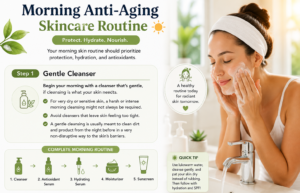
Step 1: Gentle Cleanser
Begin your morning with a cleanser that’s gentle, if cleansing is what your skin needs.
For very dry or sensitive skin, a harsh or intense morning cleansing might not always be required. Avoid cleansers that leave skin feeling too tight.
A gentle cleansing is usually meant to clean dirt and product from the night before in a very non-disruptive way to the skin’s barriers.
Step 2: Antioxidant Serum
A morning antioxidant serum can be an addition to your morning routine.
Vitamin C is one of the most popular antioxidant skincare ingredients. With its ability, depending on skin tolerance and formulation, it’s meant to partner and supplement the effect of sunscreens and more than supplement an even-toned complexion. Other antioxidants are also found in formulas.
If new to active ingredients, only layer one treatment at a time rather than multiple products.
Step 3: Hydrating Serum
Hydrated skin looks and feels smoother, plumper. Skin with moisture drawn in and sealed there thanks to hydrating ingredients like Hyaluronic Acid and Glycerin may help. It isn’t a necessity for everyone, but if your skin looks dried out or stretched, it can certainly help.
Step 4: Moisturizer
This step can and should be customized to your individual skin type and its needs.
A good moisturizer should seal moisture loss from skin and restore skin barrier, A Cream type formulation can be very effective than gel or lotion type for dry skin, for oily or Combination skin a gel or light lotion might do the best, there should be other skin support ingredients such as ceramides and Glycerin along with emollients and occlusive in a formulation.
Step 5: Broad Spectrum SPF
This step, at daytime is non-negotiable to Anti-Aging the skin. Apply a broad-spectrum sunscreen with the correct SPF, generously across all exposed areas. Always remember to re-apply depending on necessity: After sweating, water activities and in relation to prolonged sun exposure.
Remember the ear area, the neck, backs of your hands: we seem to forget this very often in our day to day lives.
If you’re willing to invest in an anti-aging regimen but would usually pass on sunscreen, you are definitely not reaping in any significant rewards.
Night Anti-Aging Skincare Routine
Focus in your evening routine can and should include a great deal of Cleansing, Treatment, Hydration, and Rebuilding for the next day.
1.Cleanse- Remove Makeup and Sunscreen
Even if you typically feel you do well with morning cleansing, your evening routine should include comprehensive cleansing when makeup and/or sunscreen have been worn for extended periods. If you are wearing makeup or sunscreen, start with a pre-cleanse to remove makeup and/or sunscreen. If you do not have a pre-cleanse, then a regular gentle cleanser should be sufficient; do not over-wash or strip the skin-this can cause dryness.
2.Treat-Apply treatment Product
It is generally best to reserve aggressive active treatments for use in the evening:
Retinoids are the best-topically proven ingredient to improve the look of photo-aging; this works at a deep level to improve fine lines and overall skin quality. Use as directed if you are new to Retinoids because too much will over-irritate, you must be careful to begin using it at low levels as recommended on your specific product if you’ve never used Retinoids before. Not everyone should be using every active ingredient, if you have a simple routine your skin will handle well then that should be better than rotating many strong actives in.
3.Hydrate the skin
Use a treatment or serum for further hydration. This would go in at this step if the treatment product does not hydrate your skin. For the best hydration, look for Glycerine, Hyaluronic Acid.
4. Moisturize
. Close the pore and lock in all treatment and hydration. Use if your Retinoids have left your skin feeling dry and if there are additional benefits that a heavier moisturizer provides. Some skin care concerns including very sensitive skin prefer that I layer moisturizer between application of topical, you should follow your product directions.
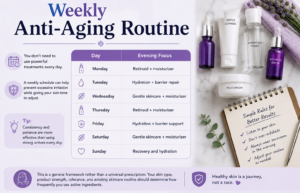
Weekly Anti-Aging Routine
Important Anti-Aging Ingredients to Know
- Retinoids: Retinoids are the standard ingredient to include to combat fine lines, skin texture, and other visual changes related to photoaging.
- Vitamin C: A commonly used antioxidant in the morning to pair with your photoprotective evening routine.
- Niacinamide: Aids in a healthy skin barrier; commonly used for concerns related to tone, oiliness, and overall skin appearance.
- Hyaluronic acid – A water-binding, humectant that plumps up skin making the skin look hydrated.
- Ceramides – A lipid that occurs naturally in the skin barrier and found in moisturizers that aim to strengthen barrier function.
- Sunscreen – Protects the skin from harmful UV rays and is integral in an anti-aging routine.
Anti-Aging Routine based on your skin type
- Dry skin – use gentle cleansing; high focus on ingredients for hydration, moisturize with plenty of emollient-rich products that contain barrier strengthening components.
- Oily skin-light; non-comedogenic moisturizing product, avoid stripping your skin over-cleanse the skin.
- Combination skin-light hydration across the whole face and vary the weight of moisturizer by the area on your face.
- Sensitive skin-use uncomplicated routine; introducing active ingredient by one, do not combine more than one possible irritating products at once.
- For mature skin, hydration is important, in addition to providing support to the skin barrier and applying sun protection, coupled with targeted ingredients that address your concerns.
Most Frequent Anti-Aging Skincare Errors
- Skincare neglect to include sun protection; none amount of investment and advanced treatment will compensate for day light exposure (Lack of sun care, is one, if not, the first thing that causes us to age faster).
- Layering too many active ingredients; multiple highly potent products used concurrently increases skin irritation risk, rather than benefitting your skin with the benefits.
- Radical routine changes; given the treatment your skin undergoes, allow for adequate time to properly observe your skin’s reaction and adjust as necessary.
- Over-exfoliating; not always more, better.
- Disregarding the skin on the neck and hands; these are often exposed as often as other areas.
- Not adequately moisturising; healthy skin barrier is key to comfortable, healthy skin.
How Long Does an Anti-Aging Routine Take to Work?
Skin care benefits are seldom immediate. Hydration may seem relatively quick whereas pigmentation issues, skin texture and fine lines are something that needs consistency. Time frames vary depending on the ingredient, formulation, frequency used, your own skin and what you are treating. Skin care consistency is better then the constant search for new product.
Frequently Asked Questions
Which are my most essential morning anti-aging ingredients?
I feel daily broad-spectrum sunscreen is most important as this will help to protect your skin from UV damage which can cause signs of premature aging of the skin.
Which are the key night-time anti-aging ingredients?
Topical ingredients most used to tackle some of the signs of skin aging have been identified, and retinoids are among the most important ones,although each suit individuals differently and products vary.
Can I use vitamin C and retinoids together?
Both can be key ingredients and can even make a good routine easier to manage and less time intensive as they could be used morning to night (e.g. Vitamin C as a part of a morning routine and the use of a retinoid in a PM routine as part of an anti aging plan).
Daily exfoliating necessary?
Not every day, some people could find this irritates the skin and barrier.
The necessity of moisturisers in the routine of oily skin type.
In the cases of an oily skin, it does not necessitate to neglect with moisturising since the lipids it contained helps to reinforce and maintain the skin barrier.
Last words
Having a beneficial AM, PM anti-aging skincare regime should mean protecting your skin in the daytime, cleaning it in a soft way, reasonably utilize its active ingredients and support and keep its barrier with sufficient hydration.
You can’t have a full cabinet of skincare in the fight against aging; you need basics at first– cleanser, moisturizer, sunscreen and 1 treatment active ingredients– and can slowly incorporate other products as your skin comes to need and accept them.
An anti-aging routine that makes sense to you and that your skin can tolerate will always be the most successful one.