
 GoBeauty Bay
 Shaista Rafi
Beauty & Lifestyle Content Writer
in
Shaista Rafi writes reader-focused beauty
and lifestyle content for GoBeautyBay,
covering skincare, hair care, makeup,
personal care and everyday beauty topics.
 Mirza Ibrahim Ali Khan
Editorial Reviewer
in
Mirza Ibrahim Ali Khan contributes to
GoBeautyBay's editorial review process,
focusing on clarity, content structure,
topical relevance and reader usefulness.
Vitamins form an important part of nutrition and normal skin function. It is the right vitamin for skin if you look at what the problem is that you are trying to correct. Dryness, acne, dark spots, fine lines and wrinkles, and other aging signs can all have many causes so a single vitamin “skin”…
Some vitamins are particularly relevant to skin biology: It supports in collagen manufacturing, add antioxidants; Different derivatives of vitamin A (retinoids) are very popular in skin care for their beneficial effects in acne, weathered skin and uneven skin tone; Derivatives of vitamin B3 (e.g. Niacinamide) are relatively widespread in skin care.
Here is the gist: treat “getting the nutrients through your food,” “taking the supplement(s) when you need it,” and “using vitamin-based ingredients on your skin” as three different things.
Vitamins for Dry Skin
Vitamin A
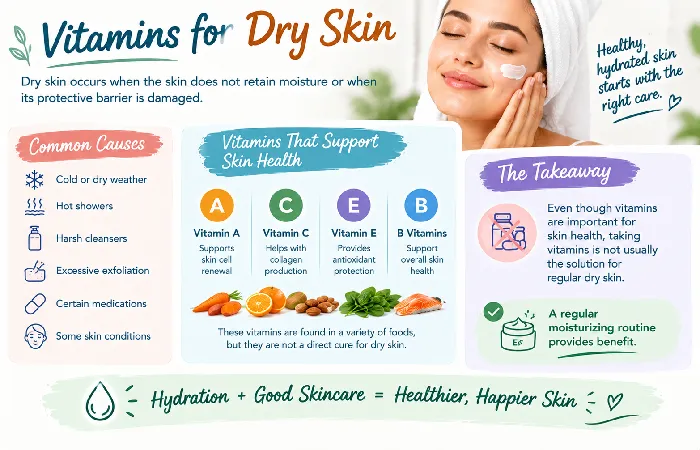
Vitamin A is important for cell growth and development. However, taking much vitamin A can actually cause skin to become dry and produce other symptoms. Therefore, vitamin A supplements should not be used casually as a skin treatment.
Topical retinoids can also cause skin to become dry, peel and turn red. They can feel irritating especially when first used. If one uses a retinoid moisturizing becomes especially important.
Vitamin B3
Vitamin B3, niacinamide is used in many skin care products. It can be included in moisturizers and skin care serums.
For skin, a simple moisturizer with barrier supporting ingredients may be more beneficial than providing actives all at one time.
Vitamin E
Food and topical vitamin E What is vitamin E? Vitamin E can be consumed as an oral supplement or topically on the skin and can be found in lots of skin care products in the form of lotions, creams and oils.
But that shouldn’t be at the cost of other effective skin moisturizers. An AAD researcher and dermatologist said choosing a moisturizer based on the severity of the dryness is better. “In general, heavier, more emollient forms like lotion, cream and ointment typically give you more moisture, and ceramides and hyaluronic acid can help too,” Bowe said.
Best Way for Dry Skin
– A gentle, fragrance-free cleanser
– When there’s a need for more moisture, a cream or ointment.
– Ceramides – glycerin or – hyaluronic acid
– Moisturizing on damp skin
– broad-spectrum sunscreen
– Avoiding too much exfoliation
Supplements of vitamins would therefore not be used in the attempt to improve moisture retention and to protect the skin barrier.
Vitamins for Acne-Prone Skin
Acne can involve products and processes such as skin cell buildup, oily skin, inflammation and changes to skin bacteria. Not all of these can be remedied by using vitamins.
Vitamin A and Retinoids
The other vitamin-like substances include vitamin A members used to treat the acne.
Retinoids These are ingredients such as adapalene, tretinoin, tazarotene and triacontane. Open the pores. How long does it take for Retinoids to work?
These ingredients can be used to treat acne.
These ingredients can help improve the texture and tone of your skin.
Retinol is another vitamin A derivative that is often found in beauty skincare. It is usually less strong than prescription retinoids. It is widely used in products that target texture, pigmentation and signs of aging.
Because retinoids can irritate skin introduce them slowly and use a moisturizer.
Vitamin B3 and Niacinamide
Acne-prone skin: Vitamin B3: Niacinamide is a vitamin B3- derived ingredent.
What is it? Can be found in serums and moisturizers. Frequently used with ingredients that are designed to treat skin prone to acne.
Tip to keep in mind: topical niacinamide is not the same thing as oral vitamin B3 supplements. Your dermatologist can apply the ingredients directly to the skin, or it can be sent to your body through an oral supplement.
Vitamin C
Vitamin C is an antioxidant. It is needed for collagen production. It is also often used in skincare for skin tone and signs of environmental skin damage.
Vitamin C is not an acne treatment. It may have a role in a routine especially when post-acne dark marks are an issue.
Moisturizer Still Matters
Acne-prone skin often feels greasy and can be prone to breakouts so people often avoid using a moisturizer. Acne treatments such as benzoyl peroxide, salicylic acid, adapalene, tretinoin and isotretinoin all have a drying effect on the skin.
If your skin is dry, the AAD says to look for moisturiser that are classified as: oilfree noncomedogenic (meaning they won’t clog your pores).
Vitamins for Aging Skin
Skin changes naturally as you get older. Fine lines, wrinkles, uneven pigmentation, dryness and changes in firmness can become more visible over time.
Even though nutrition helps with skin function, topical skincare and sun protection are usually directly important for signs of skin aging.
Vitamin C for Collagen Support
Vitamin C is involved in the production of collagen. Collagen is a protein that provides strength and support to tissues. Vitamin C is also an antioxidant.
Vitamin C serum can also be applied first thing in the day for your morning routine. The AAD states that vitamin C is a research-supported skincare ingredient that is good for the signs of aging and the dark spots.
A simple morning routine can be:
**Cleanser → Vitamin C serum → Moisturizer → Sunscreen**
Vitamin A and Retinoids
Retinoids are among the vitamin A‑derived ingredients used for signs of aging.
They can help with:
– lines
– Wrinkles
– Uneven textur
– Dark spots
– Some types of acne
The AAD says retinoids can treat lines and wrinkles, acne and dark spots while making skin texture better.
Retinids are usually used at night. Starting slowly can help reduce irritation for people with skin.
Vitamin E
Vitamin E is an antioxidant. It is often used with ingredients in skincare products.
However there is a difference between using antioxidant‑skincare to help skin and expecting a vitamin E supplement to get rid of wrinkles. Supplements should not be seen as a replacement for sunscreen, moisturizer or proven topical treatments.
The Important “Vitamin” for Aging Skin: Sun Protection
When talking about vitamins for aging skin it is easy to forget how important sunscreen is.
The AAD says sunscreen and moisturizer are two of the anti‑aging skincare products. A spectrum water‑resistant sunscreen with SPF 30 or higher can help protect skin from UV damage.
This is important because UV exposure plays a role in aging of skin.
A vitamin C serum or retinoid can be part of a anti‑aging routine. Neither takes the place of sun protection.
Vitamins for Dark Spots and Uneven Skin Tone
Should You Take Vitamin Supplements for Skin?
Not automatically.
A balanced diet usually gives the vitamins you need for health. Supplements can be helpful when a deficiency is present dietary intake is not enough or a healthcare professional suggests them for another reason.
Taking more of a vitamin does not always lead to skin. In fact some vitamins can cause problems when taken in amounts.
Biotin is an example. It is often advertised for skin, hair and nails. The NIH says there is no proof that these benefits work in people without a deficiency. High‑dose biotin can also affect some lab tests.
Vitamin A is another example because much pre‑formed vitamin A can build up in the body and cause toxicity.
A Simple Vitamin‑Focused Skincare Routine
Morning
- Use a cleanser.
- Apply vitamin C if skin has a benefit for your skin.
- Apply moisturizer.
- Finish with broad‑spectrum SPF 30 or higher.
Evening
- Cleanse gently.
- Apply a treatment like a retinoid if recommended for skin and tolerable.
- Apply moisturizer.
If your skin is introduce ingredients slowly rather than adding several new products at once.
What to Choose by Skin Concern
For Dryness
Focus on **moisturizers and barrier support** of vitamin supplements. Ceramides, glycerin, hyaluronic acid and richer cream or ointment types can help.
For Aging
Make sure to use sunscreen and moisturizer every day. Vitamin C can be helpful in the morning while retinoids can help with lines, texture, pigmentation and acne.
For Dark Spots
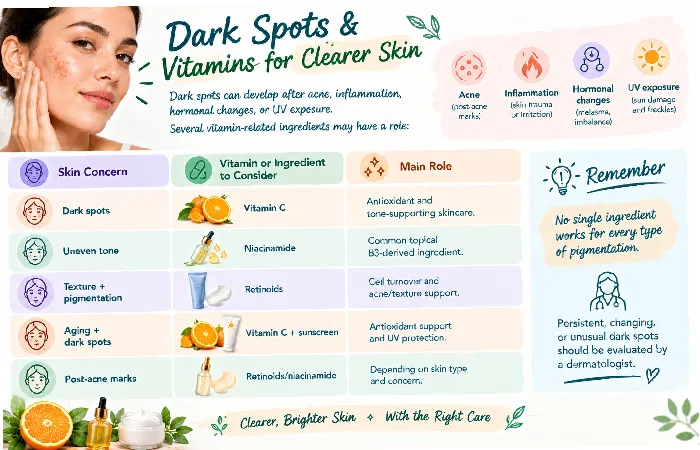
Vitamin C, niacinamide and retinoids may all play a part depending on what’s causing the spots and how well skin can handle them. Sunscreen is still very important because sun exposure can lead to pigmentation and signs of aging.
FAQS
Which vitamin’s best for skin?
There is no one vitamin that works for everyone with skin. A moisturizer that has ingredients that help the skin’s barrier is usually better than taking vitamin supplements.
Which vitamin is best, for acne?
I have noticed that Vitamin A products, especially retinoids that you apply to the skin have a proven role in treating acne. I also see that Vitamin B3, known as niacinamide can be helpful in skincare depending on how Vitamin B3’s made and which problem you have.
I wonder which vitamin is best for aging skin.
I find that Vitamin C and retinoids from Vitamin A are often used to deal with signs of aging. I also find that using sunscreen and moisturizer every day is very important for an aging routine.
I wonder if vitamins can remove wrinkles.
Vitamins do not get rid of wrinkles. Some vitamin-based products, retinoids, can make fine lines and skin texture look better over time. Expectations are important.
I wonder if I should take biotin for skin.
I think biotin is important. I also think there is no proof that taking a lot of biotin helps skin in people who already have biotin. I know that taking a lot can also affect some lab tests.
Final Thoughts
I know that the best plan with vitamins for skin depends on what problem you’re dealing with.
I think the focus should be on keeping the skin moist and protecting the skin barrier. I also think that for acne retinoids from Vitamin A are important. I know that using moisturizer can help make acne treatment easier to handle. I feel that for aging and uneven tone Vitamin C and retinoids can work well as products you put on the skin, with sunscreen giving the protection you need every day.
I understand that vitamins used in skincare and vitamins you take as food are not the same. I know that a healthy diet gives your body the nutrients it needs while vitamins you put on your skin can focus on skin problems. I believe supplements are best when there is a need or when a doctor says to take them not just because a product claims to make skin look healthier.