
 GoBeauty Bay
  Shaista Rafi
Beauty & Lifestyle Content Writer
in
Shaista Rafi writes reader-focused beauty
and lifestyle content for GoBeautyBay,
covering skincare, hair care, makeup,
personal care and everyday beauty topics.
Shaista Rafi
Beauty & Lifestyle Content Writer
in
Shaista Rafi writes reader-focused beauty
and lifestyle content for GoBeautyBay,
covering skincare, hair care, makeup,
personal care and everyday beauty topics.
 Mirza Ibrahim Ali Khan
Editorial Reviewer
in
Mirza Ibrahim Ali Khan contributes to
GoBeautyBay's editorial review process,
focusing on clarity, content structure,
topical relevance and reader usefulness.
Mirza Ibrahim Ali Khan
Editorial Reviewer
in
Mirza Ibrahim Ali Khan contributes to
GoBeautyBay's editorial review process,
focusing on clarity, content structure,
topical relevance and reader usefulness.
Finding a foundation shade that allows for a naturally flawless application versus a heavy foundation application has a lot to do with finding the right match for your skin tone and undertone, not to mention skin type and the formula/finish of the foundation you select. With that, any foundation you choose should not stand out differently than the surrounding skin on your face, along your jawline and on your neck. Below outlines how to choose a foundation shade by identifying and determining your skin undertone, properly testing each foundation formula, and picking out a base suitable for your skin.
Why Is foundation Shade Matching Important ?
Foundation is meant to even out your complexion while still allow you to look like you! To do so effectively, your shade cannot appear noticeably lighter or darker (in terms of pink, yellow, orange, and Gray) than you. Foundation matching can allow for:
- A evener complexion
- A more natural makeup application
- A reduction of visible foundation line (which separates skin tone from formula tone)
- Complementing your undertones
- A cohesive, blindable makeup look
When foundation matching from online retailers, foundation colours can often be mistaken from one another because product image lighting can vary and will rarely match up to what a shade looks like in person.
Skin tone vs. Undertone
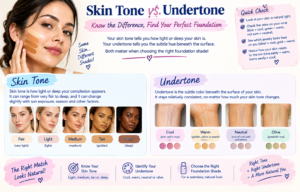
For you to be able to accurately pick out foundation that best complements your skin tone, the difference between skin tone and undertone must be clarified.
Skin Tone:
Skin tone is a surface measurement (which measures how light and deep your complexion looks in terms of light to dark). This typically runs from fair to rich deep tones with medium and tans in between, depending on your exposure to sun and changes of the seasons. Skin tones will fluctuate, and when it comes to your shade of foundation, it’s important to know which foundation shade matches best during that time.
Skin Undertone:
This is a subtle tint to your skin. Your undertones will not change, and typically come in categories of Cool, Warm, Neutral, Olive tones, etc. Your undertone helps a cosmetologist get closer to the shade needed and can allow makeup to seem more natural on a client when the two undertones match.
If both cool tones (pink, Rosy, Red) and warm tones (golden, Yellow, Peach) blend equally with certain foundation shades you may be neutral.
Olive undertones are characterized by yellow or green undertones.
Undertone Testing (Identifying yours)
There is NO single test to accurately determine your skin’s undertone; here are some different indicators to help you find yours:
Your Undertone Guide
You can check to see what undertones make your skin look most harmonizing and appealing when they are displayed next to both red and yellow tones on a wall or card. This test shows what your skin is doing differently when under and near both warm and cool tones (in this case, it’s the red compared to the yellow).
- Cool: Skin will either have red and pink tones or has a blue to purplish tint and looks better when near cool tone paints. The vein check method could also indicate you have a Cool undertone. Check the veins on your wrist. If you mostly see blue and purple tones running through them, you have a cool undertone.
- Warm: Skin tone will look golden and more yellow but also have a peachy/sun-kissed tone depending on your foundation’s formula. If you appear to wear jewel tones more easily and have golden or yellow veins on your wrist, you will be a warm undertone as well. Your foundation colour will complement best if yellow, gold, or peach tints are included in the makeup application.
- Neutral: Skin tone will have little to none of pink or yellow tones, with some green tints as well, and can work well with any tone of foundation whether warm or cool. Check the color of the veins on your wrist, when if they seem neither warm (Yellow) or cool (Pink/Blue), you most likely have a neutral undertone. If an even mix, consider blending.
- Olive: Skin will either show a slightly green, or very dull green tint and works best with warm foundation hues. Many times, ” Olive skin tones” are assumed warm, yet can be unique because there is greener mixed in than yellow. Olive undertones usually look best with a more golden foundation colour as opposed to one with deep red tints, you might wear gold, deep browns, and earthy tones well and see a multitude of colour tones in your veins.
How to properly test foundation for best match
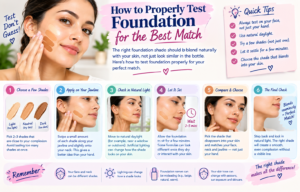
This is often tricky to get right but will give you the closest outcome to finding your true match. The most common test done when seeking out foundation is the one done on hands. However, if you are not of the same skin tones as your hands it will throw your matched foundation shade off. The correct way:
- Pick two to three foundation shades that most closely appear similar to your skin tone in terms of colour and matchings undertones.
- Dip the side of your fingertip into one product at a time and create a small stripe along your jawline (extending slightly onto your neck also as sometimes the two have variations from one another).
- Wait a few minutes. Some foundation colours can oxidise which changes their shade after being in your skin for a bit.
- Once they’ve been on there for some minutes look from left to right to see how it blends between areas and is indistinguishable from skin.
The correct matched shade should be the colour that disappears from view into your skin without seeing a line to differentiate face from makeup.
Skin Type Foundation Choice
Now that your skin undertone has been identified, and a proper selection of formulas that work well with that tone has been narrowed down. The formulas chosen would be based on skin type and formula type.
The four most common foundation formulas are: Cream foundation, Liquid Foundation, Stick Foundation, and Powder Foundation.
- Cream: Cream foundation often can be slightly denser and is more suitable for skin that is drier or is experiencing mature skin. It typically provides good coverage, but not too heavy that it settles into any fine’s lines or textures. These formulas contain higher amounts of emollients and humectants that moisturize and rehydrating the skin.
- Liquid: Liquid foundations are arguably the most versatile foundation choice as they come in different undertones, finishes, oil control methods and thickness for skin from oily to dry, light coverage to full coverage.
- Stick: Stick foundation has a firmer makeup texture and is one of the best for longer lasting coverage when used over primer as a corrector. It’s also very convenient for touching up any areas throughout the day as it’s easier to handle. These formulations have an emulsion of water and oil, which provides moisturizing but not drying effects; yet stick foundation can often be found with very few oil based ingredients too that have an emphasis in oil control. If you want good-coverage and aren’t concerned with a bit more intensity it will work great.
- Powder: Powder foundations can work well for very oily skin or if someone who does not wish for skin that appears too dewy. This makeup selection offers a lighter coverage that blends more seamlessly if chosen in the right formula shade and can absorb any unnecessary oiliness that might arise throughout the day. They also provide a completely matte finish as it removes excess oils in the skin. For better result use it with your foundation brush in outward & upward strokes across the whole face for more an even application as well.
Foundation And Skin Type Formula Preferences:
- Normal: Normal skin types often work best with any of these types of foundation, it really depends on desired level of finish desired… Radiant, matte, natural, and coverage preference. Natural/ satin finishes and buildable coverage shades are often preferred with liquid, cream, or powders for ease.
- Dry: Drier skin types often work best when they are supplemented by foundations that contain hydrating ingredients. Liquid and cream foundations with a satin, luminous or dewy finish are typically best as matte and/or higher coverage textures often leave their skin looking flaked and unnatural as a more noticeable sheen in certain dry areas.
- Oily: Oily skin types often work best with foundations that can absorb unwanted oil and leave the skin with a matte finish. Powder and certain types of matte foundation are always popular picks for oil-controlling. These are often called “long wearing” or “matte finish”.
- Combination: A combination skin type needs a foundation to cater to all the diverse parts of their complexion so formulas with a medium, buildable finish, or even a natural-looking formula can adapt well. Applying mattifiers to oily regions of skin while moisturizing the dry regions of the face prior to makeup application can be a useful strategy.
- Sensitive: With extremely sensitive skin types a brand should be tried where formulas come free of scent, fragrance and potential allergens and irritants present in different formulations on skin. Before applying a face anywhere along one’s facial skin a patch test is strongly encouraged.
- Mature: If an option to keep skin moisturized and less flat appearance can be given with formula applied such as lighter makeup it does wonders for more mature skin. Using a product with lightweight fluid ingredients will give a luminous finish to their skin and will appear less cakey and creased into its naturally formed lines and texture. If you desire a full coverage product on the other hand, it must contain hydrating ingredients.
Choosing the best foundation formula
Foundation shade isn’t the only thing that is important to take into consideration though. Different formulations can provide you with varying consistencies, levels of coverage, and types of finish.
- Liquid foundation is most universally used and comes with all varieties of shades, finishes, and tones.
- Cream foundation is a richer foundation and could be a great alternative if your skin tends to be very dry.
- Stick foundation is highly compact and can provide you with a fuller/buildable foundation.
- Powder foundation provides you with a lighter coverage and is suitable for skin which suffers with unwanted shine.
- Choose the formula that suit your skin type and wanted finish best.
FAQS
What to do to make sure your foundation shade isn’t too light or dark?
Foundation that is a shade lighter than your skin tone will make your complexion look rather washed out and a shade darker than your complexion may result in a visible difference to the color of your neck.
In order to choose what shade your skin is closest to, test both shades against each other side by side on your jawline and take notice, also check it in natural daylight. It may need to settle for a little before a conclusive decision can be made. If trying to get a tanned look from the start, don’t just jump at the darkest tone as this will make it obvious and if you change your skin tone and then are using the wrong foundation colour will lead into a bigger problem. Bronzer and other colour enhancing makeup products may come in handy for tanned effects.
Which is the common mistake for foundation shade matching?
- Avoid the following mistake to have a great choice in foundation shades:
- Don’t just try on foundation just from the test bottle.
- Don’t choose a foundation just by what you see in the bottle
- Don’t ignore your own undertone when choosing a foundation.
- Avoid comparing shades when shopping under bright artificial light.
- Avoid choosing a foundation with darker colors with the purpose of getting a tan look
- Avoid deciding before comparing so to make sure it doesn’t require too much application before seeing the colour
- Remember that skin tone is temporary and can alter in different season, for this reason have 2 colors side by side for the most suitable shade depending on what time of the year it is.
- Don’t assume that just because the shade has the same colour code such as, natural, warm beige, ivory or neutral on, will mean that it’s on the same depth of colour. You should always test each product so to work out its consistency within the skin.
Buying foundation online and what to do?
It may be quite frustrating and difficult to buy your foundation when it’s all displayed via screen, this could make the colors look different to how it is when in natural light, and images may be portrayed in slightly different lighting situations.
When buying online you can always take a look at what colors they provide, also check the descriptions on the skin tones, compare the different shades of what you feel would match by using the descriptions, then after that comparison, pick and decide the one that most suits and that you feel fits you the most. After that read their shade matching guide and if there’s a return policy, always use it. Also, compare the images of skin tones to yours, just don’t use one picture and you may be in for more hope than buying what looks right on the screen.
Online shade-matching could also help and guide you, even so use these as basic guidelines only, as screen appearances vary.
Is your foundation shade always going to stay the same?
Your chosen foundation shade can change over time; it might depend on various factors of life. The skin could turn a more tanned colour due to sun exposure in certain periods, changes in skincare products could give the skin a different tone, tanning can also affect skin tones, depending what brand you use too. All these factors could alter you’re most suited shade, or it may vary between each season. Buying one of the shades beside what your normally wear can often assist with your ever-changing skin tone.
Checking foundation shades when buying a foundation quickly:
To find your exact shade before buying, ask yourself a variety of questions so to obtain one.
- What is my skin tone?
- What tone is my skin?
- Have I applied and tested this foundation on my jawline?
- Is there a visible difference between this and the skin color tone of my neck?
Do they look identical when in the natural daylight?
What finish is your skin needing and how does this foundation fare?
Is your favourite look made up of a radiant or matt finish, as this type of foundation comes with a particular tone that may enhance them differently.
Does the foundation skin colour tone still look same after applying it on?
The final thoughts
The truth is that it might be better to just match the colour to what complements your individual skin type and tone, not what colour you think would best suit you. Just know, that by using the above ideas, you should never end up again with a complexion-popping bright makeup, but instead an even and beautifully natural look that will compliment you!