
 GoBeauty Bay
 Shaista Rafi
Beauty & Lifestyle Content Writer
in
Shaista Rafi writes reader-focused beauty
and lifestyle content for GoBeautyBay,
covering skincare, hair care, makeup,
personal care and everyday beauty topics.
 Mirza Ibrahim Ali Khan
Editorial Reviewer
in
Mirza Ibrahim Ali Khan contributes to
GoBeautyBay's editorial review process,
focusing on clarity, content structure,
topical relevance and reader usefulness.
One of the essential vitamins connected to skin health is Vitamin A. It’s a vitamin that supports normal cell development, immune health and vision. Also it’s the foundation of a category of skincare ingredients called Retinoids.
However, they are widely used in dermatology and more often in skin care because they help to treat skin problems such as acne, blackheads, age spots, uneven skin texture, as well as lines and wrinkles. About retinoids: The most common use of topical retinoids is to treat acne, lines, wrinkles, age spots and uneven skin texture.
Food source vitamin A, cosmetic retinol, and prescription retinoids are different. Comparing what each one does can help you select skincare that’s safe.
What Is Vitamin A?
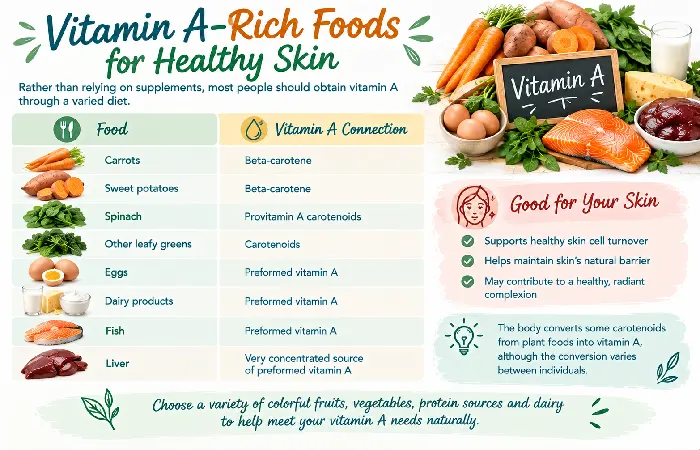
Vitamin A is a vitamin that is fat-soluble. The body needs it for healthy vision, immune system function, growth and development, and cell growth and change. There are 2 forms of vitamin A: preformed vitamin A and provitamin A carotenoids.
Preformed vitamin A [e.g. In the form of retinol and retinyl esters] can be found in:
- Eggs
- Dairy products
- Fish
- Liver and other organ meats
Plant foods contain provitamin A carotenoids. These are best known as beta-carotene, and some of it can be turned into vitamin A by the body. Carrots, sweet potatoes, spinach and other brightly coloured fruit and vegetables contain carotenoids.
If you want healthier skin by eating vitamin A foods, that’s fine. But getting excessive amounts of vitamin A through consumption will not provide a rapid path to improved skin.
What Are Retinoids?
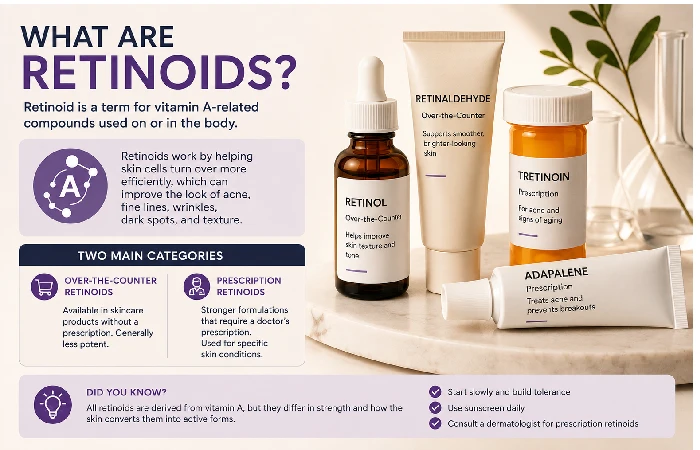
Some examples are:
- Retinol
- Adapalene
- Tretinoin
- Tazarotene
- Trifarotene
- Other prescription retinoids
These ingredients vary in strength, where you can get them how they are. What they are used for.
For example, the AAD says retinol is a type of retinoid often used to deal with skin tone, dark spots and texture while doctors might prescribe retinoids like adapalene, tazarotene, tretinoin or trifarotene for acne.
Vitamin A Benefits for Skin
1. Helps with Normal Skin Cell Growth
Vitamin A is very important for cell growth and change.
Since the skin is always renewing itself enough vitamin A is needed for skin care. Vitamin A also helps the working of tissues in the body.
A lack of vitamin A in the diet can harm skin health.
However people who already have vitamin A do not usually get more skin benefits by eating too much.
2. Retinoids Can Help Treat Acne
One of the known uses of retinoids on the skin is to treat acne.
Acne often happens when pores get blocked with oil, dead skin cells and other stuff. Retinoids can help clear pores and stop breakouts.
The AAD says that topical retinoids are a treatment option for acne.
Adapalene is available without a prescription in some places while other retinoids might need a doctors advice.
Retinoids can be especially helpful for:
- Blackheads
- Whiteheads
- Mild to moderate acne
- Recurring blocked pores
- Acne with texture
If acne is still there hurts a lot is very bad or leaves scars seeing a professional might be the best choice.
Retinoids for Fine Lines and Wrinkles
Retinoids are also known for helping with signs of aging on the skin.
The AAD says retinoids can treat fine lines and wrinkles and make skin texture better.
Retinoids are often used in routines because they can make skin more sensitive and many formulas are best for evening use.
A retinoid routine should start slowly not by using it every day from the beginning.
Retinoids for Dark Spots and Uneven Skin Tone
Retinoids can also be useful when there is coloring or dark spots.
The AAD says retinoids are among the ingredients that can help with spots and uneven texture.
Retinoids may be especially helpful when the color change happens with acne or rough texture.
However color changes can have causes. If a dark spot is new, changing, lasting or strange it is better to get it checked of thinking it is just a beauty problem.
Sun protection every day is also important when dealing with color changes.
Retinol vs. Retinoids
The words retinol and retinoid are sometimes used together. They are not exactly the same.
Retinoid is the group.
Retinol is one type of retinoid that is often found in over-the-counter skincare.
Prescription retinoids can be stronger. Are used with a doctors help for issues like acne and other skin problems.
This difference is important because stronger doesn’t always mean better for everyone. A product should fit your skin problem how your skin reacts and what you need.
How to Use Retinol in a Skincare Routine
If you are adding a retinol product from the store a simple routine can help avoid irritation.
Evening
- Gently wash your skin.
- Let your skin dry.
- Put an amount of retinol on your skin as the product says.
- Add moisturizer after.
People with dry skin might want to use retinol less often.
The AAD says if a retinoid is too dry using moisturizer can help with dryness and make it easier to use.
Don’t use product than the instructions say. Using more doesn’t make results faster. Might make irritation worse.
Common Retinoid Side Effects
Retinoids can cause irritation especially when you first start using them.
Possible effects are:
- Dryness
- Peeling
- Redness
- Stinging
- Burning
- More sensitivity
- Flaking
That is why starting slowly can help.
If the irritation is bad stop the product. See a professional.
Using strong active ingredients at once can also cause more irritation. A simple routine with a cleanser, moisturizer, retinoid and sunscreen might be easier to handle than a routine with many exfoliating products.
Who Should Avoid Retinoids?
Pregnancy needs care with vitamin A products.
The AAD says people who are pregnant or nursing should not use products with retinol or retinyl palmitate.
Prescription oral retinoids have risks during pregnancy. Getting much preformed vitamin A can also cause birth defects.
If you are pregnant thinking about getting pregnant, nursing or not sure if a retinoid is right for you talk to your doctor before using it.
Vitamin A Supplements and Skin
Unless you have a health or nutrition-related reason to take these supplements, shouldn’t need a supplement.
Vitamin A is fat-soluble, meaning the excess can be stored in your body. Too much preformed vitamin A might have health risks, including headaches, nausea, dizziness, muscle pain and liver damage.
The RDA for adults is 3,000 mcg RAE of vitamin A per day from all sources (see note below).
Vitamin A is especially dangerous during pregnancy, because overuse of preformed vitamin A will cause birth defects.
Vitamin A-Rich Foods for Healthy Skin
Retinoids and Sunscreen
If you are using a retinoid, be sure to use extra caution when exposing yourself to the sun.
A good daytime routine can include:
Morning:
Gentle cleanser Moisturizer Broad-spectrum sunscreen
Evening:
Cleanser Retinoid Moisturizer
As UV exposure is one of the main causes of premature skin ageing and pigmentation, sunscreen is a must.
That is why Retinoids should only ever be one part of your skin care routine and not instead of always using a good daily Sunscreen.
Retinoids During Isotretinoin Treatment
Prescription retinoid (acne medication) Isotretinoin is an oral prescription retinoid (acne medication) used to treat severe acne.
Isotretinoin is a type of vitamin A. And, the AAD advises, Anyone taking isotretinoin should not take vitamin A supplements unless your doctor has told you to do so. You should also steer clear of retinol that is applied to your skin, say the experts at the AAD.
You can opt to repeat the course of it with your dermatologist’s recommendation rather than trying to go on yourself combining several components in one go.
Frequently Asked Questions
Is vitamin A good for skin?
Yes. Sufficient vitamin A is needed for cellular growth and development. Retinoids form vitamin A are known for their topical application for acne, blemishes, aging skin and uneven texture.
Is retinol the same as vitamin A?
What is Retinol? What Are Retinoids? Retinol is one of several types of vitamin A-related retinoid used in skin care. The more general term “retinoids” refers to retinol and other vitamin A derivatives.
Is retinol good for acne?
Retinoids are an evidence-based acne treatment that can help clear pores and prevent further breakouts.
Can retinol reduce wrinkles?
Retinoids will increase the appearance of fine lines and wrinkles, and can improve skin texture.
Can retinol remove dark spots?
Retinoids can aid in the correction of dark spots and darkening, although the extent of correction will vary depending on the nature of the pigmentation.
Can I use retinol every day?
Others can progressively handle daily use. It is best to start slowly if you are a beginner. Overdoing it and your skin becoming overly dry, tight or flaky may mean you need to cut back the frequency of use or switch to using moisturizers.
Can I use retinol during pregnancy?
The AAD recommends that you avoid using retinol and retinyl palmitate while pregnant or nursing.
Is vitamin A supplementation good for skin?
Vitamin A should not be used as a beauty supplement. The body’s reserves of preformed vitamin A can be damaging, and any vitamin A supplements should be used in the context of nutritional or medical need.
Wrap-up On
Vitamin A plays a vital nutritional role in normal cell development and health, whereas retinoids happen to be among the most important vitamin A -based ingredients in dermatology and skincare.
They are mainly used for; Acne, open and closed clogged pores, rough textures and texture irregularities, pigmentation, age spots, and fine lines and wrinkles.
For cosmetic use, start using it by itself with a mild cleanser, moisturizer and daily sunscreen. Use stronger prescription retinoids as directed.
And for the record – never get confused between taking topicals and vitamin A in supplement form. Too much vitamin A can be dangerous and, of course, you need to be super careful during pregnancy with preformed vitamin A and drugs that contain retinoids.
What’s wrong: We’re not using the strongest Vitamin A product we can find. What’s right: We are selecting the most suitable form, loading it gently into the routine, and applying it regularly.