
 GoBeauty Bay
 Shaista Rafi
Beauty & Lifestyle Content Writer
in
Shaista Rafi writes reader-focused beauty
and lifestyle content for GoBeautyBay,
covering skincare, hair care, makeup,
personal care and everyday beauty topics.
 Mirza Ibrahim Ali Khan
Editorial Reviewer
in
Mirza Ibrahim Ali Khan contributes to
GoBeautyBay's editorial review process,
focusing on clarity, content structure,
topical relevance and reader usefulness.
Vitamin E is a Fat-Soluble Nutrient and an Antioxidant – Helping Cells Protect Against Damage Caused by Free Radicals Which Occur in the Environment and as a Result of Other Underlying Processes – Naturally Occurs in Nuts, Seeds, Veggie Oils and Green Leafy Vegetables. Vitamin E is also found in Moisturizers, Facial Oils, Serums, Creams and Other Cosmetics.
What are the advantages of vitamin E for skin?
To support the skin, vitamin E can be taken with food as part of a healthy diet. Applied directly to the skin vitamin E may provide protection and keep skin moist. The advice on dosages is to stay realistic as, although research studies and experiments indicate how vitamin E could benefit skin, solid clinical evidence for a few of its uses is lacking.
Knowing about the differences between vitamin E, as a supplement or as a skincare, can help you determine if/how you want to add it to your routine.
What Is Vitamin E?
Vitamin E is not just one thing – it’s a family of water-soluble compounds with four tocopherols and four tocotrienols. The most commonly found in nature, and most utilized by the body, is alpha tocopherol, which is the primary source of vitamin E.
Provides antioxidant Vitamin E is an antioxidant. Meaning it can assist protect the cells from damage caused by molecules called radicals. These molecules are produced naturally in the body, and exposure to things like cigarette smoke, air pollution, and UV rays can cause them to increase.
As skin is exposed to many external influences, vitamin E has become a popular substance for skin care and dermatology.
Vitamin E Benefits for Skin
-
Provides Antioxidant Support
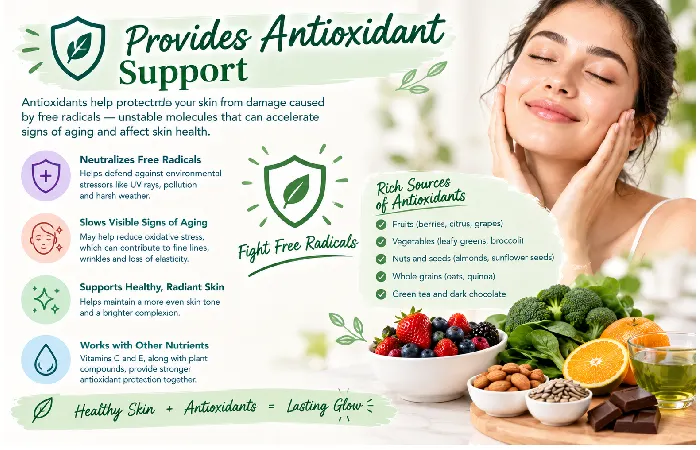
One of the most recognized properties of vitamin E is its function as an antioxidant.
It may also help damage skin cells. This is particularly valuable as skin is under persistent attack from pollution, UV rays and similar.
Vitamin E at the skin level has been examined as to its properties of protection of the skin against stress and damage caused by UV rays. Different effects are obtained with different items and studies, so it cannot be a substitute for sunscreen.
A good skincare routine should still include broad-spectrum sunscreen whenever needed.
-
Supports the Skin’s Protective Barrier
Vitamin E is a soluble antioxidant that occurs naturally in skin tissue.
Research in dermatology suggests that vitamin E may help support the skin’s barrier function and protect it from damage. More controlled clinical studies are needed to confirm specific benefits.
In skincare products vitamin E is often mixed with oils and moisturizing ingredients. This makes it common in products designed for dehydrated skin.
-
May Help Support Dry-Looking Skin
Vitamin E is commonly found in moisturizers, creams, lotions and facial oils.
Its appeal for skin comes from how well it works with lipid-based products. Products with vitamin E may make skin feel softer and more comfortable especially when combined with emollients and occlusive agents.
Vitamin E alone should not be seen as a cure for chronic dry skin.
If your skin is dry, painful cracked, itchy or has a rash it’s best to see a healthcare provider to find out what’s causing it.
-
Provides Support in Anti-Aging Skincare
Oxidative stress and long-term exposure to UV rays can lead to visible signs of aging
Because vitamin E is an antioxidant it’s often included in -aging skincare products. Studies have looked into its effects against UV damage and how it helps maintain the skin barrier.. More strong clinical evidence is needed for many of the claims.
So vitamin E can be an ingredient in skincare but it shouldn’t be expected to work alone as an anti-aging solution.
For lasting skin protection sunscreen is more important than relying on an antioxidant cream.
Vitamin E and Sun Protection
Vitamin E has been studied for its role in protecting skin from UV-related damage.
Some research suggests that topical vitamin E may offer benefits especially when combined with other antioxidants like vitamin C.
But this does not mean vitamin E can replace sunscreen.
If you are worried about aging, dark spots or sun damage use broad-spectrum sunscreen and follow sun protection measures.
Vitamin E should be seen as a supporting ingredient, not a substitute for sun protection.
Vitamin E for Dark Spots and Uneven Skin Tone
Vitamin E is sometimes promoted as a treatment for pigmentation, scars and dark spots.
The evidence is not strong enough to say that applying vitamin E alone will clear dark spots.
Studies have looked at vitamin E used with ingredients and in different skin conditions but high-quality clinical proof for many cosmetic uses is still lacking.
If dark spots are your concern, other ingredients with stronger evidence may be better choices depending on the cause. Sunscreen is also essential because UV exposure can make pigmentation worse
Vitamin E for Scars
Vitamin E is one of the common home remedies for scars.
Research does not support the idea that using pure vitamin E topically improves scars.
A review of studies on vitamin E for treatment found there isn’t enough evidence to recommend it alone. Some studies even reported side effects like contact dermatitis, itching and rashes.
So don’t assume that applying vitamin E oil directly to a wound or scar will help it heal better.
For scars especially raised or painful ones see a dermatologist for treatment options.
Vitamin E-Rich Foods for Healthy Skin
vitamin E is important for overall health.
Good sources include:
- Almonds
- Sunflower seeds
- Peanuts
- Vegetable oils
- Spinach
- Broccoli
- Kiwi
- Mango
- Avocado
- Other nuts and seeds
The National Institutes of Health lists nuts, seeds, vegetable oils and green leafy vegetables as sources of vitamin E.
Eating a variety of foods is better than taking high-dose supplements for skin goals.
How Vitamin E Do You Need?
The recommended daily amount of vitamin E for adults is 15 mg per day. During pregnancy it’s also 15 mg. During breastfeeding it increases to 19 mg.
Most people don’t need to take vitamin E supplements just to improve skin appearance.
Vitamin E deficiency is rare in individuals. It usually happens in people with fat absorption problems or certain rare genetic disorders.
Vitamin E Supplements for Skin
Vitamin E supplements are easy to find. Higher doses don’t mean better results.
The NIH warns that high doses of vitamin E supplements can increase the risk of bleeding. Vitamin E can also interact with blood thinners and antiplatelet drugs.
The upper limit for vitamin E is 1,000 mg per day.. Some studies have raised concerns about safety even at lower doses.
So don’t take dose vitamin E supplements just for skin without talking to a healthcare provider.
This is especially important if you:
- Take blood-thinning medicine
- Have a bleeding disorder
- Are getting ready for surgery
- Are receiving chemotherapy or radiation
- Take supplements
- Have a condition that affects how your body absorbs nutrients
How to Use Vitamin E in a Skincare Routine
Vitamin E can be found in many types of skincare products including:
- Moisturizers
- Facial oils
- Serums
- Body creams
- Lip balms
- Hand creams
- Barrier-support products
These products can help support skin health especially for dry or sensitive skin. Always patch test products and use them as part of a consistent routine.
Choose products, with vitamin E that match your skin type and concerns.. Remember, vitamin E works best as part of a balanced skincare approach—not as a miracle fix.
If a moisturizer already has vitamin E there is usually no need to use a vitamin E oil on top.
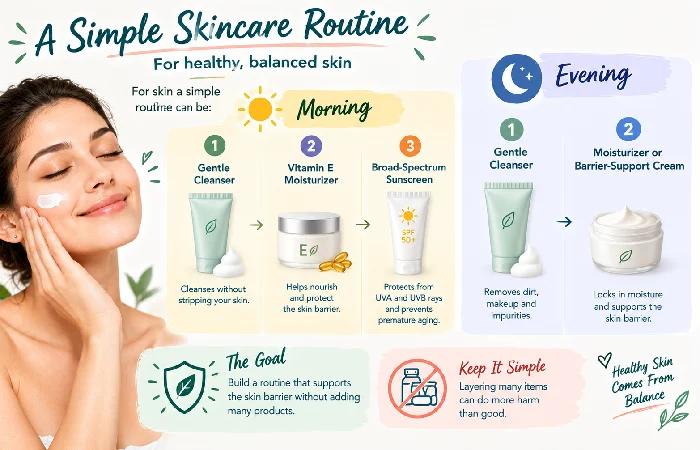
For skin a simple routine can be:
Vitamin E, Vitamin C Together
Vitamin E and vitamin C are often used together in skincare products.
Studies have looked into combining vitamin C and vitamin E for protection against sun damage. Some research shows that combining them gives antioxidant protection than using either one alone.
This does not mean all vitamin C and vitamin E products will work the same. The way a product is made matters a lot. Stability, concentration, packaging and the form of the ingredients all play a role.
For people buying skincare it is better to choose a formulated product that stays stable than to pick one just because it has a high percentage of vitamin C or vitamin E.
Is Vitamin E Good for Every Skin Type?
Vitamin E can work for skin types but the full product formulation is key.
Dry Skin
Vitamin E creams and moisturizers can feel especially comfortable for skin. They help keep the skin soft and hydrated.
Skin
A moisturizer with vitamin E can give antioxidant support and help keep the skin moisturized. There is often no need to add extra vitamin E.
Oily Skin
Choose formulas. Avoid oils if you get shiny skin or breakouts easily.
Sensitive Skin
Start slowly when using products. Even though vitamin E is common in skincare it can cause contact dermatitis in some people. Be careful when using concentrated forms.
Acne-Prone Skin
Do not assume vitamin E oil is safe for acne- skin. Focus on the formula and texture. The presence of vitamin E alone does not make a product
Frequently Asked Questions
Is vitamin E good for skin?
What is it? A vitamin E is a type of antioxidant. – It is found in some skin care products. – It may help to keep skin moist and to prevent it from being damaged. – Evidence for treatments varies.
Can vitamin E remove spots?
Vitamin E alone has not been proven to remove spots. Other ingredients may be more effective depending on the cause.
Is vitamin E good for skin?
Yes. It is often in moisturizers. May help keep dry skin feeling more comfortable.
Can I apply vitamin E oil directly to my face?
Is taking vitamin E oil good. But because of the concentrated nature of the oil, it might be a little too thick and heavy if your skin is oily or prone to acne. In addition, some people may experience irritation and allergies.
Does vitamin E remove scars?
There is no proof that using vitamin E alone helps with scars. A review found benefits and some studies reported side effects.
Can vitamin E replace sunscreen?
No. While vitamin E or antioxidant products are helpful they will never serve as a substitute for sunscreen. Use a daily broad spectrum sunscreen always.
Which foods are high in vitamin E?
Source for: Vitamins A, D and K. You can get them from: Nuts, seeds, vegetable oils and green leafy vegetables.
Can I take vitamin E supplements for glowing skin?
Taking vitamin E supplements is not needed for people just for better skin. A healthy diet is the way to get nutrients. High doses of supplements can have risks.
Final Thoughts on Vitamin E Benefits for Skin
Vitamin E helps protect the skin because it’s a fat-soluble antioxidant. It helps guard cells from damage. It is used in products to help keep skin moisturized and looking healthy.
Topical vitamin E has been studied for sun protection, skin barrier support and other uses.. Evidence for things like scar healing is limited. It should not be seen as a cure-all.
For people the best way to get vitamin E is through a balanced diet. Eat nuts, seeds, oils and vegetables. Use vitamin E products when they fit your skin type.
Importantly do not rely on vitamin E alone to fix sun damage dark spots, acne or serious skin issues. A simple routine, with a cleanser, moisturizer and daily sunscreen is the most effective way to keep skin healthy over time.